Gokyo Lakes Trek Overview
The Gokyo Lakes Trek is one of the most beautiful and rewarding high-altitude journeys in Nepal's Everest (Khumbu) region. While many trekkers head straight for Everest Base Camp, this route leads into the peaceful Gokyo Valley, a world of sparkling turquoise lakes, vast glaciers and breathtaking panoramas of the world's highest mountains. With fewer crowds, spectacular scenery and rich Sherpa culture, it's a favourite among trekkers seeking a quieter yet equally dramatic Himalayan adventure.
Your journey begins with a thrilling mountain flight from Kathmandu (or Ramechhap during peak seasons) to Lukla (2,860 m), gateway to the Everest region. From here, the trail follows the rushing Dudh Koshi River through pine and rhododendron forests, crossing prayer-flag-draped suspension bridges and passing mani walls, chortens and traditional Sherpa villages. You'll enter Sagarmatha National Park, a UNESCO World Heritage Site, before climbing to Namche Bazaar (3,440 m), the lively Sherpa capital. An acclimatisation day here allows you to explore local markets, visit the Sherpa Museum and enjoy your first views of Everest, Lhotse and Ama Dablam.
Beyond Namche, the route leaves the busy Everest Base Camp trail and heads north into the Gokyo Valley. Passing through quiet settlements like Dole and Machhermo, where a second acclimatisation stop helps your body adjust, the landscape becomes wilder and more remote. Yaks graze on high pastures, and snow-capped peaks such as Cho Oyu and Thamserku dominate the horizon.
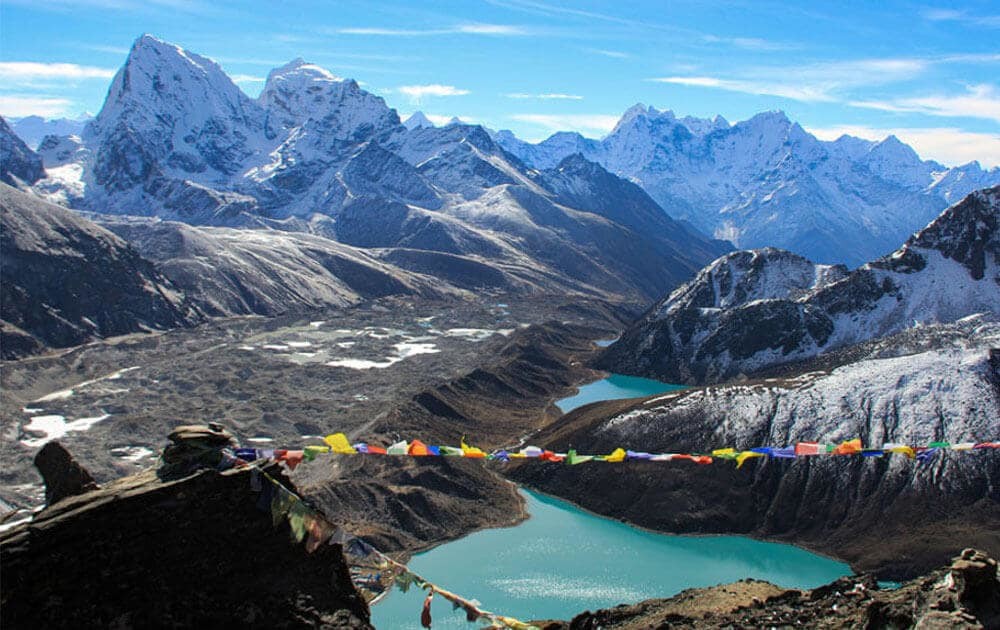
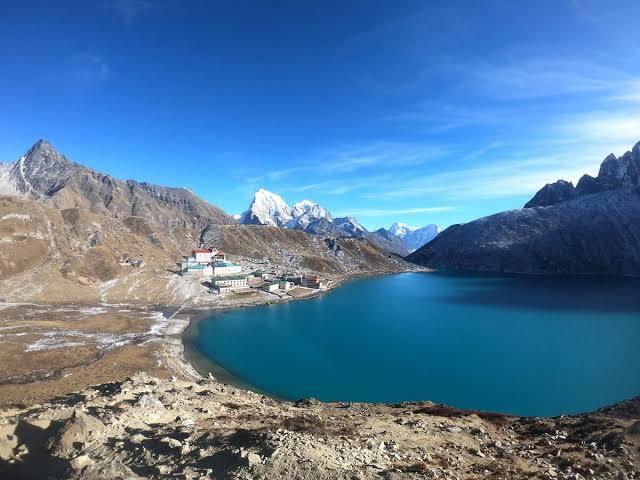
Soon, you'll reach the first of the famous Gokyo Lakes. This chain of six sacred glacial lakes lies between 4,700 and 5,000 metres, forming one of the highest freshwater lake systems in the world. Protected as a Ramsar Wetland of International Importance, the lakes shimmer in brilliant shades of turquoise and emerald. The largest, Dudh Pokhari (Gokyo Cho), sits beside the small village of Gokyo (about 4,790 m), your base for exploring the valley. Alongside the lakes stretches the mighty Ngozumpa Glacier, the largest glacier in Nepal, flowing down from the slopes of Cho Oyu.
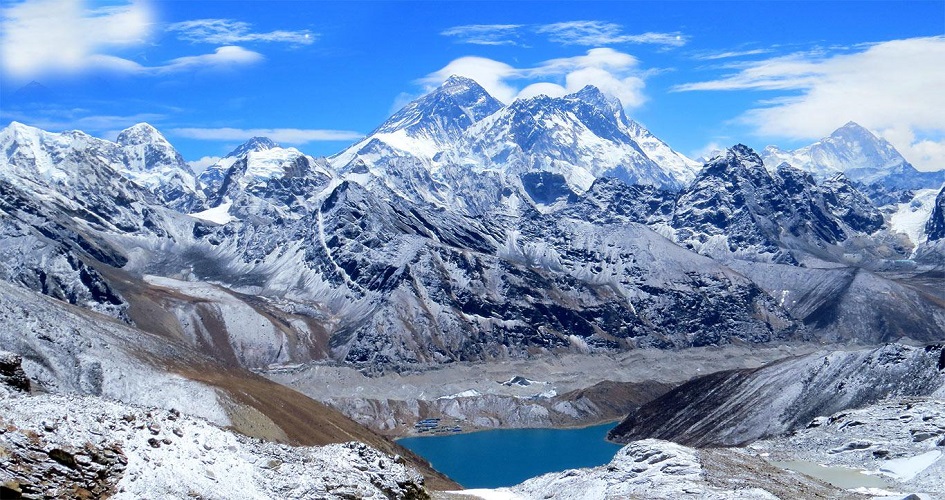
The highlight of the trek is an early-morning climb to Gokyo Ri (5,357 m). From its summit, a breathtaking 360-degree panorama unfolds, revealing four of the world's 8,000-metre giants: Mount Everest, Lhotse, Makalu and Cho Oyu, along with the sparkling lakes and glacier far below. Many trekkers consider this view even more spectacular than Kala Patthar on the Everest Base Camp route. With extra time, you can also hike to the Fourth and Fifth Lakes for close-up views of Cho Oyu and the famous "Scoundrel's Viewpoint" of Everest.
After soaking in the scenery, the trek descends back through the valley to Namche Bazaar and Lukla, where you'll celebrate with your team before flying back to Kathmandu. For adventurous trekkers, the route can be extended by crossing the Renjo La (5,360 m) or Cho La (5,420 m) passes, or combined with Everest Base Camp for a complete Khumbu experience.
The Gokyo Lakes Trek is graded moderate to challenging due to its high altitude, but no technical climbing skills are required. With well-planned acclimatisation days, comfortable teahouse accommodation and support from experienced local guides, it's achievable for fit trekkers with good preparation. The best times to trek are spring (March–May) and autumn (September–November), when skies are clear and mountain views are at their best.
Combining turquoise lakes, massive glaciers, towering peaks and warm Sherpa hospitality, the Gokyo Lakes Trek offers an unforgettable journey into the heart of the Himalayas.
Gokyo Lakes Trek Facts
| Detail |
Information |
| Trek Region |
Everest (Khumbu) Region, Nepal |
| Duration |
12–14 days (Kathmandu to Kathmandu) |
| Maximum Altitude |
Gokyo Ri – 5,357 m (17,575 ft) |
| Highest Overnight Stay |
Gokyo village – about 4,790 m |
| Trek Start / End |
Lukla |
| Trip Grade |
Moderate to Challenging |
| Daily Walking |
5–7 hours |
| Accommodation |
Hotels in Kathmandu, teahouses on the trek |
| Transportation |
Domestic flights (Kathmandu/Ramechhap – Lukla) |
| Permits |
Sagarmatha National Park Permit & Khumbu Pasang Lhamu Rural Municipality Permit |
| Best Season |
March–May & September–November |
| Main Highlights |
Gokyo Lakes, Gokyo Ri, Ngozumpa Glacier, Namche Bazaar |
| Suitable For |
Fit trekkers, ideally with some hiking experience |
Gokyo Lakes Trek: A Quieter Alternative to Everest Base Camp
For trekkers who want the grandeur of the Everest region without the busy trails, the Gokyo Lakes Trek is the perfect choice. Branching away from the main Everest Base Camp route after Namche Bazaar, this peaceful path leads into the remote Gokyo Valley, where six sacred turquoise lakes shimmer beside the vast Ngozumpa Glacier, Nepal's largest. Instead of crowded teahouses, you'll find quiet Sherpa villages, grazing yaks and wide-open Himalayan landscapes. The reward is a sunrise climb to Gokyo Ri (5,357 m), where Everest, Lhotse, Makalu and Cho Oyu rise together in a panorama many trekkers rate even higher than Kala Patthar. It's the Everest experience with more solitude, more scenery and unforgettable views.
Gokyo Lakes Trek: Turquoise Lakes, Gokyo Ri & Everest Panoramas
The Gokyo Lakes Trek brings together three of the Everest region's greatest treasures in one unforgettable journey. Walk beside six sacred glacial lakes that glow in brilliant shades of turquoise between 4,700 and 5,000 metres, forming the world's highest freshwater lake system and a protected Ramsar wetland. From the lakeside village of Gokyo, climb at dawn to the summit of Gokyo Ri (5,357 m), where the rising sun lights up a sweeping panorama of Mount Everest, Lhotse, Makalu and Cho Oyu, with the vast Ngozumpa Glacier stretching below. Combined with Sherpa villages, Namche Bazaar and peaceful high valleys, it's one of the most scenic treks in the Himalayas.
Discover the Gokyo Valley: Sacred Lakes & the Mighty Ngozumpa Glacier
Tucked away in the heart of the Everest region, the Gokyo Valley is a hidden world of striking natural beauty and deep spiritual meaning. Its six glacial lakes, including the famous Dudh Pokhari beside Gokyo village, are sacred to both Hindus and Buddhists, and pilgrims visit during the Janai Purnima festival to bathe in their icy waters. Stretching alongside the lakes is the mighty Ngozumpa Glacier, the largest glacier in Nepal, flowing around 36 km from the slopes of Cho Oyu in a vast river of ice and rock. Surrounded by towering peaks, peaceful yak pastures and quiet Sherpa settlements, the Gokyo Valley offers a rare blend of serenity, culture and raw Himalayan grandeur.
Why Choose the Gokyo Lakes Trek?
- Breathtaking Gokyo Ri Panorama: Climb Gokyo Ri (5,357 m) at sunrise for a sweeping view of four 8,000-metre peaks: Everest, Lhotse, Makalu and Cho Oyu, often rated even better than Kala Patthar.
- Stunning Turquoise Lakes: Explore six sacred glacial lakes between 4,700 and 5,000 metres, part of the world's highest freshwater lake system and a protected Ramsar wetland.
- Nepal's Largest Glacier: Walk beside the mighty Ngozumpa Glacier, a vast river of ice and rock flowing from the slopes of Cho Oyu.
- Fewer Crowds than Everest Base Camp: Enjoy a peaceful trail, quieter teahouses and a more relaxed trekking experience away from the busy EBC route.
- Authentic Sherpa Culture: Visit Namche Bazaar and remote Sherpa villages, with monasteries, prayer flags, mani walls and warm mountain hospitality.
- Scenic Lukla Flight: Begin your adventure with one of the world's most thrilling mountain flights into Lukla.
- UNESCO World Heritage Trek: Trek through Sagarmatha National Park, home to Mount Everest and rare Himalayan wildlife like the Himalayan tahr and Danphe pheasant.
- Well-Planned Acclimatisation: Rest days in Namche Bazaar and Machhermo help your body adjust safely to high altitude.
- Lower Sleeping Altitude than EBC: Gokyo village sits lower than Gorak Shep, making nights more comfortable while still offering world-class views.
- Comfortable Teahouse Stays: Enjoy cosy lodges with hot meals and friendly service, with no camping required.
- Flexible Adventure Options: Extend your journey via the Renjo La or Cho La passes, or combine it with Everest Base Camp for the ultimate Khumbu experience.
- Photographer's Paradise: Capture glowing lakes, glaciers, snow peaks and Sherpa life at every turn of the trail.
Is the Gokyo Lakes Trek Suitable for Beginners?
Yes, the Gokyo Lakes Trek can suit beginners who are fit and well prepared. It is graded moderate to challenging and needs no technical skills, but it reaches 5,357 m at Gokyo Ri, with several nights above 4,000 m, so altitude is the main challenge. With a licensed guide, a shared porter, teahouse stays, built-in acclimatization days and 8 to 12 weeks of training, first-timers can complete it comfortably. If you have never trekked above 3,000 m, an easier route such as the Everest View Trek may be a better first step. For a full breakdown of difficulty, training, altitude tips and gear, read our complete guide: Gokyo Lakes Trek for Beginners: Difficulty & Preparation Guide
Meals & Accommodation During the Gokyo Lakes Trek
| Day |
Route |
Altitude |
🍽️ Meals |
🏨 Accommodation |
| 01 |
Arrival in Kathmandu |
1,338 m |
Welcome Dinner |
Hotel in Kathmandu |
| 02 |
Kathmandu → Lukla (flight) → Phakding |
2,610 m |
B, L, D |
Teahouse in Phakding |
| 03 |
Phakding → Namche Bazaar |
3,440 m |
B, L, D |
Teahouse in Namche |
| 04 |
Acclimatisation day in Namche Bazaar |
3,440 m |
B, L, D |
Teahouse in Namche |
| 05 |
Namche Bazaar → Dole |
4,040 m |
B, L, D |
Teahouse in Dole |
| 06 |
Dole → Machhermo |
4,470 m |
B, L, D |
Teahouse in Machhermo |
| 07 |
Machhermo → Gokyo (afternoon hike to Gokyo Ri) |
4,790 m / 5,357 m |
B, L, D |
Lakeside Teahouse in Gokyo |
| 08 |
Gokyo → Machhermo (morning hike to Fourth Lake) |
4,470 m |
B, L, D |
Teahouse in Machhermo |
| 09 |
Machhermo → Namche Bazaar |
3,440 m |
B, L, D |
Teahouse in Namche |
| 10 |
Namche Bazaar → Lukla |
2,860 m |
B, L, D |
Teahouse in Lukla |
| 11 |
Lukla → Kathmandu (flight) |
1,338 m |
Breakfast & Farewell Dinner |
Hotel in Kathmandu |
| 12 |
Final departure |
1,338 m |
Breakfast |
— |
B = Breakfast, L = Lunch, D = Dinner
Meal Summary
| Meal |
Total Included |
| Breakfast |
11 |
| Lunch |
9 |
| Dinner |
11 (including welcome & farewell dinners) |
Accommodation Summary
| Location |
Nights |
Type |
| Kathmandu |
2 |
3-star hotel (twin sharing) |
| Phakding |
1 |
Teahouse |
| Namche Bazaar |
3 |
Teahouse / mountain lodge |
| Dole |
1 |
Teahouse |
| Machhermo |
2 |
Teahouse |
| Gokyo |
1 |
Lakeside teahouse |
| Lukla |
1 |
Teahouse |
All accommodation is on a twin-sharing basis. Teahouses provide simple rooms with blankets, mostly shared bathrooms, and warm dining halls. Hot showers, charging and Wi-Fi may cost extra at higher villages.
Transportation for the Gokyo Lakes Trek
Transportation for the Gokyo Lakes Trek is simple and well organised. On arrival, you'll be transferred from Tribhuvan International Airport to your hotel in Kathmandu by private vehicle. The trek begins with a thrilling 30–40 minute domestic flight to Lukla (2,860 m), one of the world's most spectacular mountain airstrips, offering stunning Himalayan views along the way. During peak seasons (spring and autumn), Lukla flights often operate from Ramechhap (Manthali) Airport, about a 4–5 hour early-morning drive from Kathmandu, to reduce air traffic congestion. From Lukla, the entire journey to Gokyo and back is on foot. At the end of the trek, you'll fly back from Lukla and enjoy a private transfer to your hotel and, later, to the airport for your departure. Mountain flights can be delayed by weather, so keeping a buffer day is always recommended.
Gokyo Lakes Trek: Additional Information
Best Time to Trek
The Gokyo Lakes Trek can be done in most seasons, but spring (March–May) and autumn (September–November) offer the best weather, clearest skies and safest trekking conditions.
Seasons at a Glance
| Season |
Months |
Weather at Gokyo |
Views |
Rating |
| Autumn |
September – November |
Dry & stable; days 5–12°C, nights -10 to -5°C |
Excellent, crystal-clear |
⭐⭐⭐⭐⭐ Best |
| Spring |
March – May |
Mild; days 5–15°C, nights -8 to 0°C |
Very good, some afternoon haze |
⭐⭐⭐⭐⭐ Excellent |
| Winter |
December – February |
Very cold; nights down to -20°C |
Clear but harsh conditions |
⭐⭐⭐ Challenging |
| Monsoon |
June – August |
Rainy & cloudy; milder temperatures |
Often hidden by clouds |
⭐⭐ Difficult |
Temperatures are approximate.
Autumn (September – November) — Best Season
Post-monsoon skies are clear and stable, offering the best views from Gokyo Ri and bright turquoise lakes. October and November are the most popular months, so trails and teahouses are busier.
Spring (March – May) — Excellent Choice
Warmer days, blooming rhododendron forests in the lower valleys and good mountain views. Afternoon clouds are more common by May.
Winter (December – February)
Quiet trails and clear mornings, but extreme cold, frozen lakes and possible snow. Suitable only for experienced trekkers with proper winter gear.
Monsoon (June – August)
Heavy rain in lower areas, cloudy views and frequent Lukla flight delays. Best avoided unless you want very quiet trails and green landscapes.
Quick Tips
- Book early for October–November and April.
- Add 1–2 buffer days for possible Lukla flight delays.
- Pack warm layers year-round, as nights at Gokyo are always freezing.
- Start early each day, as mornings offer the clearest views.
For the perfect balance of clear views and comfortable weather, plan your Gokyo Lakes Trek for October–November or March–April.
Weather & Temperature by Season
Weather on the Gokyo Lakes Trek changes with both season and altitude. As you climb from Lukla (2,860 m) to Gokyo (4,790 m) and Gokyo Ri (5,357 m), temperatures drop sharply, especially at night and early morning. Nights at Gokyo are below freezing in every season.
Temperature by Altitude (Approximate)
| Location |
Altitude |
Daytime |
Night / Early Morning |
| Lukla |
2,860 m |
5°C – 22°C |
-5°C – 10°C |
| Namche Bazaar |
3,440 m |
2°C – 18°C |
-10°C – 6°C |
| Dole |
4,040 m |
0°C – 15°C |
-14°C – 3°C |
| Machhermo |
4,470 m |
-2°C – 13°C |
-16°C – 1°C |
| Gokyo |
4,790 m |
-5°C – 12°C |
-20°C – 0°C |
| Gokyo Ri (summit) |
5,357 m |
-10°C – 8°C |
Down to -25°C with wind chill |
Ranges cover the full year; the coldest figures occur in winter.
Seasonal Weather at Gokyo (4,790 m)
| Season |
Months |
Day Temp |
Night Temp |
Conditions |
| Spring |
March – May |
5°C – 15°C |
-8°C – 0°C |
Mild days, clear mornings, afternoon clouds by May |
| Monsoon |
June – August |
10°C – 15°C |
0°C – 5°C |
Rain in lower areas, cloudy peaks, flight delays |
| Autumn |
September – November |
5°C – 12°C |
-10°C – -5°C |
Dry, stable, crystal-clear skies |
| Winter |
December – February |
-5°C – 5°C |
-20°C – -15°C |
Very cold, frozen lakes, possible snow |
What to Pack by Season
| Season |
Essentials |
| Spring |
Layers, fleece, down jacket, sun protection |
| Monsoon |
Waterproof jacket & pants, rain cover, quick-dry clothes |
| Autumn |
Warm down jacket, thermals, insulated gloves & hat |
| Winter |
Heavy down jacket, -20°C sleeping bag, microspikes, gaiters |
Quick Weather Tips
- Expect freezing nights at Gokyo year-round.
- Layer your clothing for warm afternoons and icy mornings.
- Protect against strong sun and wind at high altitude.
- Views are clearest in the morning, before clouds build.
- Allow buffer days for weather-related Lukla flight delays.
Temperatures are approximate and can vary each year. Your guide will monitor weather conditions and adjust plans for your safety.
Permits & Entry Fees (Sagarmatha NP & Khumbu)
The Gokyo Lakes Trek lies inside Sagarmatha National Park, a UNESCO World Heritage Site, and the Khumbu Pasang Lhamu Rural Municipality. Every foreign trekker needs two permits. A TIMS card is not required for the Everest region.
Required Permits & Fees (2026)
| Permit |
Foreign Nationals |
SAARC Nationals |
Where to Get It |
| Sagarmatha National Park Entry Permit |
NPR 3,000 |
NPR 1,500 |
NTB office, Kathmandu or Monjo entry gate |
| Khumbu Pasang Lhamu Rural Municipality Permit |
NPR 3,000 |
Reduced rate |
Lukla (or Monjo) checkpoint |
| Total |
NPR 6,000 (about USD 45) |
— |
— |
- Sagarmatha NP: Supports conservation, trail upkeep and park management.
- Khumbu Permit: Funds local development in Sherpa communities.
- The Khumbu permit increased from NPR 2,000 to NPR 3,000, so older guides may show outdated figures.
Both permits are included in our Gokyo Lakes Trek package.
What You Need
- Passport (or a clear copy)
- Passport-size photos (if applying in Kathmandu)
- Payment in Nepalese rupees (US dollars not accepted)
Permit Checkpoints
Permits are checked at Lukla and the Sagarmatha National Park gate at Monjo, with further checks possible along the trail. Keep them in a waterproof pouch and easy to reach.
Good to Know
- Children under 10 are usually exempt from the national park fee.
- Permits are non-refundable and valid for a single entry.
- Trekking without valid permits can result in fines.
- Fees can change, so confirm the latest rates before travel.
Let us handle the paperwork, so you can focus on the mountains, lakes and Sherpa culture.
Note: The FAQ I wrote earlier listed the Khumbu permit at NPR 2,000. Current sources show it's now NPR 3,000, so you may want to update FAQ #14 to match.
Difficulty & Fitness Level
Trek Grade: Moderate to Challenging
The Gokyo Lakes Trek requires no technical climbing skills, but its high altitude, long walking days and rocky terrain make it more demanding than lower treks like Poon Hill. With good fitness, proper acclimatisation and a steady pace, most healthy trekkers can complete it successfully.
Difficulty at a Glance
| Factor |
Details |
Difficulty |
| Maximum Altitude |
Gokyo Ri – 5,357 m |
High |
| Highest Sleeping Point |
Gokyo – 4,790 m |
Moderate–High |
| Daily Walking |
4–7 hours |
Moderate |
| Terrain |
Rocky trails, steep climbs, moraine sections |
Moderate–Challenging |
| Technical Skills |
None required |
Easy |
| Altitude Sickness Risk |
Moderate |
Challenging |
| Overall Grade |
Fit beginners to experienced trekkers |
⭐⭐⭐ Moderate to Challenging |
Toughest Sections of the Trek
| Day |
Section |
Why It's Challenging |
| Day 3 |
Phakding → Namche Bazaar |
Long, steep climb of around 800 m |
| Day 5 |
Namche → Dole |
Big altitude gain past 4,000 m |
| Day 7 |
Machhermo → Gokyo + Gokyo Ri |
Trekking plus a steep 2–3 hour summit climb to 5,357 m |
| Day 9–10 |
Return to Namche and Lukla |
Long descents that are hard on knees |
Main Challenges
- High altitude: Thin air above 4,000 m makes walking slower and more tiring.
- Cold temperatures: Nights at Gokyo are well below freezing.
- Steep climbs & descents: Rocky paths and moraine sections require care.
- Basic facilities: Teahouses become simpler at higher villages.
- Weather & flights: Lukla flight delays can affect your schedule.
Who Can Do This Trek?
- Fit beginners with good preparation
- Trekkers with previous hiking or trekking experience
- Active adults able to walk 5–7 hours for several consecutive days
- Those with heart, lung or blood pressure conditions should consult a doctor first
How to Prepare (Start 6–8 Weeks Before)
- Cardio: Running, cycling, swimming or brisk walking 4–5 times a week
- Hill hiking: Long walks with elevation gain, ideally carrying a 5–8 kg daypack
- Stair climbing: Builds strength for steep ascents and descents
- Leg & core strength: Squats, lunges and planks
- Back-to-back training: Multi-hour hikes on consecutive days
Tips to Make the Trek Easier
- Walk slowly and steadily ("bistarai, bistarai")
- Take acclimatisation days seriously in Namche Bazaar
- Hydrate well, drinking 3–4 litres of water daily
- Use trekking poles to protect your knees
- Let your porter carry the heavy load
- Tell your guide immediately if you feel unwell
With proper training, a positive mindset and expert support, the Gokyo Lakes Trek is a challenging yet deeply rewarding Himalayan adventure.
Altitude & Altitude Sickness Prevention
The Gokyo Lakes Trek climbs to 5,357 m at Gokyo Ri, with overnight stays above 4,000 m. At these heights, oxygen levels are much lower, so Acute Mountain Sickness (AMS) is a real risk. The good news: with gradual ascent, rest days and sensible habits, most trekkers acclimatise safely.
Altitude Profile
| Day |
Overnight Stop |
Altitude |
Altitude Gain |
| 2 |
Phakding |
2,610 m |
— |
| 3 |
Namche Bazaar |
3,440 m |
+830 m |
| 4 |
Namche (acclimatisation) |
3,440 m |
Rest day |
| 5 |
Dole |
4,040 m |
+600 m |
| 6 |
Machhermo |
4,470 m |
+430 m |
| 7 |
Gokyo (+ Gokyo Ri hike) |
4,790 m / 5,357 m |
+320 m (highest point) |
| 8 |
Machhermo |
4,470 m |
Descent |
| 9–10 |
Namche → Lukla |
3,440 m → 2,860 m |
Descent |
You spend only one night at Gokyo, the highest sleeping point, and then descend, following the safe "climb high, sleep low" principle.
Know the Symptoms
| Mild AMS (Common) |
Serious Warning Signs (Descend Immediately) |
| Headache |
Severe headache not relieved by rest or medicine |
| Nausea or loss of appetite |
Repeated vomiting |
| Dizziness or tiredness |
Confusion, poor balance or unusual behaviour |
| Difficulty sleeping |
Breathlessness at rest |
| Shortness of breath when walking |
Persistent wet cough or frothy sputum |
Serious symptoms may indicate HACE (brain swelling) or HAPE (fluid in the lungs), which require immediate descent and medical help.
How to Prevent Altitude Sickness
- Ascend gradually: Avoid rushing; follow the planned itinerary.
- Use acclimatisation days: Take short hikes in Namche Bazaar and rest well.
- Walk slowly: Keep a steady, comfortable pace ("bistarai, bistarai").
- Stay hydrated: Drink 3–4 litres of water daily.
- Eat well: Carbohydrate-rich meals like dal bhat help your body adapt.
- Avoid alcohol and smoking throughout the trek.
- Keep warm and rest: Cold and exhaustion can worsen symptoms.
- Consult your doctor about preventive medication before your trip.
- Speak up early: Tell your guide about any symptoms immediately.
If Symptoms Appear
- Stop ascending and rest.
- Hydrate and eat something light.
- Inform your guide, who will monitor you with a pulse oximeter.
- Descend if symptoms don't improve or get worse.
- Emergency evacuation by helicopter can be arranged if needed.
Your Safety on Our Trek
- Experienced guides trained in first aid and altitude awareness
- Daily health checks with a pulse oximeter
- Comprehensive first-aid kit carried throughout
- Flexible itinerary with extra rest days if needed
- Emergency rescue coordination with your insurance provider
Travel insurance must cover trekking up to at least 5,500 m and helicopter evacuation.
Respect the altitude, listen to your body and trek at a steady pace, and you'll be ready to enjoy the breathtaking views from Gokyo Ri safely.
Lukla Flights, Delays & Baggage Limits
Your Gokyo Lakes adventure begins and ends with a thrilling flight to Lukla's Tenzing-Hillary Airport (2,860 m), one of the world's most famous mountain airstrips. Here's what you need to know about flights, possible delays and baggage rules.
Lukla Flight at a Glance
| Detail |
Information |
| Route |
Kathmandu / Ramechhap → Lukla |
| Flight Duration |
About 30–40 mins (Kathmandu) / 20 mins (Ramechhap) |
| Airport |
Tenzing-Hillary Airport, Lukla (2,860 m) |
| Runway |
Short, steep runway on a mountain slope |
| Flight Times |
Early morning, when weather is most stable |
| Aircraft |
Small twin-engine planes (Dornier, Twin Otter, Let-410) |
| Main Airlines |
Tara Air, Summit Air, Sita Air |
Kathmandu or Ramechhap?
During peak seasons (spring and autumn), many Lukla flights operate from Ramechhap (Manthali) Airport to reduce air traffic at Kathmandu.
| Departure Point |
Details |
| Kathmandu (TIA) |
Direct flight, usually in off-peak months |
| Ramechhap (Manthali) |
About 4–5 hour drive from Kathmandu, often leaving around 1–3 AM, then a 20-minute flight |
We arrange all transfers, including the early-morning drive to Ramechhap if required.
Flight Delays & Cancellations
Lukla flights depend on clear visibility in Kathmandu, Ramechhap and Lukla. Delays are common, especially in certain seasons.
| Season |
Delay Risk |
Reason |
| Autumn (Sep–Nov) |
Low–Moderate |
Generally clear weather |
| Spring (Mar–May) |
Low–Moderate |
Occasional afternoon clouds |
| Winter (Dec–Feb) |
Moderate |
Morning fog |
| Monsoon (Jun–Aug) |
High |
Rain and low clouds |
What Happens If Flights Are Delayed?
- You'll be rebooked on the next available flight.
- Long delays may require an extra night in Kathmandu or Lukla.
- A helicopter charter can be arranged at extra cost (sharing reduces the price).
Add 1–2 buffer days before your international departure.
Lukla Baggage Limits
| Baggage Type |
Allowance |
| Checked Baggage |
10 kg |
| Hand Luggage |
5 kg |
| Total |
15 kg per person |
| Excess Baggage |
Charged per kg (subject to space) |
Baggage tips:
- Pack light and smart; your porter carries your duffel on the trail.
- Use a soft duffel bag, not a hard suitcase.
- Keep power banks and batteries in hand luggage.
- Wear your heaviest items (boots, down jacket) on the flight.
- Store extra luggage at your Kathmandu hotel, free of charge.
Quick Travel Tips
- Book early morning flights, which are more reliable.
- Sit on the left side flying to Lukla for Himalayan views.
- Carry snacks, water and a book in case of waiting time.
- Stay flexible; weather always comes first in the mountains.
- Get travel insurance covering flight delays and cancellations.
Flying into Lukla is an unforgettable start to your Gokyo Lakes Trek. With smart packing and buffer days, you'll be ready for whatever the mountain weather brings.
Gokyo Ri Sunrise & Everest Views Guide
Standing at 5,357 m, Gokyo Ri offers one of the finest mountain panoramas in the Himalayas, and many trekkers rate it above Kala Patthar. From its summit, you'll see four of the world's 8,000-metre peaks, the turquoise Gokyo Lakes and the vast Ngozumpa Glacier, all in one breathtaking view.
What You Can See from Gokyo Ri
| Mountain |
Height |
Highlight |
| Mount Everest |
8,849 m |
World's highest peak, rising above the eastern ridges |
| Lhotse |
8,516 m |
World's 4th highest, beside Everest |
| Makalu |
8,485 m |
World's 5th highest, distinctive pyramid shape |
| Cho Oyu |
8,188 m |
World's 6th highest, towering directly to the north |
| Gyachung Kang |
7,952 m |
Massive peak between Cho Oyu and Everest |
| Nuptse |
7,861 m |
Sharp ridge in front of Everest |
| Cholatse & Taboche |
6,440 m / 6,495 m |
Dramatic nearby peaks to the southeast |
Below you: The sparkling Dudh Pokhari (Third Lake), Gokyo village and the 36 km Ngozumpa Glacier, Nepal's largest.
The Gokyo Ri Hike
| Detail |
Information |
| Start Point |
Gokyo village (4,790 m) |
| Summit |
Gokyo Ri (5,357 m) |
| Elevation Gain |
About 570 m |
| Ascent Time |
2–3 hours |
| Descent Time |
1–1.5 hours |
| Trail |
Steep, zig-zag path on rocky slopes |
| Difficulty |
Challenging due to altitude |
The trail starts by crossing the stream at the lake's edge, then climbs steadily up the hillside. Walk slowly, rest often and enjoy expanding views with every step.
Sunrise vs Sunset: When to Climb?
| Option |
Pros |
Things to Know |
| Sunrise |
Clearest skies, golden glow on Cho Oyu and the lakes |
Very cold (often -15°C or lower); start around 4:00–5:00 AM; Everest is backlit |
| Afternoon / Sunset |
Warmer, soft light falling directly on Everest and the eastern peaks |
Clouds can build in the afternoon, especially in spring |
Our itinerary includes an afternoon climb on arrival day (Day 7), when the sun lights up Everest beautifully. If you'd prefer a sunrise climb, your guide can adjust the plan on Day 8, depending on weather and your energy.
Approximate Sunrise Times at Gokyo
| Season |
Sunrise |
Leave Gokyo |
| Spring (Mar–May) |
5:15 – 6:00 AM |
3:00 – 4:00 AM |
| Autumn (Sep–Nov) |
5:30 – 6:15 AM |
3:30 – 4:15 AM |
| Winter (Dec–Feb) |
6:30 – 6:50 AM |
4:15 – 4:45 AM |
Bonus Viewpoints Near Gokyo
- Fourth Lake (Thonak Tsho): Peaceful lake with close views of Cho Oyu (included on Day 8)
- Fifth Lake (Ngozumpa Tsho) & Scoundrel's Viewpoint: A famous Everest viewpoint across the glacier (optional extra day)
- Ngozumpa Glacier Ridge: Easy walk from Gokyo with dramatic views of the ice and moraine
What to Bring for Gokyo Ri
- Warm down jacket, thermal layers and windproof shell
- Insulated gloves, warm hat and buff
- Headlamp (for sunrise climbs)
- Trekking poles
- Water (insulated bottle) and energy snacks
- Sunglasses and sunscreen
- Camera with fully charged, warm batteries
Photography Tips
- Wide-angle lens for the full panorama with the lakes below
- Zoom lens for Everest, Makalu and Cho Oyu close-ups
- Keep batteries warm inside your jacket
- Shoot early and late for the best light
- Include the lakes for unique foreground compositions
Quick Tips
- Climb slowly; this is the highest point of your trek.
- Watch for altitude symptoms and inform your guide if you feel unwell.
- Check the weather with your guide before starting.
- Respect the summit: take your rubbish back down.
- Stay a while to enjoy one of the greatest views on Earth.
Standing on Gokyo Ri, with Everest on the horizon and turquoise lakes at your feet, is the unforgettable highlight of the Gokyo Lakes Trek.
Teahouse Accommodation & Facilities
On the Gokyo Lakes Trek, you'll stay in teahouses, family-run Sherpa mountain lodges that offer warm hospitality, hearty meals and a cosy place to rest. Facilities are comfortable in lower villages like Namche Bazaar but become simpler and more expensive as you climb higher toward Gokyo.
Where You'll Stay
| Location |
Altitude |
Nights |
Accommodation Highlight |
| Kathmandu |
1,338 m |
2 |
Comfortable 3-star hotel |
| Phakding |
2,610 m |
1 |
Riverside teahouse |
| Namche Bazaar |
3,440 m |
3 |
Well-equipped lodges, bakeries and cafés |
| Dole |
4,040 m |
1 |
Small, quiet mountain teahouse |
| Machhermo |
4,470 m |
2 |
Basic lodges with peaceful valley views |
| Gokyo |
4,790 m |
1 |
Lakeside lodges beside Dudh Pokhari |
| Lukla |
2,860 m |
1 |
Comfortable lodge near the airport |
Teahouse Facilities by Altitude
| Facility |
Lower Villages (Phakding, Namche, Lukla) |
Higher Villages (Dole, Machhermo, Gokyo) |
| Rooms |
Twin-sharing, some with attached bathrooms |
Basic twin-sharing rooms |
| Bedding |
Mattress, pillow & blanket |
Mattress, pillow & blanket (bring a warm sleeping bag) |
| Bathrooms |
Shared or attached; Western toilets common |
Mostly shared; squat or Western toilets |
| Hot Showers |
Available, small fee |
Limited, higher fee |
| Charging |
Available, small fee |
Available, higher fee (solar power) |
| Wi-Fi |
Good coverage, often paid |
Limited; paid prepaid cards (e.g. Everest Link) |
| Heating |
Dining hall stove |
Dining hall stove only (often yak-dung fuelled) |
| Bedrooms |
Unheated |
Unheated and very cold at night |
Food in Teahouses
Teahouses serve Nepali, Sherpa and international dishes:
- Dal bhat (unlimited refills), the best trekking fuel
- Momo, noodles, fried rice and pasta
- Sherpa stew, garlic soup and potato dishes
- Tibetan bread, porridge and pancakes for breakfast
- Ginger-lemon-honey tea and hot chocolate
High-altitude tip: Choose vegetarian meals above Namche, as meat is carried up for days without refrigeration.
Extra Costs to Expect
| Service |
Notes |
| Hot showers |
Prices rise with altitude |
| Device charging |
Charged per device or per hour |
| Wi-Fi |
Prepaid data cards in higher villages |
| Boiled / filtered water |
Cheaper and greener than bottled water |
| Snacks & drinks |
More expensive higher up |
Carry enough Nepalese rupees, as ATMs are only available in Lukla and Namche.
Teahouse Tips
- Bring a four-season sleeping bag (rated -15°C to -20°C)
- Carry a power bank, since charging is limited and costly
- Pack toilet paper and hand sanitiser
- Use a headlamp for night-time bathroom trips
- Eat where you sleep, a teahouse custom that keeps room prices low
- Be patient; meals are cooked fresh, often on a single stove
- Book ahead in peak season; we reserve your rooms in advance
Simple yet welcoming, Gokyo's teahouses offer warm meals, friendly Sherpa hospitality and unforgettable mountain views right outside your window.
Travel Insurance & Helicopter Rescue
Travel insurance is mandatory for the Gokyo Lakes Trek. With altitudes reaching 5,357 m at Gokyo Ri, remote trails and weather-dependent Lukla flights, the right policy protects you from high medical costs and unexpected emergencies. In serious cases, helicopter rescue is often the fastest and only way to reach medical care.
Essential Insurance Coverage
| Coverage |
Why It Matters |
| Trekking up to at least 5,500 m |
Gokyo Ri reaches 5,357 m; many standard policies exclude high-altitude trekking |
| Emergency helicopter evacuation |
Fastest way to reach hospitals from remote areas |
| Medical treatment & hospitalisation |
Covers altitude sickness, illness and injuries |
| Repatriation |
Returns you home safely if required |
Recommended Additional Coverage
- Trip cancellation or interruption
- Lukla flight delays and cancellations
- Lost, stolen or damaged baggage
- Personal liability
- Extra accommodation due to weather delays
How Helicopter Rescue Works
- Assessment: Your guide checks your condition, including oxygen levels with a pulse oximeter.
- Contact: Our office is notified and coordinates with your insurance company.
- Approval: Your insurer confirms coverage for the evacuation.
- Rescue: A helicopter flies you from the trail (weather permitting) to Lukla or directly to Kathmandu.
- Treatment: You're transferred to a hospital in Kathmandu for medical care.
Helicopter rescue is very expensive, often costing several thousand US dollars, so proper insurance is essential.
Common Reasons for Evacuation
- Severe altitude sickness (AMS, HAPE or HACE)
- Serious injuries such as fractures or sprains
- Sudden illness requiring urgent treatment
- Extreme exhaustion or dehydration
What We Need Before Your Trek
- Insurance company name
- Policy number
- 24-hour emergency contact number
- Confirmation that trekking above 5,000 m and helicopter rescue are covered
Insurance Tips
- Read the fine print for altitude limits and exclusions.
- Buy before you travel; some policies can't be purchased once you're in Nepal.
- Carry printed and digital copies of your policy.
- Share your details with your guide and a family member.
- Keep all receipts for medical and rescue claims.
We don't sell insurance, but we'll guide you on what to look for. With the right coverage, you can trek to Gokyo with complete peace of mind.
Booking & Cancellation Policy
Booking your Gokyo Lakes Trek with us is simple, secure and transparent. Please review these terms before confirming your adventure.
How to Book
- Choose your trek dates and group size.
- Send your booking request via our website, email or WhatsApp with full names, nationalities and passport copies.
- Pay the deposit to confirm your booking.
- Receive confirmation with your itinerary, packing list and pre-trek information.
Tip: Book 2–3 months in advance for peak seasons (March–May and September–November) to secure Lukla flights and the best teahouses.
Payment Terms
| Payment Stage |
Amount |
When It's Due |
| Deposit |
20% of the total trek cost |
At the time of booking |
| Balance |
Remaining 80% |
On arrival in Kathmandu or before the trek starts |
- Payment methods: Bank transfer, credit/debit card (Visa, Mastercard, American Express, UnionPay) or cash (USD/NPR)
- Card payments may include a 3–4% bank service charge
- International bank transfer fees are the traveller's responsibility
Cancellation by the Traveller
Cancellations must be made in writing by email.
| Notice Before Trip Starts |
Cancellation Charge |
| 45 days or more |
Loss of deposit (20%) |
| 30–44 days |
40% of the total trek cost |
| 15–29 days |
60% of the total trek cost |
| Less than 15 days / No-show |
100% of the total trek cost |
- Lukla flight tickets and permits are non-refundable once issued.
- No refunds for unused services, early return from the trek or missed days.
Date Changes & Postponement
- Free date changes up to 45 days before departure, subject to availability
- Later changes may incur extra costs from airlines, hotels or permits
- Deposits may be transferred to a new date within 12 months in special cases
Changes or Cancellation by the Company
We may adjust or cancel parts of the trek due to events beyond our control, including:
- Lukla flight delays or cancellations
- Bad weather, snowfall or trail closures
- Natural disasters, strikes or political unrest
- Government restrictions or health emergencies
In such cases, we'll offer an alternative route, a new date or a fair refund for unused services. Extra costs, such as additional hotel nights or helicopter flights due to delays, are the traveller's responsibility.
Travel Insurance
Travel insurance is mandatory and must cover trekking up to at least 5,500 m, emergency helicopter evacuation, medical treatment and trip cancellation.
Need Help?
Contact our team by email, phone or WhatsApp for bookings, changes or cancellations. We're here to support you before, during and after your trek.
By paying the deposit, you agree to these booking and cancellation terms.
Note: The percentages and timeframes above are sample terms, set slightly stricter than for shorter treks because Lukla flights and permits are booked well in advance. Please update them to match your company's official policy before publishing.
Frequently Asked Questions (FAQs)
1. What is the Gokyo Lakes Trek?
The Gokyo Lakes Trek is a high-altitude trek in Nepal's Everest (Khumbu) region that leads to six sacred turquoise glacial lakes and the famous Gokyo Ri viewpoint. The route passes through Sherpa villages, Namche Bazaar and the peaceful Gokyo Valley beside the Ngozumpa Glacier. From Gokyo Ri, you can see four of the world's 8,000-metre peaks, including Mount Everest. It's a quieter and more scenic alternative to the Everest Base Camp trek.
2. Where are the Gokyo Lakes located?
The Gokyo Lakes lie in the Gokyo Valley of Sagarmatha National Park, in the Solukhumbu District of northeastern Nepal. They sit west of the main Everest Base Camp route, at the foot of Cho Oyu. The lakes are fed by the Ngozumpa Glacier and surrounding streams. Gokyo village sits on the shore of the largest lake, Dudh Pokhari.
3. How long is the Gokyo Lakes Trek?
Our Gokyo Lakes Trek takes 12 days from Kathmandu to Kathmandu, including 9 days of trekking. This includes arrival and departure days, flights to and from Lukla, and a dedicated acclimatisation day in Namche Bazaar. Longer versions can include the Renjo La or Cho La passes or Everest Base Camp. The itinerary can be customised to your schedule and fitness.
4. What is the maximum altitude of the Gokyo Lakes Trek?
The highest point is Gokyo Ri at 5,357 metres (17,575 ft). The highest overnight stay is in Gokyo village at about 4,790 metres. These altitudes require careful acclimatisation. The itinerary includes gradual ascents and a rest day to help your body adjust.
5. How many Gokyo Lakes are there?
There are six main Gokyo Lakes, lying between about 4,700 and 5,000 metres. The largest and most famous is the third lake, Dudh Pokhari (Gokyo Cho), beside Gokyo village. The fourth and fifth lakes lie further north along the Ngozumpa Glacier. Together, they form one of the highest freshwater lake systems in the world.
6. Why are the Gokyo Lakes famous?
The Gokyo Lakes are famous for their stunning turquoise colour, dramatic mountain setting and spiritual significance. They are sacred to both Hindus and Buddhists and are protected as a Ramsar Wetland of International Importance. The nearby Gokyo Ri viewpoint offers one of the best Everest panoramas in Nepal. The combination of lakes, glacier and giant peaks makes the valley truly unique.
7. What can I see from Gokyo Ri?
From Gokyo Ri, you can see Mount Everest, Lhotse, Makalu and Cho Oyu, four of the world's six highest mountains. You'll also enjoy views of Cholatse, Taboche, Thamserku and many other peaks. Below lies the sparkling Dudh Pokhari and the vast Ngozumpa Glacier. Many trekkers consider this view even better than Kala Patthar on the EBC route.
8. How long does it take to climb Gokyo Ri?
The climb from Gokyo village to the summit of Gokyo Ri usually takes 2–3 hours. The trail is steep and rocky, with a significant elevation gain of around 550 metres. The descent takes about 1–1.5 hours. In our itinerary, you climb in the afternoon on arrival day for sunset views, though sunrise climbs are also popular.
9. How difficult is the Gokyo Lakes Trek?
The Gokyo Lakes Trek is graded moderate to challenging. Daily walks last 5–7 hours, often on rocky, uneven trails with steep climbs and descents. The main challenge is high altitude, with thin air above 4,000 metres. No technical climbing skills are needed, but good fitness and preparation are important.
10. Can beginners do the Gokyo Lakes Trek?
Yes, beginners can complete the Gokyo Lakes Trek with good fitness, proper preparation and a sensible pace. Previous hiking experience is helpful but not essential. The itinerary includes acclimatisation days to reduce altitude risks. Training for 6–8 weeks beforehand will make the trek much more enjoyable.
11. Is Gokyo Lakes Trek better than Everest Base Camp?
It depends on what you want. The Gokyo Lakes Trek offers quieter trails, turquoise lakes, the Ngozumpa Glacier and arguably better Everest views from Gokyo Ri. Everest Base Camp offers the experience of standing at the foot of Everest and seeing the Khumbu Icefall. Many trekkers combine both via the Cho La pass for the best of both worlds.
12. What is the best time to do the Gokyo Lakes Trek?
The best seasons are spring (March–May) and autumn (September–November). Autumn offers the clearest skies and most stable weather, while spring brings warmer days and blooming rhododendrons in the lower valleys. Winter is possible but very cold, with frozen lakes and snow. The monsoon (June–August) brings clouds, rain and frequent flight delays.
13. Can I do the Gokyo Lakes Trek in winter?
Yes, the trek is possible in winter (December–February), with clear skies and very few trekkers. However, temperatures at Gokyo can drop well below -15°C at night, and the lakes often freeze. Snow may cover trails, and some teahouses may close. Good winter gear and an experienced guide are essential.
14. What permits are required for the Gokyo Lakes Trek?
You need two permits: the Sagarmatha National Park entry permit and the Khumbu Pasang Lhamu Rural Municipality entry permit. The national park permit is currently around NPR 3,000 plus VAT, and the local permit around NPR 2,000 for foreign trekkers. These fees can change, so confirm before your trip. Our package includes both permits.
15. Do I need a guide for the Gokyo Lakes Trek?
A licensed guide is strongly recommended for the Gokyo Lakes Trek. Trekking rules in Nepal have changed in recent years, and guided trekking is now the standard in most regions. A guide helps with navigation, acclimatisation, safety and teahouse bookings. They also share valuable knowledge about Sherpa culture and the mountains.
16. Do I need a porter?
A porter isn't mandatory but is highly recommended at high altitude. Carrying a heavy bag at over 4,000 metres is tiring and increases the risk of altitude sickness. Our package includes one porter for every two trekkers, carrying up to about 20–25 kg. This lets you trek with just a light daypack.
17. How long do I walk each day?
You'll typically walk 5–7 hours per day, depending on the section and your pace. Some days, like Namche to Dole, are longer, while others are shorter to aid acclimatisation. Walking times include rest and photo stops. Your guide will set a steady, comfortable pace.
18. What is the total trekking distance?
The total trekking distance from Lukla to Gokyo and back is roughly 90–95 km. This includes side hikes such as Gokyo Ri and the Fourth Lake. Daily distances vary from about 8 to 15 km. The terrain and altitude matter more than distance in determining difficulty.
19. Will I get altitude sickness on the Gokyo Lakes Trek?
Altitude sickness is possible because the trek goes above 4,000 metres, reaching 5,357 m at Gokyo Ri. Common symptoms include headache, nausea, dizziness and fatigue. Our itinerary includes acclimatisation in Namche and a gradual ascent to reduce the risk. Walk slowly, drink plenty of water and inform your guide immediately if you feel unwell.
20. How can I prevent altitude sickness?
Ascend gradually, take acclimatisation days seriously and follow the "climb high, sleep low" principle. Drink 3–4 litres of water daily, eat well and avoid alcohol and smoking. Walk slowly and rest when needed. Consult your doctor about preventive medication before your trip.
21. What kind of accommodation is available?
You'll stay in a 3-star hotel in Kathmandu and in teahouses during the trek. Teahouses offer simple twin-sharing rooms with beds and blankets, mostly shared bathrooms and warm dining halls. Namche Bazaar has more comfortable lodges, some with attached bathrooms. Facilities become more basic at higher villages like Machhermo and Gokyo.
22. What food is available on the trek?
Teahouses serve dal bhat, momo, noodles, fried rice, pasta, soups, potatoes, Tibetan bread and pancakes. Dal bhat is the most popular choice because it's filling and comes with free refills. Garlic soup and ginger tea are favourites at high altitude. Choosing vegetarian meals above Namche is recommended for freshness.
23. Is drinking water safe?
Tap and stream water must be treated before drinking. You can buy bottled water, but refilling with boiled or filtered water is cheaper and more eco-friendly. Carry purification tablets or a filter bottle. Staying well hydrated is especially important at high altitude.
24. Is there internet and phone signal on the trek?
Wi-Fi is available in most teahouses, often through paid services, especially in Namche and higher villages. Mobile coverage is good around Lukla and Namche but becomes limited higher up. Connections can be slow or interrupted by weather. A local SIM card and patience are helpful.
25. Can I charge my devices during the trek?
Yes, charging is available at most teahouses, usually for a fee that increases with altitude. Electricity may be limited in higher villages, relying on solar power. Carry a large power bank and keep batteries warm at night. A universal adapter is also useful.
26. Are there ATMs on the Gokyo Lakes Trek?
ATMs are available in Lukla and Namche Bazaar, but they can be unreliable or run out of cash. There are no ATMs beyond Namche. Withdraw enough Nepalese rupees in Kathmandu before your trek. Cash is needed for snacks, drinks, showers, charging, Wi-Fi and tips.
27. What happens if Lukla flights are delayed?
Lukla flights are often delayed or cancelled due to weather, especially in the monsoon and sometimes in winter. We recommend adding one or two buffer days before your international flight. In case of long delays, a helicopter charter may be arranged at extra cost. Flexible travel plans help avoid stress.
28. Do I need travel insurance for the Gokyo Lakes Trek?
Yes, travel insurance is mandatory. Your policy must cover trekking up to at least 5,500 metres, medical treatment and emergency helicopter evacuation. Coverage for trip cancellation, flight delays and lost baggage is also recommended. Carry a copy of your policy and emergency contact numbers.
29. Can I combine the Gokyo Lakes Trek with Everest Base Camp?
Yes, the Gokyo Lakes Trek can be combined with Everest Base Camp by crossing the Cho La Pass (5,420 m). This route, often called the Gokyo–Cho La–EBC Trek, takes around 15–18 days. You can also cross the Renjo La Pass (5,360 m) for a loop via Thame. These extensions are ideal for experienced trekkers seeking a bigger adventure.
30. How do I book the Gokyo Lakes Trek?
You can book by contacting us through our website, email or WhatsApp with your preferred dates, group size and special requirements. A deposit confirms your booking, with the balance payable before the trek starts. We'll arrange your flights, permits, guide, porter and accommodation in advance. Our team is always happy to help you plan the perfect Gokyo adventure.





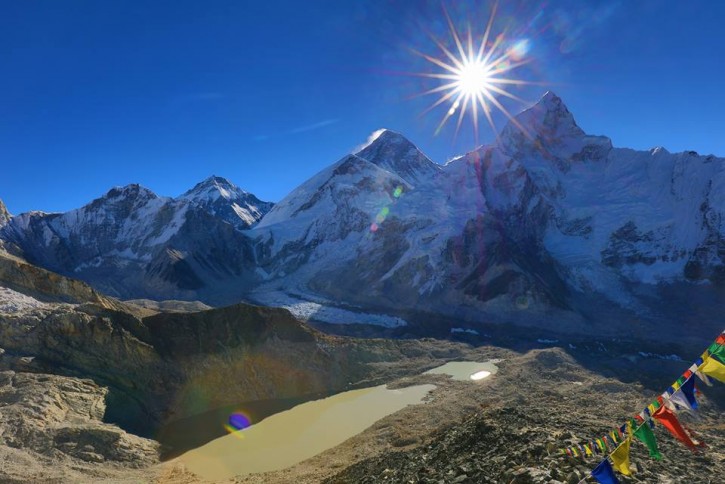



A Peaceful And Spectacular Journey Through The Himalayas
The Gokyo Lakes Trek Was One Of The Most Beautiful Trekking Experiences I Have Ever Had. I Chose This Route Because I Wanted To Explore The Everest Region Beyond The Usual Trails, And The Scenery Exceeded My Expectations. The Turquoise Gokyo Lakes Surrounded By Snow-covered Mountains Were Absolutely Stunning, And Climbing Gokyo Ri Rewarded Us With Incredible Panoramic Views Of Everest, Lhotse, Makalu, And Cho Oyu. I Also Enjoyed Walking Through Traditional Sherpa Villages And Experiencing The Peaceful Atmosphere Of The High Himalayas. Some Sections Were Challenging Because Of The Altitude, But Taking Our Time And Allowing For Acclimatization Made The Journey More Manageable. This Trek Offered A Wonderful Combination Of Natural Beauty, Adventure, And Local Culture. I Would Highly Recommend It To Trekkers Looking For A Quieter And Unforgettable Experience In The Everest Region.
The Most Beautiful Mountain Scenery I Have Ever Seen
The Gokyo Lakes Trek Was An Incredible Adventure And A Highlight Of My Visit To Nepal. I Was Amazed By The Changing Landscapes Along The Trail, From Peaceful Forests And Traditional Sherpa Villages To Rugged Mountain Paths And The Beautiful Turquoise Lakes At Higher Elevations. Gokyo Was Especially Memorable Because The Lakes Looked So Different From Anything I Had Seen Before, With The Surrounding Himalayan Peaks Reflected In The Clear Water. The Hike To Gokyo Ri Was Challenging, But The Panoramic Mountain Views Made The Effort Worthwhile. I Also Appreciated The Quieter Atmosphere Compared With Some Of The Busier Trekking Routes In The Everest Region. This Trek Requires Good Preparation And Patience With The Altitude, But It Rewards You With Extraordinary Scenery And A Genuine Sense Of Achievement. I Would Recommend It To Anyone Who Loves Nature And Wants To Explore A Special Part Of The Himalayas.
A Hidden Himalayan Gem Worth Every Step
The Gokyo Lakes Trek Was Everything I Hoped For And More. I Wanted A Trekking Experience With Incredible Mountain Views And A Little More Tranquility, And This Route Was An Excellent Choice. The Walk Through The Khumbu Region Offered Beautiful Scenery At Every Stage, With Welcoming Villages, Dramatic Valleys, And Spectacular Views Of The Surrounding Peaks. The Turquoise Lakes Near Gokyo Were The Real Highlight For Me. Their Colors Looked Almost Unreal Against The Rocky Landscape And Snowy Mountains. Reaching The Viewpoint At Gokyo Ri Was Physically Demanding, But Standing Above The Valley And Seeing The Himalayan Panorama Made It Worthwhile. I Also Enjoyed Learning About Local Sherpa Life Along The Trail. This Trek Is Challenging At Altitude, But For Anyone Who Loves Mountain Scenery And Outdoor Adventure, It Is An Experience I Would Gladly Recommend.