Kathmandu Valley Tour Overview: Explore Nepal's Cultural Heartland
The Kathmandu Valley Tour is the perfect introduction to Nepal's rich cultural heritage, ancient architecture and Himalayan scenery. Nestled at around 1,400 metres and surrounded by green hills, the Kathmandu Valley is home to three historic royal cities—Kathmandu, Patan and Bhaktapur—and seven UNESCO World Heritage Sites, making it one of the most culturally concentrated destinations in the world.
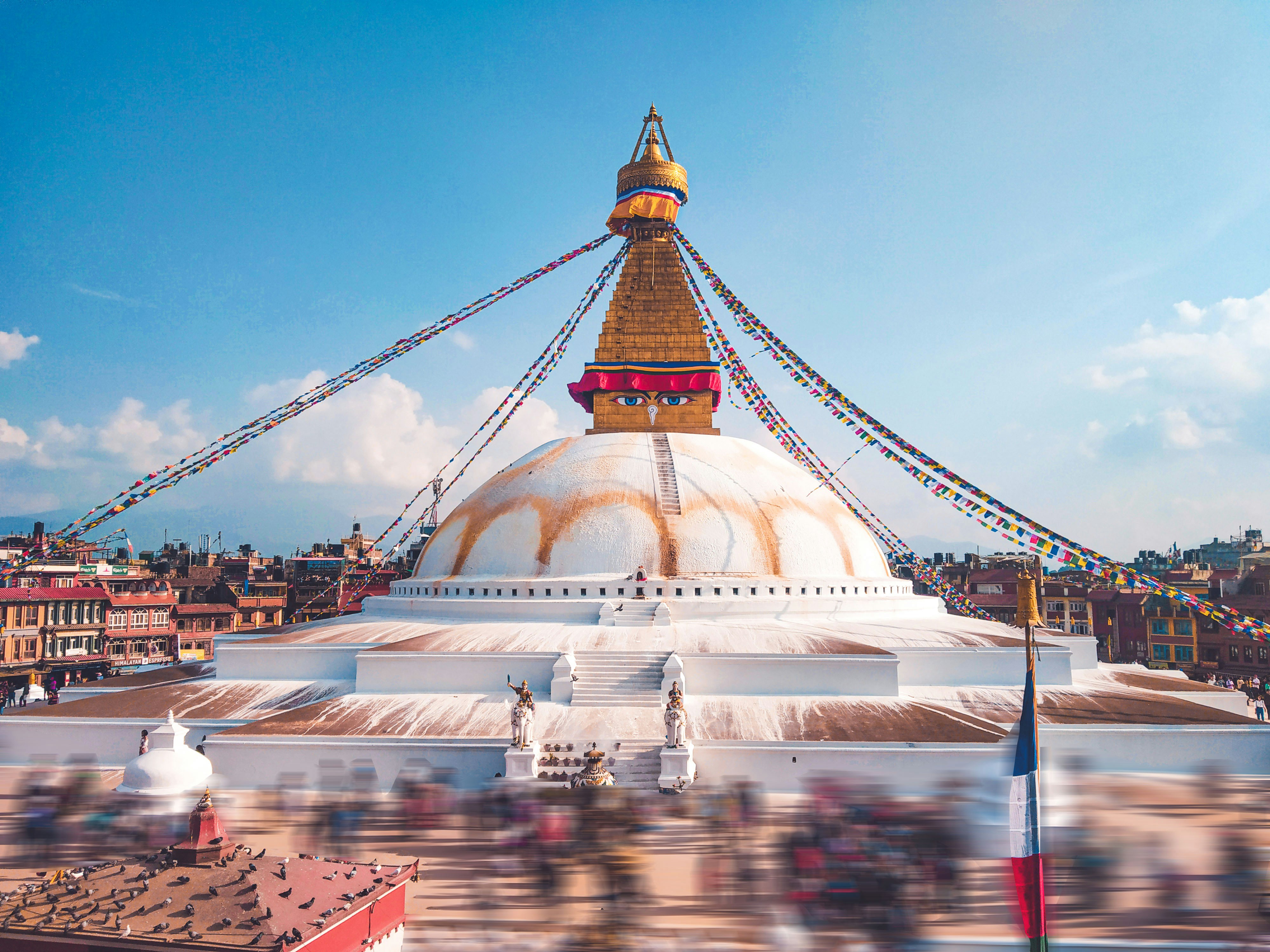
Your journey begins in Kathmandu, Nepal's vibrant capital, where ancient traditions thrive alongside busy modern life. Visit the sacred Pashupatinath Temple, one of the holiest Hindu shrines in South Asia, and watch pilgrims gather along the Bagmati River. Walk clockwise around the massive Boudhanath Stupa among Tibetan monks and prayer wheels, then climb to the hilltop Swayambhunath (Monkey Temple) for sweeping views of the city. At Kathmandu Durbar Square, explore centuries-old palaces and temples, and catch a glimpse of the Kumari, Nepal's Living Goddess.
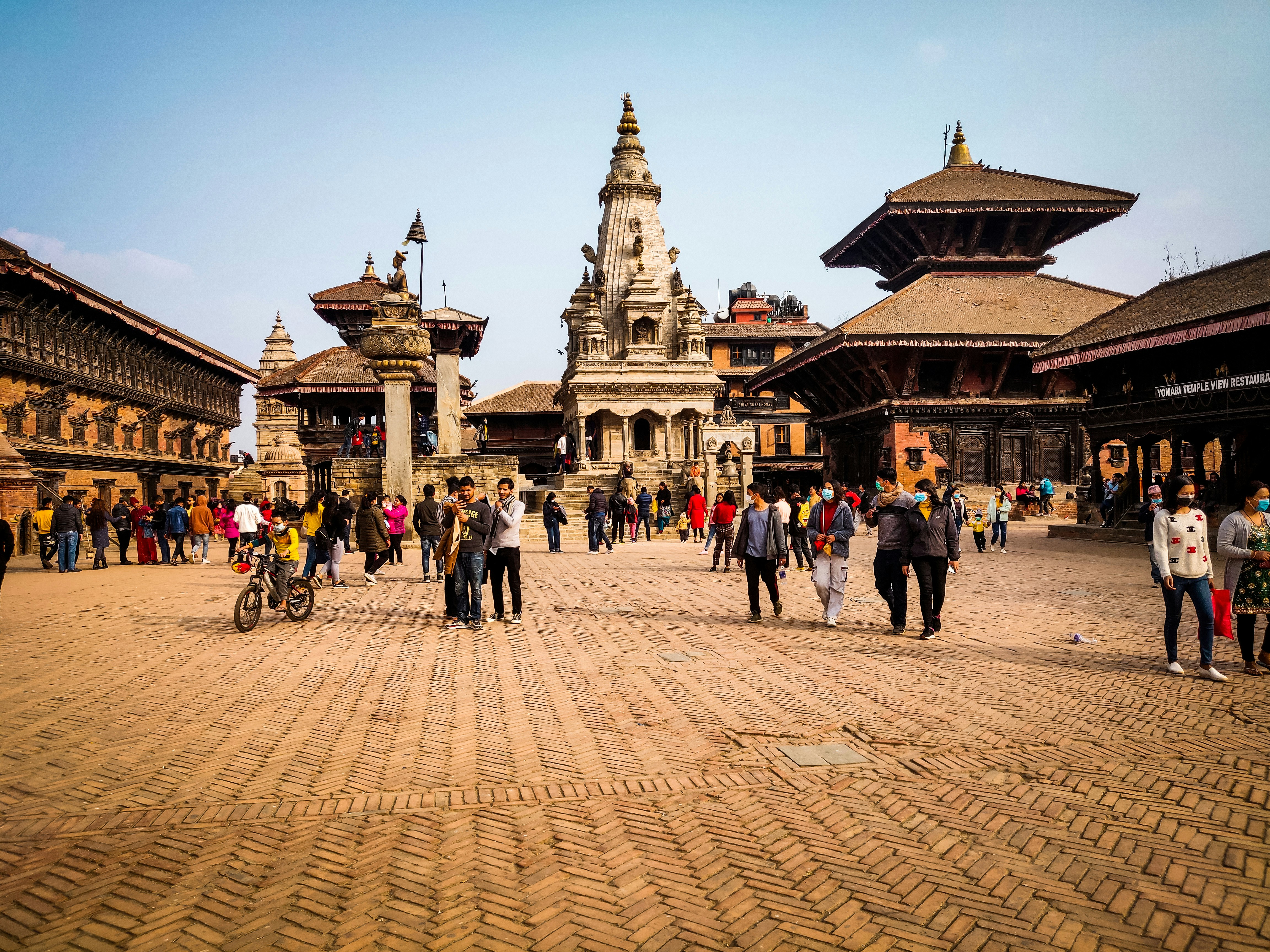
The tour continues to Patan, known as the "City of Fine Arts", where exquisite Newar craftsmanship shines in its temples, courtyards and metalwork studios. Next, step back in time in Bhaktapur, the valley's best-preserved medieval city, famous for its pagoda temples, pottery traditions, carved wooden windows and creamy Juju Dhau yoghurt. Along the way, you can also visit Changu Narayan, the oldest Hindu temple in the valley, showcasing remarkable stone and woodcarvings.
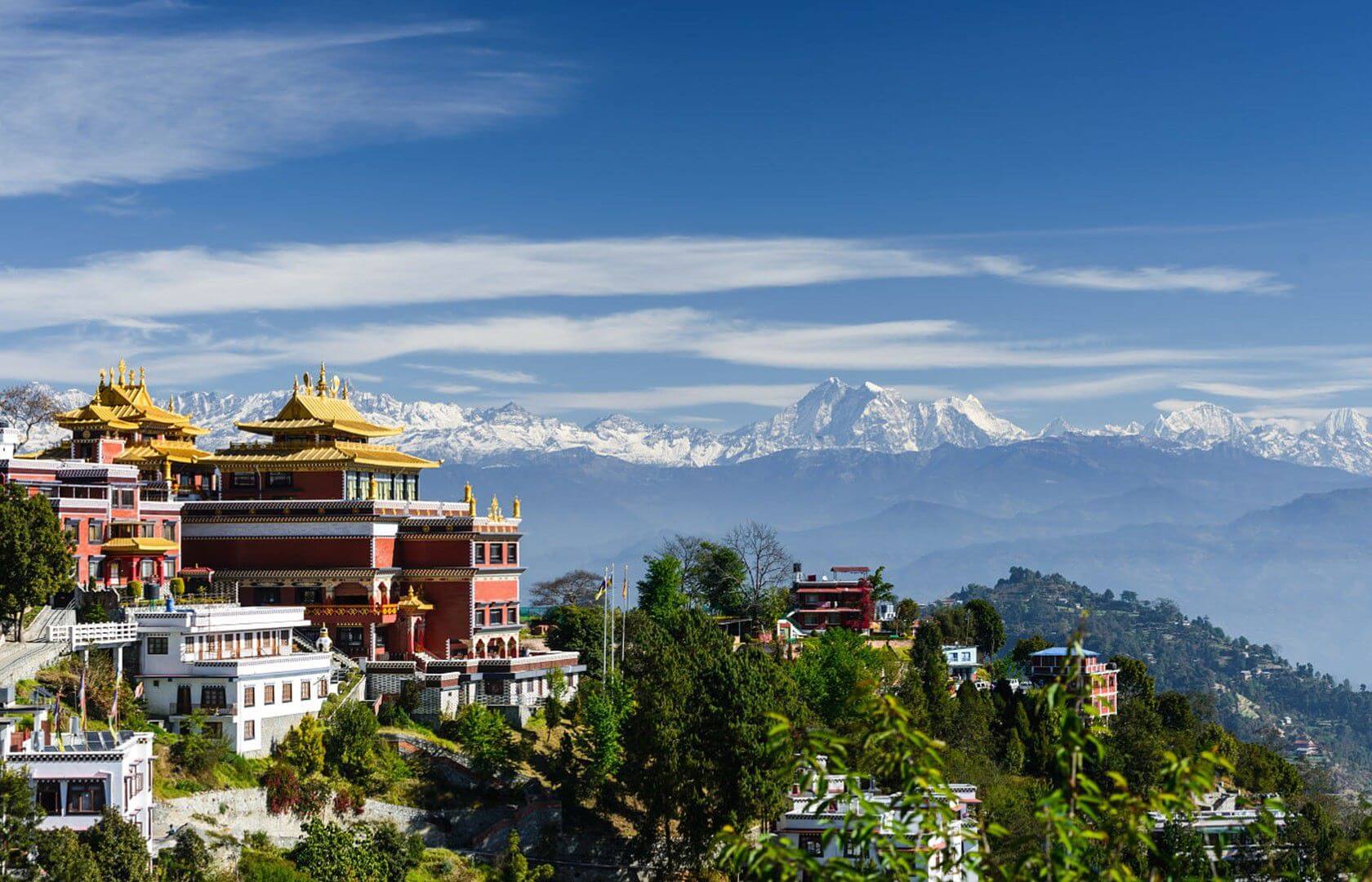
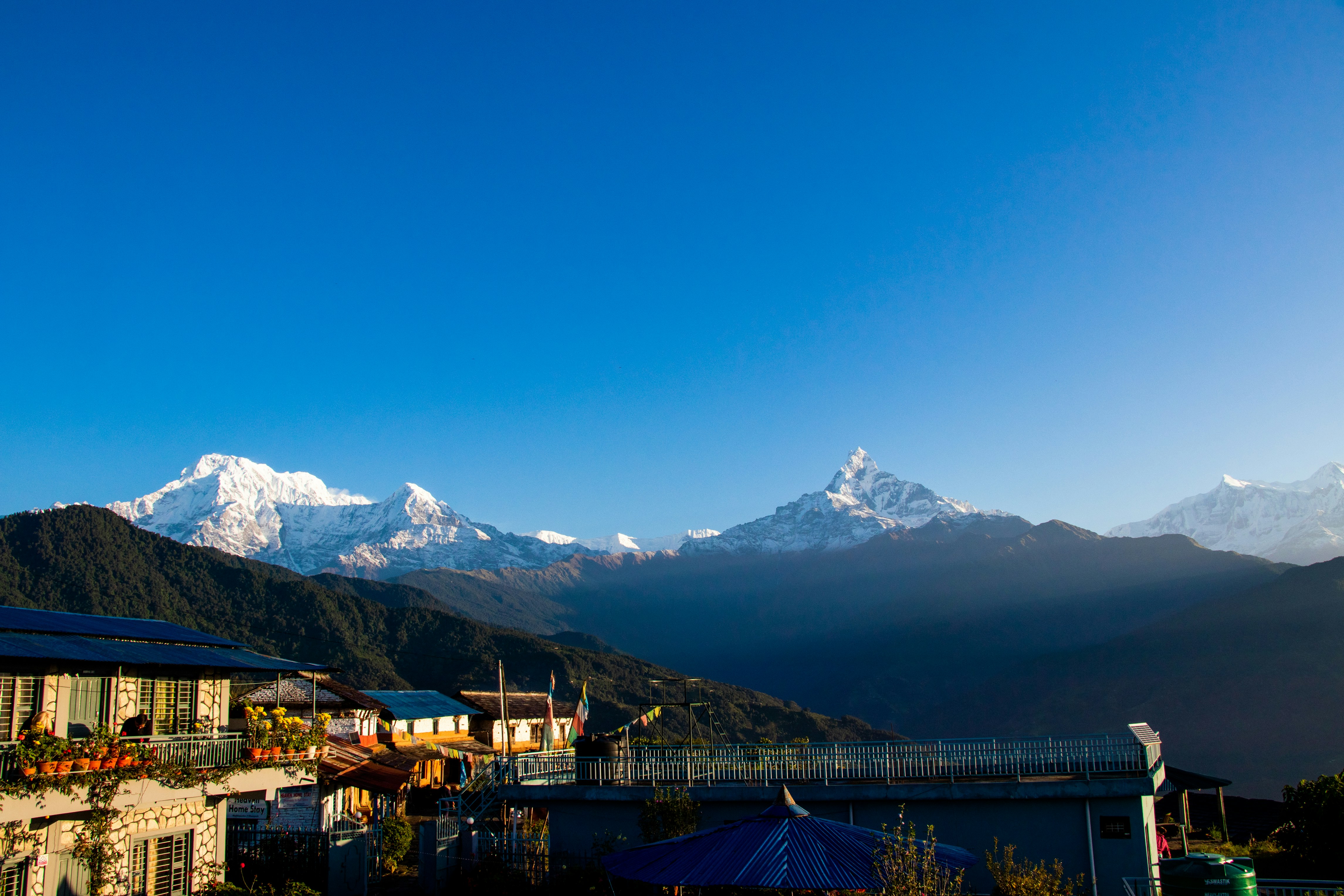
To complete the experience, head up to Nagarkot (2,175 m), a peaceful hill station on the valley's eastern rim. Known for its fresh air and panoramic Himalayan views, Nagarkot offers breathtaking sunrises and sunsets over snow-capped peaks stretching from Langtang to Mount Everest on clear days. It's the perfect place to relax after days of sightseeing and enjoy nature at its finest.
Throughout the tour, experienced local guides bring each site to life, sharing stories of Newar culture, Hindu and Buddhist traditions, and the history of the Malla kings who shaped the valley. You'll also have plenty of chances to taste authentic Newari cuisine, browse colourful local markets and meet friendly locals.
With easy walking, comfortable transport and no trekking required, the Kathmandu Valley Tour is ideal for first-time visitors, families, seniors, photographers and culture lovers. It can be enjoyed as a standalone trip or combined with destinations like Pokhara, Chitwan and Lumbini for a complete Nepal experience.
Trip Facts About Kathmandu Valley Tour
| Detail |
Information |
| Destinations |
Kathmandu, Patan, Bhaktapur, Changu Narayan, Nagarkot |
| Highest Point |
Nagarkot (2,175 m / 7,136 ft) |
| Trip Grade |
Easy |
| UNESCO Sites |
7 World Heritage monument zones |
| Transport |
Private car, van or jeep |
| Best Time |
October–November & February–April |
| Trip Style |
Culture, heritage, spirituality & mountain views |
| Suitable For |
All ages and fitness levels |
Kathmandu Valley Heritage Tour with Nagarkot Sunrise
Combine Nepal's finest cultural landmarks with one of its most beautiful mountain views on the Kathmandu Valley Heritage Tour. Spend your days exploring UNESCO-listed treasures, including the spiritual Pashupatinath Temple, the towering Boudhanath Stupa, the ancient Swayambhunath and the historic Durbar Squares of Kathmandu, Patan and Bhaktapur. Stroll through centuries-old Newar neighbourhoods, admire intricate temple carvings and discover traditional crafts still practised today. Then escape to Nagarkot, a peaceful hilltop retreat on the valley's rim, where the rising sun paints the Himalayan peaks in shades of gold and pink. This easy, rewarding tour offers the ideal balance of heritage, culture and natural beauty.
Discover the Timeless Beauty of the Kathmandu Valley
Step into a valley where ancient history, living traditions and Himalayan scenery come together. The Kathmandu Valley Tour takes you through seven UNESCO World Heritage Sites, from the sacred Pashupatinath Temple and the majestic Boudhanath Stupa to the hilltop Swayambhunath and the royal Durbar Squares of Kathmandu, Patan and Bhaktapur. Wander through medieval Newar streets filled with pagoda temples, carved wooden windows and vibrant markets, where Hindu and Buddhist cultures thrive side by side. End your journey in Nagarkot, where stunning sunrise and sunset views over the Himalayas offer a peaceful escape from the city. With easy sightseeing and expert local guides, this tour is the perfect way to experience the true soul of Nepal.
Ancient Cities, Sacred Temples & Himalayan Sunrises
Experience the perfect blend of history, spirituality and natural beauty on the Kathmandu Valley Tour. Explore the ancient royal cities of Kathmandu, Patan and Bhaktapur, where centuries-old palaces, pagoda temples and intricately carved courtyards showcase the brilliance of Newar craftsmanship. Visit sacred sites such as Pashupatinath Temple, Boudhanath Stupa and Swayambhunath, each offering a unique glimpse into Nepal's Hindu and Buddhist heritage. Then head to the tranquil hilltop of Nagarkot to witness breathtaking sunrises over snow-capped Himalayan peaks. Easy, enriching and full of cultural discovery, this tour offers an unforgettable introduction to Nepal's timeless charm.
Kathmandu Valley Cultural Tour: 7 UNESCO World Heritage Sites
Explore one of the world's richest cultural treasures on the Kathmandu Valley Cultural Tour, featuring all seven UNESCO World Heritage monument zones. Visit the sacred Pashupatinath Temple, the majestic Boudhanath Stupa and the hilltop Swayambhunath, then discover the royal Durbar Squares of Kathmandu, Patan and Bhaktapur, each filled with ancient palaces, pagoda temples and masterful Newar craftsmanship. Complete the journey at Changu Narayan, the valley's oldest Hindu temple, renowned for its remarkable stone and wood carvings. With expert local guides sharing stories of Hindu and Buddhist traditions, this easy and immersive tour offers a meaningful look into Nepal's living heritage, with a peaceful Nagarkot sunrise as the perfect finishing touch.
Why Choose the Kathmandu Valley Tour?
- Seven UNESCO World Heritage Sites in One Valley: Explore Pashupatinath, Boudhanath, Swayambhunath, Changu Narayan and the Durbar Squares of Kathmandu, Patan and Bhaktapur, all within a short drive of each other.
- Authentic Cultural Experience: Discover living Newar traditions, ancient festivals, local crafts and the unique harmony of Hindu and Buddhist faiths.
- Stunning Himalayan Views: Enjoy breathtaking sunrise and sunset views over snow-capped peaks from the peaceful hill station of Nagarkot.
- Expert Local Guides: Learn the history, legends and spiritual meaning behind every temple, stupa and palace from knowledgeable, licensed guides.
- Easy & Comfortable Travel: No trekking required, with short drives and gentle walks, making it suitable for all ages and fitness levels.
- Perfect for Short Trips: Experience the best of Nepal's culture and heritage even with limited time.
- Delicious Newari Cuisine: Taste traditional dishes like samay baji, bara, yomari and Bhaktapur's famous Juju Dhau.
- Flexible & Customisable Itinerary: Tailor the tour to your interests, pace and budget, or combine it with Pokhara, Chitwan or Lumbini.
- Great Value for Money: Enjoy rich cultural experiences, iconic landmarks and mountain views in one affordable package.
- Unforgettable Photo Opportunities: Capture ancient architecture, colourful markets, spiritual rituals and Himalayan sunrises at every stop.
Meals & Accommodation During the Kathmandu Valley Tour
| Day |
Itinerary |
Meals |
Accommodation |
| Day 01 |
Arrival in Kathmandu |
Welcome Dinner |
Hotel in Kathmandu |
| Day 02 |
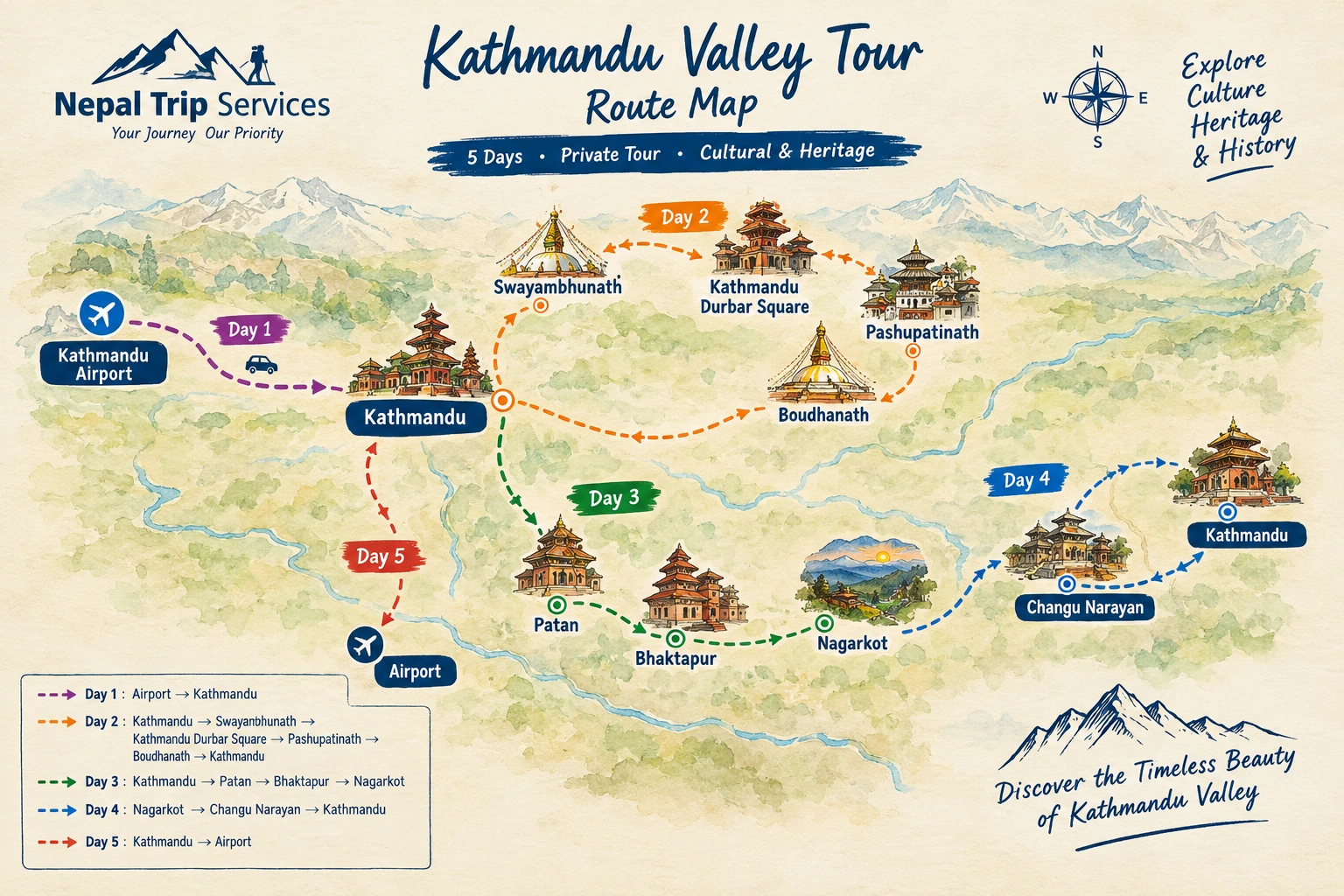
Kathmandu sightseeing: Swayambhunath Stupa, Basantapur (Kathmandu) Durbar Square, Pashupatinath Temple & Boudhanath Stupa |
Breakfast |
Hotel in Kathmandu |
| Day 03 |
Patan Durbar Square & Bhaktapur Durbar Square sightseeing, then drive to Nagarkot |
Breakfast & Dinner |
Hill Resort/Hotel in Nagarkot |
| Day 04 |
Nagarkot sunrise, Changu Narayan Temple visit & drive back to Kathmandu |
Breakfast & Farewell Dinner |
Hotel in Kathmandu |
| Day 05 |
Final Departure |
Breakfast |
— |
Meal Summary
| Meal |
Total Included |
| Breakfast |
4 |
| Dinner |
3 (Welcome, Nagarkot & Farewell) |
| Lunch |
Not included (enjoy local restaurants during sightseeing) |
Accommodation Summary
| Location |
Nights |
Type |
| Kathmandu |
3 Nights |
Comfortable 3-star hotel (upgrades available) |
| Nagarkot |
1 Night |
Hillside resort with Himalayan views |
All rooms are on twin or double sharing basis with private bathrooms. Single rooms, hotel upgrades and special dietary meals (vegetarian, vegan, gluten-free, halal) are available on request.
Transportation for the Kathmandu Valley Tour
Travel in comfort and convenience throughout your Kathmandu Valley Tour with private, air-conditioned vehicles driven by experienced local drivers. From your airport arrival and departure transfers to sightseeing in Kathmandu, Patan and Bhaktapur, the scenic drive up to Nagarkot and the visit to Changu Narayan, every journey is carefully arranged for a smooth, hassle-free experience. Depending on your group size, we provide a car, van or jeep, with short drive times between sites so you spend more time exploring and less time on the road. Safe, reliable and flexible, our transportation lets you enjoy the valley at a relaxed pace, with room for photo stops along the way.
Kathmandu Valley Tour: Additional Information
Travel Documents & Visa
Having the right travel documents ensures a smooth arrival and a stress-free Kathmandu Valley Tour. Here's everything you need to know before you fly to Nepal.
Passport Requirements
- Your passport must have at least 6 months of validity.
- Make sure you have at least one or two blank pages for your visa stamp.
- Carry your original passport throughout the tour, as it's required at hotels and for buying a local SIM card.
Nepal Tourist Visa
Most travellers can get a visa on arrival at Kathmandu's Tribhuvan International Airport, and all tourist visas allow multiple entry. You can also apply in advance through Nepal's online eVisa portal and receive the visa by email.
Visa Fees (2026)
| Visa Duration |
Fee |
Best For |
| 15 days |
USD 30 |
Kathmandu Valley Tour (5 days) |
| 30 days |
USD 50 |
Combined tours with Pokhara, Chitwan or Lumbini |
| 90 days |
USD 125 |
Long stays and extended travel |
Tip: A 15-day visa is ideal for the 5-day Kathmandu Valley Tour.
Special Visa Rules
- Indian citizens don't need a visa, and other SAARC nationals receive a free 30-day visa once per year. Indian nationals should carry a valid passport or voter ID card.
- Children under 10 receive their visa free of charge.
- Citizens of 12 countries can't get a visa on arrival and must apply through a Nepali embassy, so check your eligibility before travelling.
How to Get a Visa on Arrival
- Fill in the arrival form online in advance or at the airport kiosks.
- Pay the visa fee at the bank counter (USD cash is easiest; bring clean, undamaged notes).
- Submit your passport and receipt at the immigration desk.
- Collect your passport with the visa stamp and proceed to baggage claim.
Documents Checklist
- Valid passport (6+ months validity)
- Visa or eVisa confirmation
- Recent passport-size photograph
- Visa fee in USD cash
- Return or onward flight ticket
- Hotel and tour booking confirmation
- Travel insurance policy
Documents During the Tour
- Hotels: Passport required at check-in in Kathmandu and Nagarkot.
- Heritage sites: Entrance tickets for all UNESCO sites are included and handled by your guide.
- SIM card: Your original passport is needed to register a local SIM or eSIM.
Helpful Tips
- Keep printed and digital copies of your passport, visa and insurance.
- Store originals in your hotel safe when not needed.
- Avoid overstaying your visa, as daily fines apply.
- Visa rules can change, so confirm the latest requirements with Nepal's Department of Immigration before travel.
Best Time to Visit
The Kathmandu Valley can be explored year-round, but the season you choose shapes your experience, from clear Himalayan views at Nagarkot to vibrant festivals in the ancient city squares. Here's a quick guide to help you plan the perfect time for your tour.
Seasons at a Glance
| Season |
Months |
Weather |
Mountain Views |
Rating |
| Autumn |
October – November |
Clear, dry & pleasant (15–25°C) |
Excellent |
⭐⭐⭐⭐⭐ Best |
| Spring |
March – May |
Warm & sunny (18–30°C) |
Good (some haze) |
⭐⭐⭐⭐ Excellent |
| Winter |
December – February |
Cool & dry (2–20°C) |
Very good |
⭐⭐⭐⭐ Great |
| Monsoon |
June – September |
Warm, humid & rainy (20–29°C) |
Limited (cloudy) |
⭐⭐⭐ Good |
Autumn (October – November) — Best Time to Visit
Autumn is the most popular season for the Kathmandu Valley Tour. After the monsoon rains, the air is fresh and clear, offering the best Himalayan sunrise views from Nagarkot. Comfortable temperatures make sightseeing enjoyable, and the valley comes alive with Nepal's biggest festivals, Dashain and Tihar.
Why go: Crystal-clear skies, festive atmosphere, perfect weather
Keep in mind: Peak season, so book hotels early
Spring (March – May) — Excellent
Spring brings warm, sunny days and colourful blooms across the valley. It's a lively time with festivals like Holi, Bisket Jatra in Bhaktapur and the Rato Machhindranath chariot festival in Patan. Mountain views are good in March and April, though afternoon haze becomes common by May.
Why go: Pleasant weather, cultural festivals, blooming nature
Keep in mind: May can be hot and hazy
Winter (December – February) — Great
Winter offers dry, sunny days and excellent mountain visibility, especially in the mornings. Fewer tourists mean quieter heritage sites and better hotel rates. Mornings and evenings are cold, particularly at Nagarkot, where temperatures can drop near freezing.
Why go: Clear views, fewer crowds, lower prices
Keep in mind: Pack warm layers for Nagarkot
Monsoon (June – September) — Good
The monsoon brings regular rain showers, usually in the afternoons or at night, leaving the valley lush and green. Clouds often hide the mountains, but temples and heritage sites remain beautiful and far less crowded. Major festivals like Gai Jatra and Indra Jatra (August–September) make this season culturally rewarding.
Why go: Green scenery, unique festivals, off-season deals
Keep in mind: Carry rain gear; Himalayan views are not guaranteed
Top Festivals by Month
| Month |
Festival |
Where |
| March |
Holi (Festival of Colours) |
Across the valley |
| April |
Bisket Jatra (Nepali New Year) |
Bhaktapur |
| April – June |
Rato Machhindranath Jatra |
Patan |
| August – September |
Gai Jatra |
Kathmandu & Bhaktapur |
| September |
Indra Jatra (Kumari chariot festival) |
Kathmandu Durbar Square |
| October |
Dashain |
Nationwide |
| October – November |
Tihar & Mha Puja (Newar New Year) |
Across the valley |
Festival dates follow the lunar calendar and change each year.
Quick Recommendation
| Travel Goal |
Best Months |
| Clear Himalayan views |
October – November, December – February |
| Festivals & culture |
September – November, March – April |
| Fewer crowds & better deals |
December – February, June – August |
| Pleasant weather overall |
October – November, March – April |
No matter when you visit, the Kathmandu Valley's temples, stupas and royal squares offer an unforgettable experience. Contact us to plan your tour around the season that suits you best.
Entrance Fees & Permits
Visiting the Kathmandu Valley's UNESCO World Heritage Sites requires paying an entrance fee at each site. These fees support the preservation and restoration of Nepal's priceless monuments. The good news: no special trekking or travel permits are needed for the Kathmandu Valley Tour.
Heritage Site Entrance Fees (2026)
| Heritage Site |
Foreign Nationals |
SAARC Nationals |
Day on Tour |
| Swayambhunath Stupa |
NPR 200 |
NPR 50 |
Day 2 |
| Kathmandu (Basantapur) Durbar Square |
NPR 1,000 |
NPR 500 |
Day 2 |
| Pashupatinath Temple |
NPR 1,000 |
NPR 1,000 (free for Indians) |
Day 2 |
| Boudhanath Stupa |
NPR 400 |
NPR 100 |
Day 2 |
| Patan Durbar Square |
NPR 1,000 |
NPR 250 |
Day 3 |
| Bhaktapur Durbar Square |
NPR 1,800 |
NPR 500 |
Day 3 |
| Changu Narayan Temple |
NPR 300 |
NPR 100 |
Day 4 |
| Nagarkot |
Free |
Free |
Day 3–4 |
Total for all 7 UNESCO sites (foreign nationals): approx. NPR 5,700 (around USD 37)
Are Entrance Fees Included in the Tour?
Yes. All entrance fees for the UNESCO World Heritage Sites on the itinerary are included in the Kathmandu Valley Tour package. Your guide will buy the tickets for you, so you can skip the queues and focus on exploring.
Additional (Optional) Fees
Some museums and inner sites charge separate tickets:
| Attraction |
Foreign Nationals |
| Patan Museum |
Included with Patan Durbar Square ticket |
| Golden Temple (Patan) |
NPR 100 |
| National Art Museum (Bhaktapur) |
NPR 150 |
| National Museum, Chhauni |
NPR 150 |
Good to Know
- No permits required: The Kathmandu Valley Tour doesn't need any trekking, TIMS or restricted-area permits.
- Children: Kids under 10 usually enter heritage sites free of charge.
- Nepali citizens enter most sites free or at minimal cost.
- Keep your ticket: Carry it throughout your visit, as it may be checked at multiple points.
- Multi-day validity: Some tickets (like Bhaktapur's) can be extended for longer stays—ask at the ticket counter with your passport.
- Pay in cash: Fees are usually paid in Nepalese Rupees at ticket counters.
- Pashupatinath: Non-Hindus can explore the complex but cannot enter the main temple.
Camera & Photography Fees
Most sites don't charge extra for personal photography. However, photography is often restricted inside temple sanctuaries, and photographing the Kumari is strictly prohibited. Professional filming and drones require separate permission.
Entrance fees are set by local authorities and may change without notice. Figures are approximate; sources differ slightly, especially for Bhaktapur. Confirm current rates with your tour operator before travel.
Culture, Dress & Temple Etiquette
The Kathmandu Valley is a living cultural treasure where Hindu and Buddhist traditions have thrived side by side for centuries. Temples and stupas here are active places of worship, not just tourist attractions. Following local customs shows respect and makes your visit to Kathmandu, Patan, Bhaktapur, Changu Narayan and Nagarkot more meaningful.
Local Culture & Customs
- Greet with "Namaste": Press your palms together at chest level with a slight bow. In Newar neighbourhoods, you may also hear "Jwajalapa".
- Use your right hand to give, receive, eat and shake hands. The left hand is considered unclean.
- Respect elders by greeting them first and speaking politely.
- Avoid public displays of affection, especially near religious sites.
- Stay calm and friendly. Raising your voice or showing anger is frowned upon.
- Don't touch anyone's head, which is considered sacred, and avoid pointing your feet at people or deities.
What to Wear
| Place |
Dress Guidelines |
| Temples & stupas |
Cover shoulders and knees; avoid sleeveless tops, shorts and short skirts |
| Durbar Squares |
Light, modest clothing; comfortable walking shoes |
| Pashupatinath |
Modest, respectful clothing; neutral colours are ideal |
| Nagarkot |
Warm layers for cool mornings and evenings |
| Monasteries |
Long trousers or skirts and covered shoulders |
Tip: Carry a light scarf or shawl to cover up quickly at religious sites, and wear slip-on shoes for easy removal.
Temple & Stupa Etiquette
- Remove your shoes before entering temples, shrines, monasteries and homes.
- Walk clockwise around stupas, temples and prayer wheels, especially at Boudhanath and Swayambhunath.
- Spin prayer wheels clockwise with your right hand.
- Don't touch offerings, idols, shrines or sacred objects.
- Avoid leather items such as belts and bags inside some Hindu temples.
- Never step over offerings or sit on religious structures.
- Keep your voice low and silence your phone.
- Donations are welcome but never required; place them in the donation box.
Site-Specific Etiquette
Pashupatinath Temple
- Non-Hindus cannot enter the main temple but may view it from the east bank of the Bagmati River.
- Cremation ceremonies take place openly. Observe quietly and never photograph grieving families up close.
- Sadhus may ask for a small tip if you photograph them.
Boudhanath & Swayambhunath
- Always walk clockwise around the stupa.
- Be mindful of monks and pilgrims praying or meditating.
- At Swayambhunath, don't feed the monkeys and keep food and bags secure.
Kathmandu Durbar Square
- Photography of the Kumari (Living Goddess) is strictly forbidden.
- Stay quiet and respectful in the Kumari Ghar courtyard.
Patan, Bhaktapur & Changu Narayan
- Some inner temple areas are open only to Hindus; look for signs.
- Ask before photographing artisans, potters or residents at work.
Photography Etiquette
- Ask permission before photographing people, monks and children.
- Follow "No Photography" signs inside temples and shrines.
- Avoid flash during prayers and rituals.
- Never block paths or disturb worshippers for a photo.
Dining & Social Etiquette
- Avoid sharing food from your plate or touching others' food with used utensils (jutho).
- Remove shoes before entering someone's home.
- Accept food, tea or gifts with your right hand or both hands.
- A 10% service charge is often included at restaurants; extra tips are appreciated.
Quick Don'ts
- Don't wear revealing clothing at religious sites
- Don't touch or climb on monuments
- Don't point your feet at shrines or people
- Don't give money or sweets to begging children
- Don't enter restricted temple areas without permission
Bargaining & Tipping
- Bargaining is common in markets and souvenir shops; keep it friendly and fair.
- Fixed prices apply in restaurants, supermarkets and branded stores.
- Tipping guides and drivers is customary and appreciated.
Respecting local customs opens doors to warm hospitality and genuine connections. With a smile, a "Namaste" and a little cultural awareness, you'll experience the true spirit of the Kathmandu Valley.
Food & Dietary Needs
Food is one of the highlights of the Kathmandu Valley Tour. From traditional Newari feasts in Bhaktapur and Patan to momo stalls in Kathmandu and rooftop cafés overlooking Boudhanath, the valley offers a delicious mix of local flavours and international cuisine. Whatever your dietary needs, you'll eat well throughout your journey.
Meals Included in the Tour
| Meal |
Included |
Details |
| Breakfast |
4 |
Daily at your hotel with continental, American and Nepali options |
| Dinner |
3 |
Welcome dinner, dinner in Nagarkot and farewell dinner |
| Lunch |
Not included |
Enjoy local restaurants during sightseeing (your guide will recommend the best spots) |
Must-Try Local Dishes
| Dish |
What It Is |
| Momo |
Nepal's favourite steamed or fried dumplings with spicy dipping sauce |
| Dal Bhat |
The national meal of rice, lentil soup, vegetable curry and pickle |
| Samay Baji |
Traditional Newari platter of beaten rice, spiced meat, egg, soybeans and pickles |
| Bara (Woh) |
Savoury lentil pancake, plain or topped with egg |
| Chatamari |
Thin rice-flour crêpe, often called "Newari pizza" |
| Yomari |
Sweet steamed dumpling filled with molasses and sesame |
| Kwati |
Hearty soup made from nine types of sprouted beans |
| Juju Dhau |
Creamy "king of curd", a Bhaktapur speciality |
| Masala Chiya |
Spiced milk tea served everywhere |
Where to Eat on the Tour
- Kathmandu (Thamel): Endless choices, from Nepali and Tibetan food to Italian, Indian, Korean and vegan cafés.
- Boudhanath: Rooftop cafés with stupa views, serving Tibetan dishes like thukpa and momo.
- Patan: Traditional Newari restaurants and charming courtyard cafés near Durbar Square.
- Bhaktapur: Authentic Newari eateries and the famous Juju Dhau served in clay pots.
- Nagarkot: Resort dining with Nepali and continental menus and Himalayan views.
Dietary Needs Made Easy
- Vegetarian: Very easy to find. Many Nepalis are vegetarian, and every menu includes plenty of options.
- Vegan: Widely available in Kathmandu, but ask about ghee (clarified butter), milk, curd and paneer, which are common in local cooking.
- Gluten-Free: Rice-based dishes like dal bhat, chatamari and bara are good choices. Avoid momos, noodles and roti, which usually contain wheat.
- Halal: Halal restaurants are available in Kathmandu, especially around Thamel and Durbar Marg.
- Jain / No Onion & Garlic: Available at many Indian-style restaurants with advance notice.
- Food Allergies: Peanuts, sesame and soybeans are often used in pickles (achar) and sauces. Always mention allergies clearly.
Tip: Share your dietary requirements when booking so we can inform hotels and restaurants in advance.
Food & Water Safety Tips
- Drink bottled, boiled or filtered water only; avoid tap water
- Choose freshly cooked, hot meals at busy restaurants
- Be cautious with raw salads, street-side cut fruit and ice
- Ask for "less spicy" (kam piro) if you're not used to chilli
- Carry hand sanitiser and use it before meals
Dining Etiquette
- Nepalis often eat with their right hand, but cutlery is always available in restaurants.
- Avoid sharing food from your plate or touching others' food with used utensils (jutho).
- A 10% service charge is often added in restaurants; extra tipping is optional but appreciated.
Come hungry and curious! Let your guide introduce you to local favourites and discover why Newari cuisine is one of Nepal's greatest cultural treasures.
Health, Vaccinations & Insurance
The Kathmandu Valley Tour is an easy, low-altitude journey, but a little health preparation helps you stay comfortable and enjoy every moment. Here's what to know about staying healthy, recommended vaccinations and choosing the right travel insurance.
Altitude & Fitness
| Location |
Altitude |
| Kathmandu, Patan & Bhaktapur |
1,350 – 1,400 m |
| Changu Narayan |
~1,541 m |
| Nagarkot (highest point) |
2,175 m |
These altitudes are low enough that altitude sickness is not a concern for healthy travellers. The tour involves gentle walking and is suitable for all ages. You may only notice cooler temperatures in Nagarkot.
Recommended Vaccinations
No vaccinations are mandatory for most travellers entering Nepal, but health authorities commonly recommend:
| Vaccine |
Why It's Recommended |
| Routine vaccines (MMR, tetanus, polio, flu) |
Ensure they are up to date |
| Hepatitis A |
Spread through contaminated food and water |
| Typhoid |
Advised for most visitors, especially if eating street food |
| Hepatitis B |
For longer stays or possible medical treatment |
| Rabies |
Consider if you may be around animals, including stray dogs and temple monkeys |
Yellow fever: Only required if arriving from a country with yellow fever risk.
Visit a travel clinic 4–8 weeks before departure for personalised advice.
Staying Healthy in the Kathmandu Valley
- Air quality: Kathmandu can be dusty and polluted, especially in the dry season (November–April). Carry a face mask if you have respiratory sensitivities.
- Food & water: Drink bottled, boiled or filtered water, and eat freshly cooked food.
- Hand hygiene: Use hand sanitiser often, particularly after visiting busy temples and markets.
- Sun protection: Wear sunscreen, sunglasses and a hat, as the sun is strong even on cool days.
- Stay warm in Nagarkot: Pack layers for chilly mornings and evenings, especially in winter.
- Mosquitoes: Use repellent during the monsoon (June–September), when dengue can occur in Kathmandu.
- Monkeys: Avoid feeding or touching monkeys at Swayambhunath and Pashupatinath.
Medical Care in Kathmandu
Kathmandu has Nepal's best medical facilities, including private hospitals and specialist travel clinics such as CIWEC Hospital, Grande International Hospital and Norvic International Hospital. Pharmacies are easy to find throughout the city for basic medicines.
Emergency numbers:
- Ambulance: 102
- Police: 100
- Tourist Police: 1144
Travel Insurance
Travel insurance is not mandatory for this tour, but it is strongly recommended. Choose a policy that covers:
- Medical treatment and hospitalisation
- Emergency evacuation and repatriation
- Trip cancellation, delays and interruptions
- Lost or stolen baggage and personal belongings
- Optional activities such as an Everest mountain flight
Tip: Keep your policy number and 24-hour emergency helpline saved on your phone and printed in your bag.
Health Checklist
- Vaccination records
- Travel insurance documents
- Personal prescription medicines (in original packaging)
- Small first-aid kit with basic medicines
- Oral rehydration salts
- Hand sanitiser and face mask
- Sunscreen and insect repellent
- Water purification tablets or filter bottle
This information is general guidance only. Please consult your doctor or a travel health clinic for advice tailored to your health and travel plans.
Currency & Payments
Handling money in the Kathmandu Valley is simple once you know the basics. This guide covers Nepal's currency, ATMs, cards and digital payments so you can explore Kathmandu, Patan, Bhaktapur and Nagarkot with confidence.
Nepal's Currency at a Glance
| Detail |
Information |
| Currency |
Nepalese Rupee (NPR / Rs) |
| Common notes |
Rs 5, 10, 20, 50, 100, 500 & 1,000 |
| Exchange rate (late Sept 2026) |
About 153.46 NPR per US dollar (mid-market) |
| Indian Rupee |
Fixed at 1 INR = 1.6 NPR |
| Best currencies to bring |
USD, EUR or GBP in clean, undamaged notes |
Bringing Money Into Nepal
- You can bring up to USD 5,000 or equivalent in foreign cash without a customs declaration.
- Indian notes: Indian Rs 200 and Rs 500 notes issued on or after 9 November 2016 are now allowed, up to Rs 25,000 per person. Rs 2,000 notes remain banned.
- Visa fee: Carry USD cash to pay for your visa on arrival.
ATMs in the Kathmandu Valley
ATMs are widely available in Thamel, Durbar Marg, Patan and Bhaktapur. Nagarkot has very few, so withdraw cash in Kathmandu beforehand.
| ATM Detail |
Typical Range |
| Withdrawal limit |
Usually NPR 20,000–35,000 per transaction, most commonly 25,000 |
| Local bank fee |
A flat NPR 500–800 per withdrawal, regardless of amount |
| Cards accepted |
Visa and Mastercard at most ATMs; Amex and Maestro at fewer |
Money-saving tips:
- Withdraw the maximum each time to reduce flat fees
- Always choose NPR if the ATM offers to charge in your home currency
- Inform your bank before travelling to avoid card blocks
Cards & Digital Payments
Cards are accepted at: Hotels, Nagarkot resorts, larger restaurants, travel agencies and bigger handicraft shops (a 3–4% surcharge may apply).
Cash is needed for: Local eateries, street food, taxis, markets, small souvenir stalls, temple donations and tips.
QR payments:
- Indian visitors can pay with UPI at Fonepay-enrolled merchants by scanning QR codes.
- Users of Alipay, KakaoPay, GCash, Touch 'n Go, AlipayHK, TrueMoney and Tinaba can pay at Fonepay QR merchants.
- UnionPay users can make QR payments at more than 2 million merchants across Nepal.
Daily Spending Guide
| Expense |
Payment Method |
| Heritage site entrance fees |
Included in your tour package |
| Lunch at local restaurants |
Cash or card |
| Snacks, tea & street food |
Cash |
| Souvenirs & handicrafts |
Cash (bargain in markets) |
| Taxis & rickshaws |
Cash |
| Tips for guides & drivers |
Cash |
Smart Money Tips
- Exchange money only at banks or licensed money changers
- Carry small notes for tips, snacks and taxis
- Keep exchange receipts to reconvert leftover rupees before departure
- Split cash between your wallet, daypack and hotel safe
- Bargain politely in markets; prices are fixed in restaurants and shops
- Nepalese rupees are hard to exchange outside Nepal, so spend or convert them before leaving
Exchange rates and banking rules change often. Check the latest updates before you travel.
Optional Activities & Add-Ons
Make your Kathmandu Valley Tour even more memorable with exciting add-on experiences. Whether you want Himalayan views from the sky, hands-on cultural workshops or peaceful hill hikes, these optional activities let you personalise your journey.
Scenic & Adventure Add-Ons
- Everest Mountain Flight: A one-hour early morning scenic flight from Kathmandu past Mount Everest and the high Himalayas, with a window seat guaranteed for every passenger.
- Everest Helicopter Tour: A once-in-a-lifetime helicopter flight to the Everest region, with a landing at a viewpoint facing the world's highest peak.
- Chandragiri Cable Car: Ride to Chandragiri Hills (2,551 m) for panoramic views of the Kathmandu Valley and Himalayan ranges.
- Nagarkot to Changu Narayan Hike: A scenic 3–4 hour downhill walk through pine forests, terraced farms and traditional villages, replacing the drive on Day 4.
- Mountain Biking Tour: Cycle through rural villages and hill trails around the valley's rim.
- Shivapuri National Park Hike: A refreshing forest hike with birdlife and valley views, just north of Kathmandu.
Cultural & Spiritual Experiences
- Pashupatinath Evening Aarti: Watch the mesmerising Hindu fire ceremony on the banks of the Bagmati River.
- Kopan Monastery Visit & Meditation: Join a meditation session at this famous Tibetan Buddhist monastery near Boudhanath.
- Budhanilkantha Temple: See the giant reclining Vishnu statue floating in a sacred pond.
- Pharping & Dakshinkali: Explore important Hindu and Buddhist pilgrimage sites south of Kathmandu.
- Namobuddha & Dhulikhel Day Trip: Visit a peaceful hilltop monastery and enjoy mountain views from Dhulikhel.
- Kirtipur, Bungamati & Khokana: Discover traditional Newar towns and villages little changed by time.
Hands-On Workshops
- Nepali & Newari Cooking Class: Learn to make momo, dal bhat and Newari dishes with a local chef.
- Pottery Class in Bhaktapur: Try shaping clay on a traditional potter's wheel in Pottery Square.
- Thangka Painting Workshop: Learn the art of sacred Buddhist painting from skilled artisans.
- Woodcarving & Metal Crafting Demonstrations: Watch master craftsmen at work in Patan and Bhaktapur.
- Singing Bowl Sound Healing Session: Experience the soothing vibrations of traditional Himalayan singing bowls.
Relaxation & Leisure
- Traditional Nepali or Ayurvedic Massage: Unwind after a day of sightseeing.
- Yoga Retreat Sessions: Morning yoga in Kathmandu or with mountain views in Nagarkot.
- Garden of Dreams: Relax in this beautifully restored neoclassical garden in the heart of Kathmandu.
- Rickshaw Ride Through Old Kathmandu: Explore Asan, Indra Chowk and hidden courtyards at a gentle pace.
- Cultural Dinner Show: Enjoy a traditional Nepali meal with folk music and dance performances.
Popular Tour Extensions
| Extension |
Highlights |
Extra Days |
| Pokhara |
Phewa Lake, Sarangkot sunrise, paragliding |
2–3 days |
| Chitwan National Park |
Jungle safari, rhinos, Tharu culture |
2–3 days |
| Lumbini |
Birthplace of Lord Buddha, Maya Devi Temple |
2 days |
| Bandipur |
Charming Newar hill town |
1–2 days |
| Short Treks |
Poon Hill, Australian Camp or Dhampus |
3–5 days |
| Bhutan or Tibet |
Cross-border cultural journeys |
4–8 days |
Good to Know
- Optional activities are not included in the standard tour price unless stated.
- Book in advance, especially during peak seasons (October–November and March–April).
- Mountain flights and scenic activities depend on weather conditions and may be rescheduled.
- Make sure your travel insurance covers any adventure activities.
- Most activities can be arranged as private or small-group experiences.
Want to add something special to your trip? Contact us, and we'll tailor your Kathmandu Valley Tour with the experiences that match your interests, time and budget.
Booking & Cancellation Policy
We make booking your Kathmandu Valley Tour simple, secure and transparent. Please read the following terms carefully before confirming your trip, so you know exactly what to expect.
How to Book Your Tour
- Choose your travel dates and group size.
- Send your booking request via our website, email or WhatsApp with full names, nationalities, passport copies and contact details.
- Pay the deposit to secure your booking.
- Receive written confirmation with your final itinerary, inclusions, exclusions and hotel details.
Tip: Book at least 4–8 weeks in advance for peak seasons (October–November and March–April) to secure the best hotels in Kathmandu and Nagarkot.
Payment Terms
| Payment Stage |
Amount |
When It's Due |
| Deposit |
20% of the total tour cost |
At the time of booking |
| Balance |
Remaining 80% |
On arrival in Kathmandu or before the tour starts |
- Accepted payment methods: Bank transfer, credit/debit card (Visa, Mastercard, American Express, UnionPay) or cash in USD/NPR.
- Card payments may include a 3–4% bank service charge.
- International bank transfer fees are the traveller's responsibility.
Cancellation by the Traveller
All cancellations must be sent in writing by email. The following charges apply based on the notice given before your tour start date:
| Notice Before Tour Starts |
Cancellation Charge |
| 30 days or more |
Loss of deposit (20%) |
| 15–29 days |
50% of the total tour cost |
| 7–14 days |
75% of the total tour cost |
| Less than 7 days / No-show |
100% of the total tour cost |
- Non-refundable costs already paid (such as hotel bookings or flight tickets for optional activities) may be deducted.
- No refunds are given for unused services, missed sightseeing, late arrival or early departure.
Date Changes & Postponement
- Free date changes up to 30 days before departure, subject to availability.
- Changes made within 30 days may incur additional costs from hotels or service providers.
- In special cases, your deposit may be transferred to a new date within 12 months.
- Group size changes may affect the per-person tour price.
Changes or Cancellation by the Company
We may need to adjust or cancel parts of the tour due to circumstances beyond our control, including:
- Severe weather, floods or landslides
- Flight delays or cancellations
- Strikes, political unrest or road closures
- Natural disasters, health emergencies or government restrictions
- Temporary closure of heritage sites
In such cases, we will offer a suitable alternative, a new travel date or a fair refund for unused services. We are not responsible for additional costs arising from these events, such as extra accommodation or rebooked international flights.
Travel Insurance
We strongly recommend comprehensive travel insurance covering trip cancellation, medical emergencies, evacuation, flight delays and lost baggage. It protects your investment if you need to cancel or change plans unexpectedly.
Need Assistance?
Our friendly team is happy to help with bookings, payments, changes or cancellations. Contact us by email, phone or WhatsApp before or during your trip, and we'll respond as quickly as possible.
By confirming your booking and paying the deposit, you agree to these booking and cancellation terms.
Note: The deposit percentages, cancellation charges and timeframes above are sample industry-standard terms. Please adjust them to match your company's official policy before publishing.
Frequently Asked Questions (FAQs)
1. What is the Kathmandu Valley Tour?
The Kathmandu Valley Tour is a cultural sightseeing journey through Nepal's historic heartland, covering Kathmandu, Patan, Bhaktapur, Changu Narayan and the hill station of Nagarkot. It includes all seven UNESCO World Heritage monument zones, such as Pashupatinath Temple, Boudhanath Stupa and Swayambhunath. You'll explore ancient palaces, pagoda temples and Newar neighbourhoods with an expert local guide. The tour ends with sunrise views over the Himalayas from Nagarkot.
2. How many days is the Kathmandu Valley Tour?
Our standard Kathmandu Valley Tour lasts 5 days and 4 nights, including arrival and departure days. This gives you enough time to explore the major heritage sites at a relaxed pace and enjoy an overnight stay in Nagarkot. If you have less time, a shorter 2–3 day version is possible. You can also extend the tour or combine it with Pokhara, Chitwan or Lumbini.
3. Which places are included in the tour?
The tour covers Swayambhunath Stupa, Kathmandu (Basantapur) Durbar Square, Pashupatinath Temple, Boudhanath Stupa, Patan Durbar Square, Bhaktapur Durbar Square, Changu Narayan Temple and Nagarkot. Together, these showcase the best of Nepal's Hindu, Buddhist and Newar heritage. Each site has its own history, architecture and spiritual significance. Nagarkot adds a peaceful natural highlight with panoramic Himalayan views.
4. Is the Kathmandu Valley Tour suitable for beginners and families?
Yes, this is an easy tour suitable for travellers of all ages, including children and seniors. It involves gentle walking on city streets and temple courtyards, with no trekking required. The drives between sites are short, and the itinerary includes plenty of rest time. Guides can adjust the pace to suit your group's needs.
5. What is the highest altitude on this tour?
The highest point is Nagarkot, at about 2,175 metres (7,136 ft). Kathmandu, Patan and Bhaktapur sit at around 1,350–1,400 metres. These altitudes are low enough that altitude sickness is not a concern for healthy travellers. You may simply notice cooler temperatures in Nagarkot, especially in the mornings and evenings.
6. What is the best time to do the Kathmandu Valley Tour?
The best months are October–November and February–April, when skies are clear and the weather is pleasant. Autumn offers the best mountain views from Nagarkot and major festivals like Dashain and Tihar. Winter (December–January) is also good, with sunny days but cold mornings. The monsoon (June–September) brings rain and clouds but also lush green scenery and fewer crowds.
7. Can I see Mount Everest from Nagarkot?
On very clear days, you can see Mount Everest as a small peak on the distant eastern horizon from Nagarkot. More prominent views include the Langtang, Ganesh Himal, Jugal and Rolwaling ranges. Visibility is best in October–November and on crisp winter mornings. During the monsoon, clouds often hide the mountains.
8. Do I need a visa to visit Nepal?
Most nationalities can get a tourist visa on arrival at Tribhuvan International Airport in Kathmandu or apply online in advance. Tourist visa fees are USD 30 for 15 days, USD 50 for 30 days and USD 125 for 90 days. Indian citizens do not need a visa, and other SAARC nationals get a free 30-day visa once per year. Your passport must be valid for at least six months.
9. Are entrance fees included in the tour cost?
Yes, entrance fees for all UNESCO World Heritage Sites on the itinerary are included in the package. This covers Pashupatinath, Boudhanath, Swayambhunath, Changu Narayan and the Durbar Squares of Kathmandu, Patan and Bhaktapur. Your guide will handle ticket purchases so you can enjoy a smooth visit. Keep your tickets with you, as they may be checked at entry points.
10. What type of accommodation is provided?
You will stay three nights in a comfortable 3-star hotel in Kathmandu, usually in the Thamel area, and one night at a hillside resort in Nagarkot with mountain views. Rooms are on a twin or double sharing basis with private bathrooms and hot water. Upgrades to 4-star, 5-star or boutique heritage hotels are available. Single rooms can be arranged for an extra supplement.
11. Which meals are included?
The package includes daily breakfast (4 in total), plus a welcome dinner, dinner in Nagarkot and a farewell dinner. Lunches are not included, giving you the freedom to try different local restaurants during sightseeing. Your guide can recommend great spots for authentic Newari and Nepali food. Special diets can be arranged on request.
12. Can special dietary needs be accommodated?
Yes, vegetarian, vegan, gluten-free, halal and Jain meals can be arranged with advance notice. Vegetarian food is especially easy to find in Nepal. If you have allergies, let us know when booking so hotels and restaurants can prepare safely. Your guide can also help explain your needs to restaurant staff.
13. What transportation is used during the tour?
All transfers and sightseeing are done in a private, air-conditioned car, van or jeep, depending on group size. Experienced local drivers ensure safe and comfortable travel. Drive times between sites are short, usually 20 minutes to 1 hour. Airport pick-up and drop-off are also included.
14. Will I have a guide during the tour?
Yes, you will be accompanied by a government-licensed, English-speaking tour guide during all sightseeing days. Guides share the history, legends and cultural meaning behind each site. Guides in other languages, such as Spanish, French, German, Chinese or Japanese, can be arranged on request, subject to availability. Having a guide greatly enriches your understanding of the valley's heritage.
15. Can I customise the Kathmandu Valley Tour?
Absolutely. You can change the length of the tour, upgrade hotels, add or remove sites, or include extra experiences like an Everest mountain flight, cooking class or Chandragiri cable car. The tour can also be extended to Pokhara, Chitwan, Lumbini or even Bhutan and Tibet. Tell us your interests and budget, and we'll design the perfect itinerary for you.
16. Is it a private or group tour?
The tour can be arranged as either a private tour or a small group tour. Private tours offer maximum flexibility and personal attention, ideal for couples, families and friends. Small group tours can be more budget-friendly and sociable. Both options follow the same high standard of service.
17. How much walking is involved?
Expect about 2–4 hours of gentle walking per day, mostly on paved streets, stone courtyards and temple steps. Swayambhunath has a long staircase, but vehicles can reach near the top. Bhaktapur and Patan involve pleasant walks through pedestrian-friendly squares. Comfortable walking shoes are recommended.
18. What should I wear during the tour?
Wear light, comfortable clothing and modest attire that covers your shoulders and knees, especially at temples. Bring a warm fleece or jacket for Nagarkot's cool mornings and evenings. Slip-on shoes are useful since you'll remove footwear at many religious sites. A scarf, sun hat and rain jacket (during the monsoon) are also handy.
19. Can non-Hindus enter Pashupatinath Temple?
Non-Hindus cannot enter the main temple building at Pashupatinath, but they can explore the surrounding complex. You can view the temple from across the Bagmati River, see the cremation ghats and visit smaller shrines. Your guide will explain the rituals and customs taking place. The evening Aarti ceremony is also open for visitors to watch.
20. Is photography allowed at heritage sites?
Photography is generally allowed in outdoor areas of temples, stupas and Durbar Squares. However, it is often not permitted inside temple sanctuaries, and photographing the Kumari (Living Goddess) is strictly forbidden. Always ask before photographing people, especially during rituals or at cremation sites. Follow posted signs and your guide's advice.
21. What is the Kumari, and can I see her?
The Kumari is a young Newar girl worshipped as a living goddess, believed to embody the goddess Taleju. She lives in the Kumari Ghar in Kathmandu Durbar Square. Visitors can sometimes catch a brief glimpse of her at a courtyard window. Photography of the Kumari is not allowed, and visitors should remain respectful and quiet.
22. Is Nepal safe for tourists?
Yes, Nepal is generally considered a safe and welcoming destination for travellers. Like any busy city, it's wise to watch for pickpockets in crowded areas and keep valuables secure. Your guide and driver will be with you throughout sightseeing days. Tourist Police are also available in Kathmandu to assist visitors.
23. What currency is used in Nepal, and can I use cards?
Nepal uses the Nepalese Rupee (NPR). ATMs are widely available in Kathmandu, and cards are accepted at most hotels, larger restaurants and shops. However, carry cash for small purchases, local eateries, markets and tips. US dollars, euros and pounds can be exchanged easily at banks and licensed money changers.
24. Will I have internet and mobile connectivity?
Yes, free Wi-Fi is available at most hotels, cafés and restaurants in Kathmandu and Nagarkot. You can also buy a local SIM card or tourist eSIM from Ncell or Nepal Telecom at the airport with your passport. Mobile data coverage is strong throughout the Kathmandu Valley. A power bank is helpful for long sightseeing days.
25. Do I need travel insurance?
Travel insurance is not mandatory for this tour, but it is strongly recommended. A good policy should cover medical treatment, trip cancellation, flight delays, lost baggage and emergency evacuation. It provides peace of mind in case of unexpected events. Carry a copy of your policy and emergency contact numbers.
26. Are there any health precautions I should take?
Drink only bottled, boiled or filtered water, and eat freshly cooked food. Routine vaccinations should be up to date, and many travellers also get Hepatitis A and Typhoid vaccines. A face mask can help with dust and pollution in Kathmandu. Carry any personal medications and a small first-aid kit.
27. How do I book the Kathmandu Valley Tour?
You can book by contacting us through our website, email or WhatsApp with your travel dates, group size and preferences. A deposit is required to confirm your booking, with the balance payable before the tour starts. Once confirmed, you'll receive a detailed itinerary and travel information. Our team is available to answer questions at every step.
28. What is the cancellation policy?
Cancellations must be made in writing, and charges depend on how far in advance you cancel. Generally, cancelling 30 or more days before departure means only the deposit is lost, while late cancellations incur higher charges. Date changes are often possible without extra cost if made early. Please review our full terms and conditions before booking.
29. Should I tip my guide and driver?
Tipping is not mandatory but is customary and appreciated in Nepal. Many travellers give tips at the end of the tour based on their satisfaction with the service. A 10% service charge is often added at restaurants. Your tip is a meaningful way to thank your guide and driver for their hard work.
30. Can I combine the Kathmandu Valley Tour with other destinations?
Yes, the Kathmandu Valley Tour combines perfectly with other popular Nepal destinations. You can add Pokhara for lakes and mountain views, Chitwan National Park for jungle safaris, or Lumbini for Buddhist pilgrimage. Adventure lovers can also add short treks, paragliding or rafting. Contact us to create a combined itinerary that suits your time and interests.






Discovering The History And Culture Of Kathmandu Valley
Our Kathmandu Valley Tour Was A Wonderful Introduction To Nepal’s History, Architecture, And Local Culture. We Visited Beautiful Heritage Sites, Explored Ancient Courtyards, And Admired The Intricate Wood Carvings And Traditional Newari Architecture Throughout The Valley. Swayambhunath And Boudhanath Were Particularly Memorable, Each Offering A Unique Atmosphere And A Fascinating Glimpse Into Nepal’s Religious Traditions. I Also Enjoyed Walking Through The Historic Squares And Seeing How Everyday Life Continues Alongside Centuries-old Monuments. Our Visit Felt Much More Meaningful Than Simply Taking Photographs Because We Had The Opportunity To Appreciate The Stories And Traditions Behind The Places We Visited. I Would Highly Recommend A Kathmandu Valley Tour To Anyone Who Wants To Understand Nepal’s Cultural Heritage And Experience The Charm Of Its Historic Cities.
A Beautiful Journey Through Nepal’s Living Heritage
Exploring Kathmandu Valley Was One Of The Most Enjoyable Parts Of Our Visit To Nepal. I Was Fascinated By The Combination Of Ancient Temples, Traditional Newari Architecture, Colorful Local Markets, And Peaceful Buddhist Stupas. Bhaktapur Durbar Square Was A Particular Favorite, With Its Beautiful Brick Streets, Historic Buildings, And Traditional Atmosphere. Visiting Pashupatinath And Boudhanath Also Gave Us A Deeper Appreciation Of The Religious And Cultural Traditions That Shape Life In Nepal. I Loved That The Tour Included Both Famous Landmarks And Opportunities To Observe Everyday Local Life. Kathmandu Valley Has So Much History And Character, And I Would Recommend This Experience To Anyone Interested In Culture, Photography, Architecture, And Discovering The Real Nepal.
An Unforgettable Cultural Experience In Kathmandu
I Really Enjoyed Discovering Kathmandu Valley And Its Remarkable Cultural Heritage. The Tour Gave Me The Opportunity To See Historic Temples, Beautiful Stupas, And Traditional Squares While Learning More About Nepal’s History And Daily Life. I Was Especially Impressed By The Detailed Architecture, The Peaceful Atmosphere Around Boudhanath Stupa, And The Spiritual Significance Of Pashupatinath Temple. Bhaktapur Was Another Highlight, With Its Traditional Buildings, Pottery Shops, And Charming Old Streets. What Made The Experience Special Was Seeing How Nepal’s Ancient Traditions Remain Part Of Modern Life. The Valley Has So Much To Offer, And A Guided Tour Is A Great Way To Appreciate Its History Beyond The Usual Photographs. I Would Recommend It To Anyone Visiting Nepal For The First Time.
The Perfect Way To Explore Kathmandu’s Hidden Charm
Our Kathmandu Valley Tour Was A Wonderful Mix Of History, Architecture, Spirituality, And Local Life. I Loved Walking Through The Historic Squares, Admiring The Intricate Carvings On Ancient Temples, And Discovering Quiet Courtyards Tucked Away In The Old Neighborhoods. Boudhanath Stupa Was Especially Memorable, With Its Peaceful Atmosphere And Colorful Prayer Flags, While Bhaktapur Impressed Me With Its Traditional Architecture And Local Craftsmanship. The Experience Helped Me Understand How Deeply Nepal’s Cultural Traditions Are Connected To Everyday Life. I Also Appreciated Having Time To Explore Rather Than Rushing Between Attractions. Kathmandu Valley Is Much More Than A Collection Of Monuments; It Is A Place Full Of Stories, Traditions, And Character. I Would Happily Recommend This Tour To Anyone Who Wants A Deeper Appreciation Of Nepal’s Cultural Heritage.
A Memorable Journey Through Nepal’s Ancient Cities
Kathmandu Valley Exceeded My Expectations With Its Incredible History, Beautiful Architecture, And Welcoming Atmosphere. Visiting Swayambhunath, Boudhanath, And Pashupatinath Gave Me A Fascinating Insight Into Nepal’s Buddhist And Hindu Traditions. I Was Equally Impressed By The Historic Squares Of Kathmandu, Patan, And Bhaktapur, Where Every Courtyard And Temple Seemed To Tell A Story. The Traditional Newari Buildings, Local Handicrafts, And Lively Streets Made The Experience Feel Authentic And Memorable. What I Enjoyed Most Was Discovering The Cultural Diversity Of The Valley And Seeing How Ancient Heritage Remains Part Of Everyday Life. This Tour Is An Excellent Choice For Anyone Who Wants To Understand Nepal Beyond Its Famous Mountains. I Left With Wonderful Memories, Beautiful Photographs, And A Strong Desire To Visit Nepal Again.