Documents & Money
- Passport (valid for 6+ months) and copies
- 4 passport-size photos
- Visa fee in US dollars (cash)
- Travel insurance details
- Card and small Nepali rupee notes

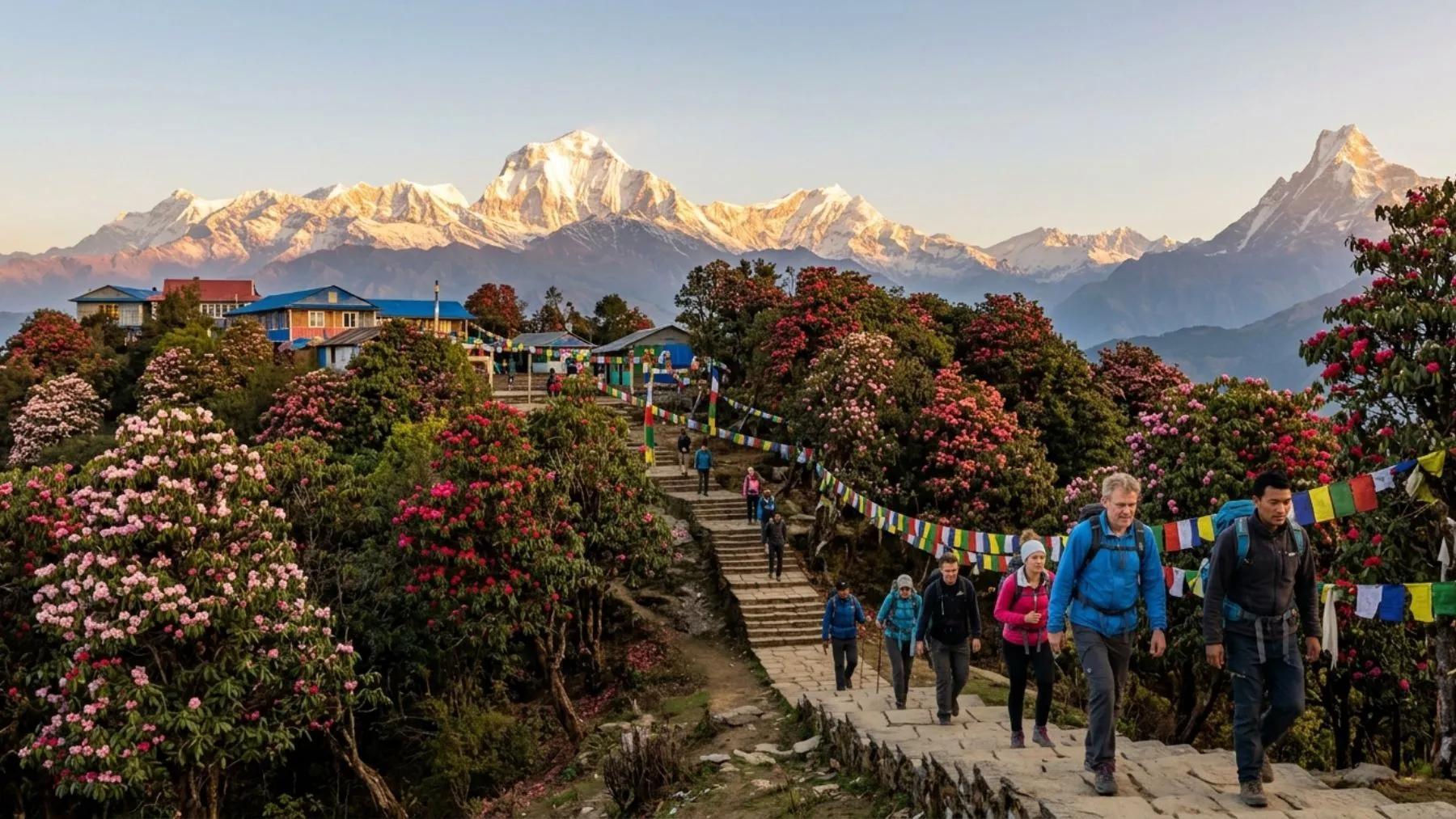
The 12-day Best of Nepal Tour with Poon Hill Trek by Nepal Trip Services brings together Nepal’s culture, Himalayan scenery and wildlife in one well-balanced journey. You’ll start in Kathmandu, exploring the UNESCO World Heritage Sites of Swayambhunath, Pashupatinath, Boudhanath and Kathmandu Durbar Square. Then you’ll head to lakeside Pokhara, the start of a short three-day trek through rhododendron forests and Gurung villages. You’ll climb Poon Hill (3,210 m) at dawn to watch the sun rise over Dhaulagiri, Annapurna South and Machhapuchhre, and visit the traditional village of Ghandruk on your way back. After a boat ride on Phewa Lake, you’ll travel south to Chitwan National Park for a jungle safari, a canoe ride and a chance to spot one-horned rhinos, along with a visit to a Tharu village. Back in Kathmandu, you’ll finish in the medieval cities of Bhaktapur and Patan. With private transport, comfortable hotels, cozy teahouses on the trail and a licensed guide throughout, this easy-to-moderate trip suits first-time trekkers, couples, friends and active families.
Choose the best time for your trek based on weather and trail conditions.
Pleasant trekking weather, blooming rhododendrons, and beautiful Himalayan views.
Monsoon rains bring lush green landscapes, but cloudy skies and slippery trails are common.
The best overall season, with clearer skies, excellent mountain visibility, and comfortable trekking conditions.
Quiet trails and crisp mountain views, but cold mornings, possible snow, and freezing temperatures at higher elevations.
Nepal is a country of striking contrasts. In a single trip, you can wander through ancient temple cities, trek beneath some of the world’s highest mountains and track rhinos through subtropical jungle. The Best of Nepal Tour with Poon Hill Trek by Nepal Trip Services brings all three experiences together in one well-paced 12-day journey. It’s designed for travelers who want more than sightseeing: a real taste of Himalayan trekking, without the long weeks or high altitudes of Nepal’s tougher trails.
Your adventure starts in Kathmandu, where a Nepal Trip Services representative will welcome you at the airport and take you to your hotel. The next day, you’ll explore the heart of the Kathmandu Valley with a licensed local guide.
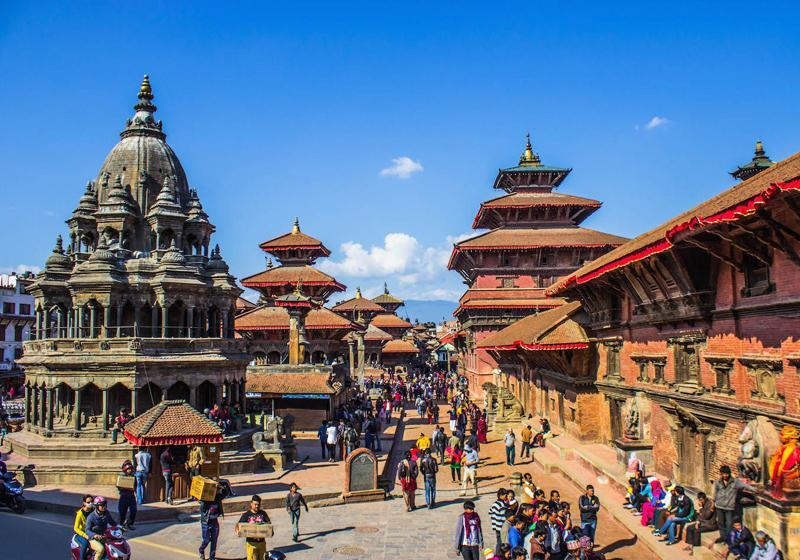
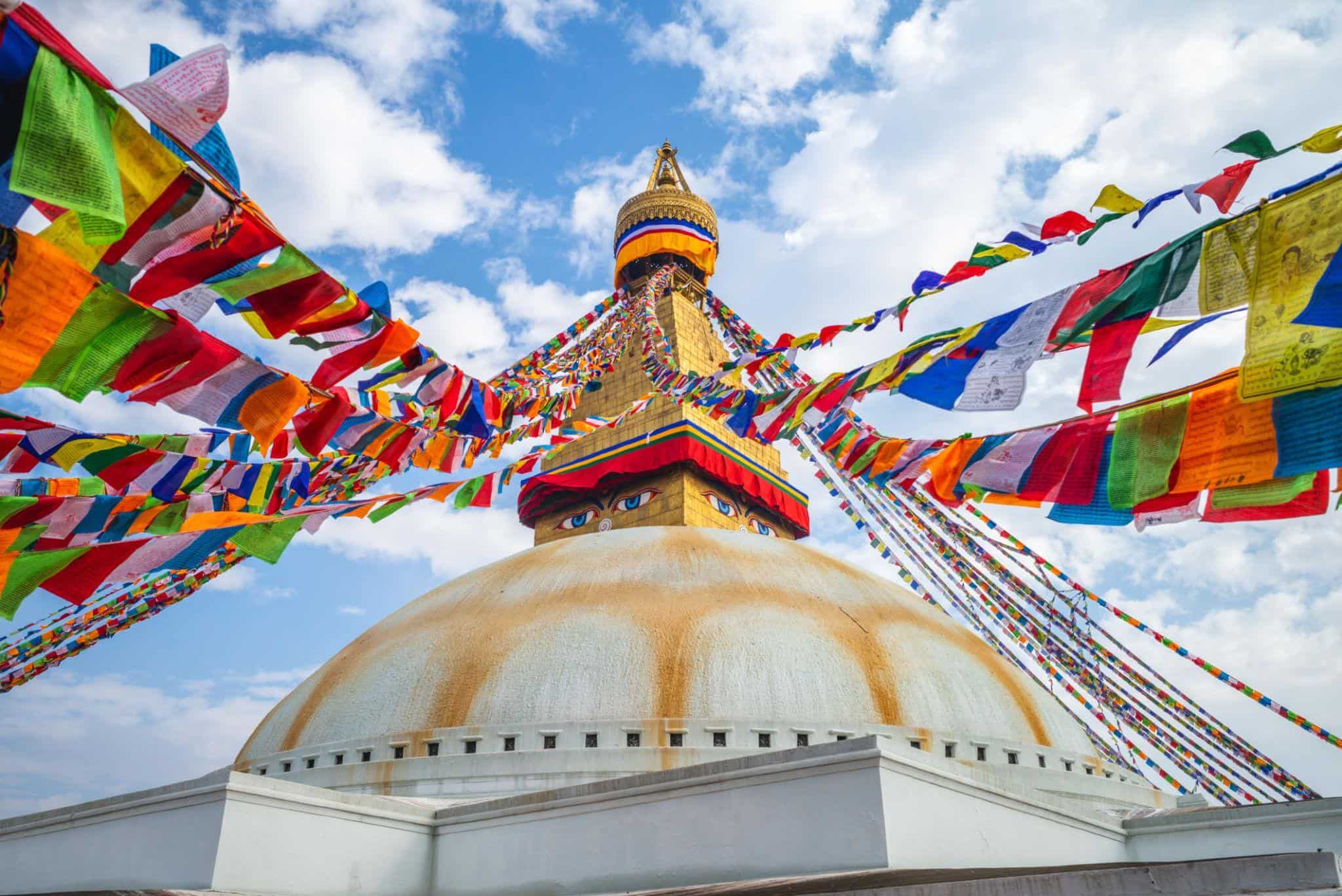
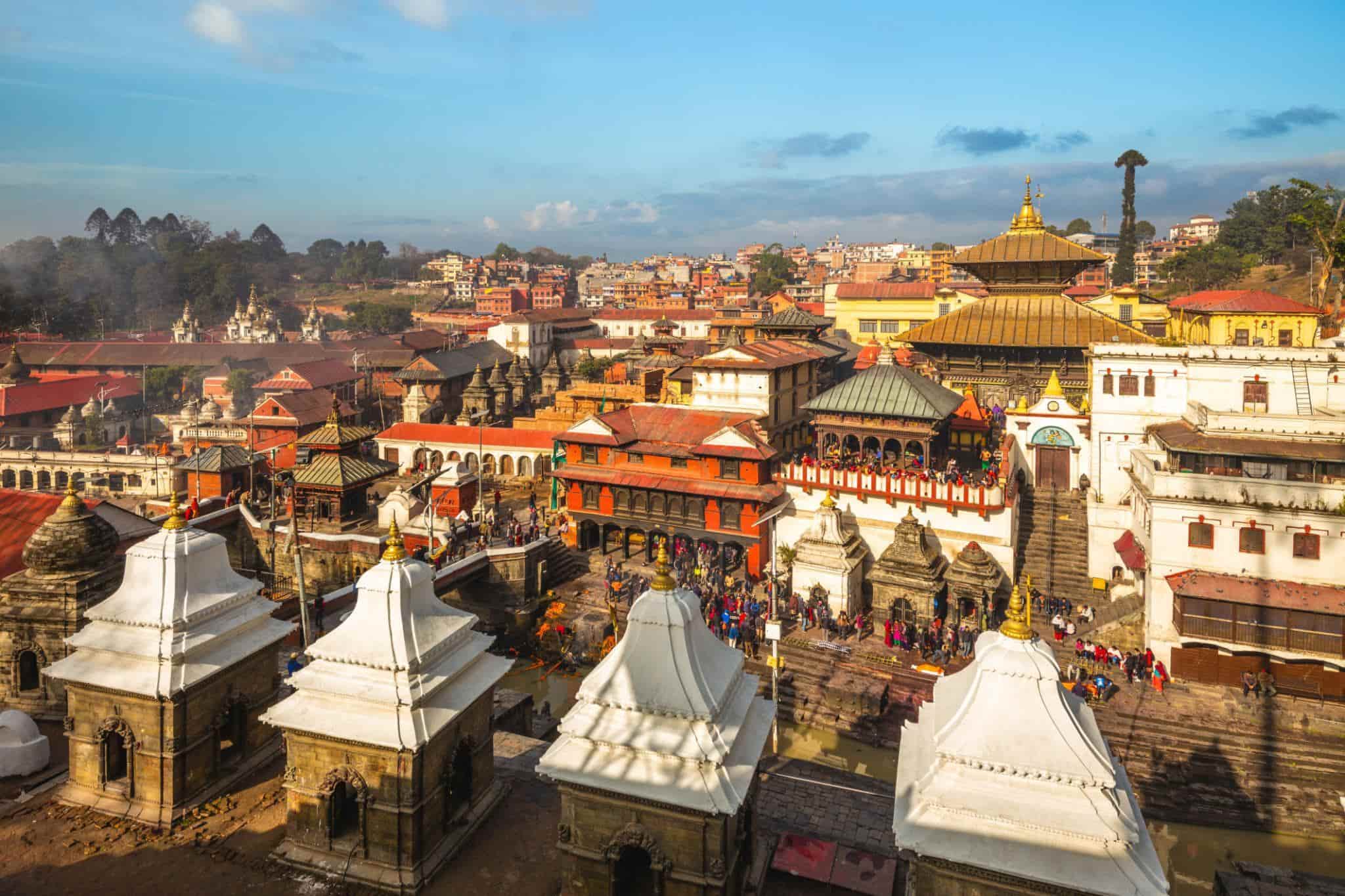
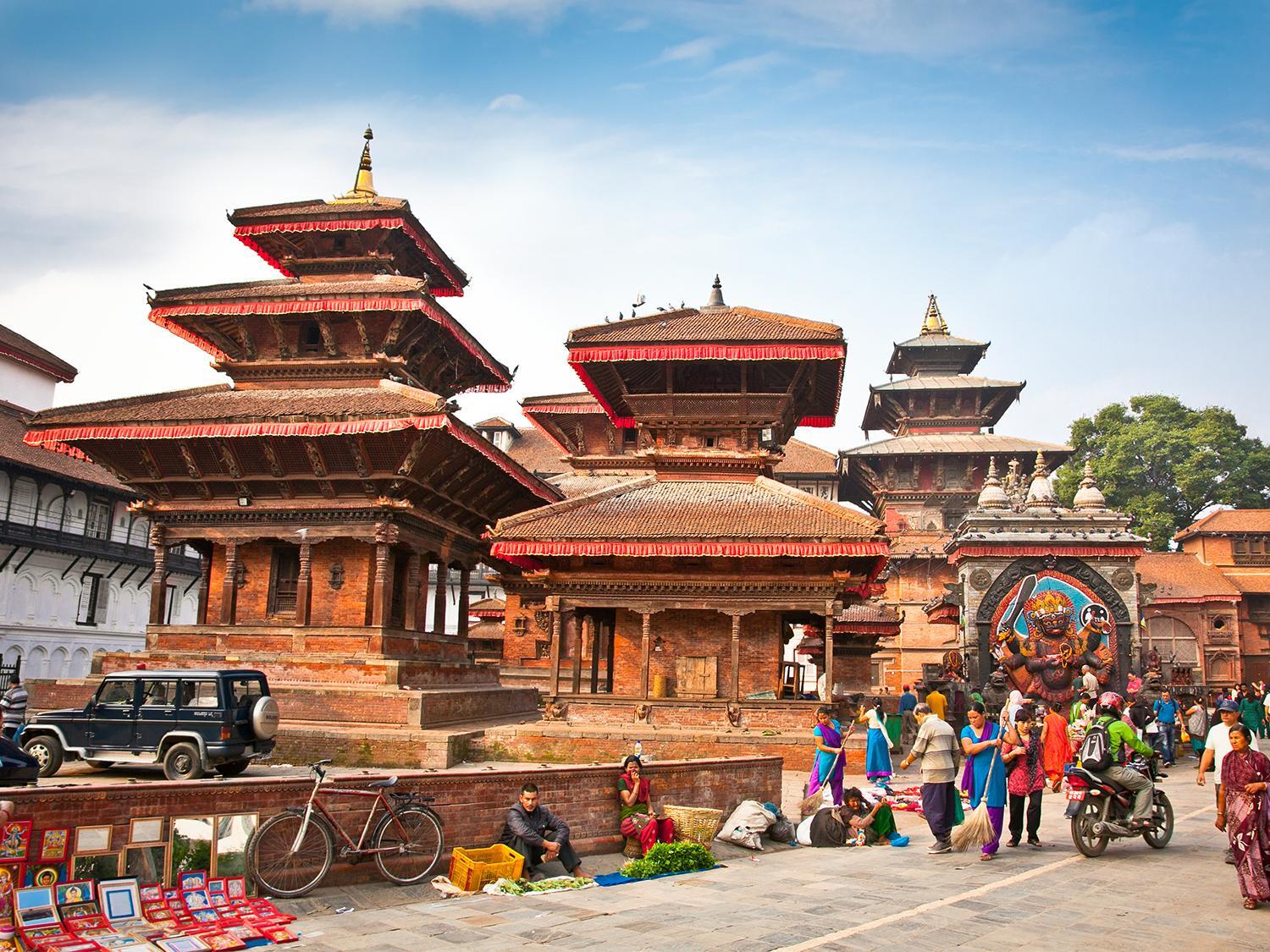
At Swayambhunath, the hilltop “Monkey Temple,” the Buddha’s painted eyes gaze over the city as prayer flags flutter overhead. At Pashupatinath, Nepal’s holiest Hindu temple, you’ll watch ancient rituals unfold along the banks of the sacred Bagmati River. You’ll then join pilgrims circling Boudhanath Stupa, one of the largest stupas in the world. You’ll end the day among the palaces and pagoda temples of Kathmandu Durbar Square, where Nepal’s kings were once crowned. All four are UNESCO World Heritage Sites.
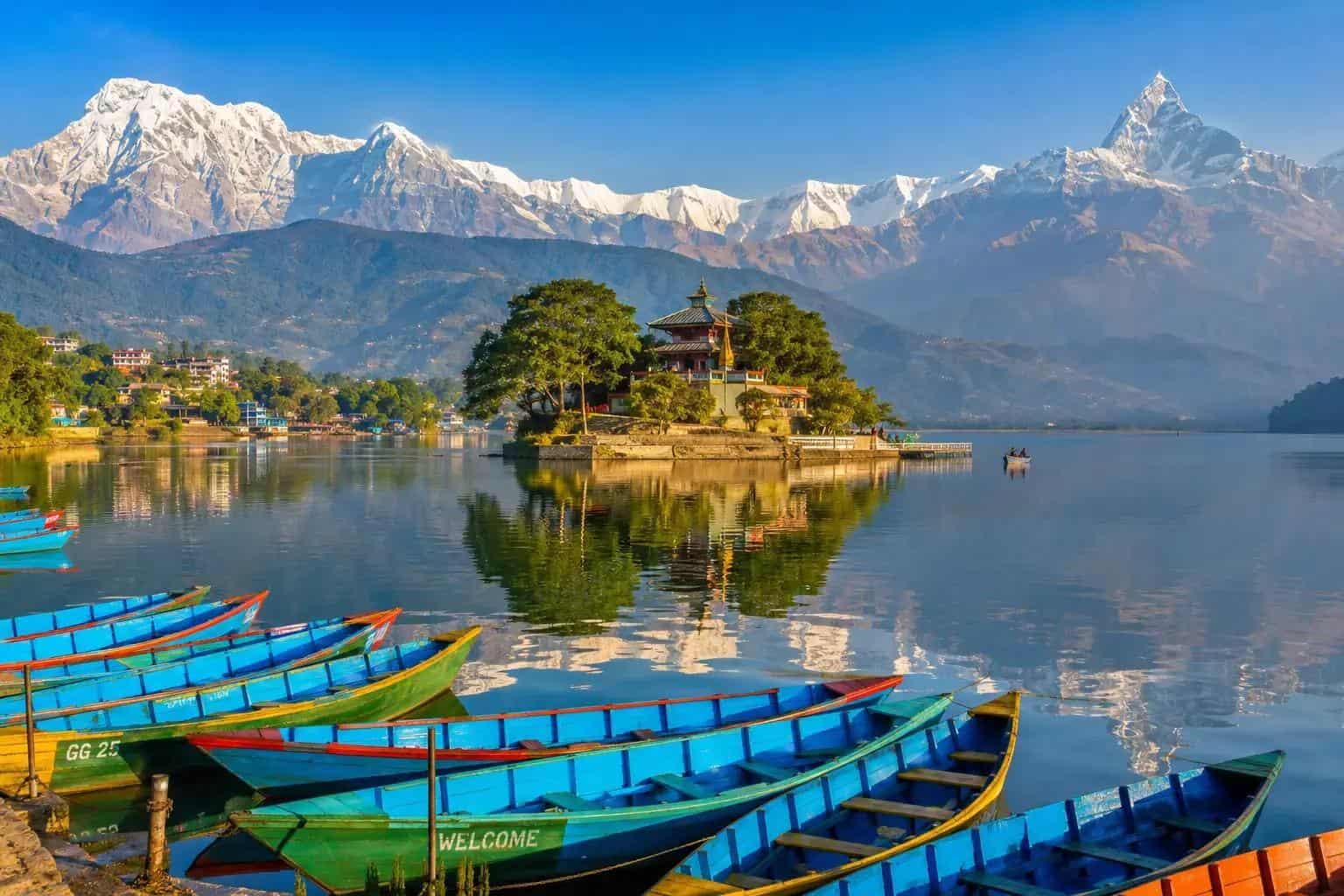
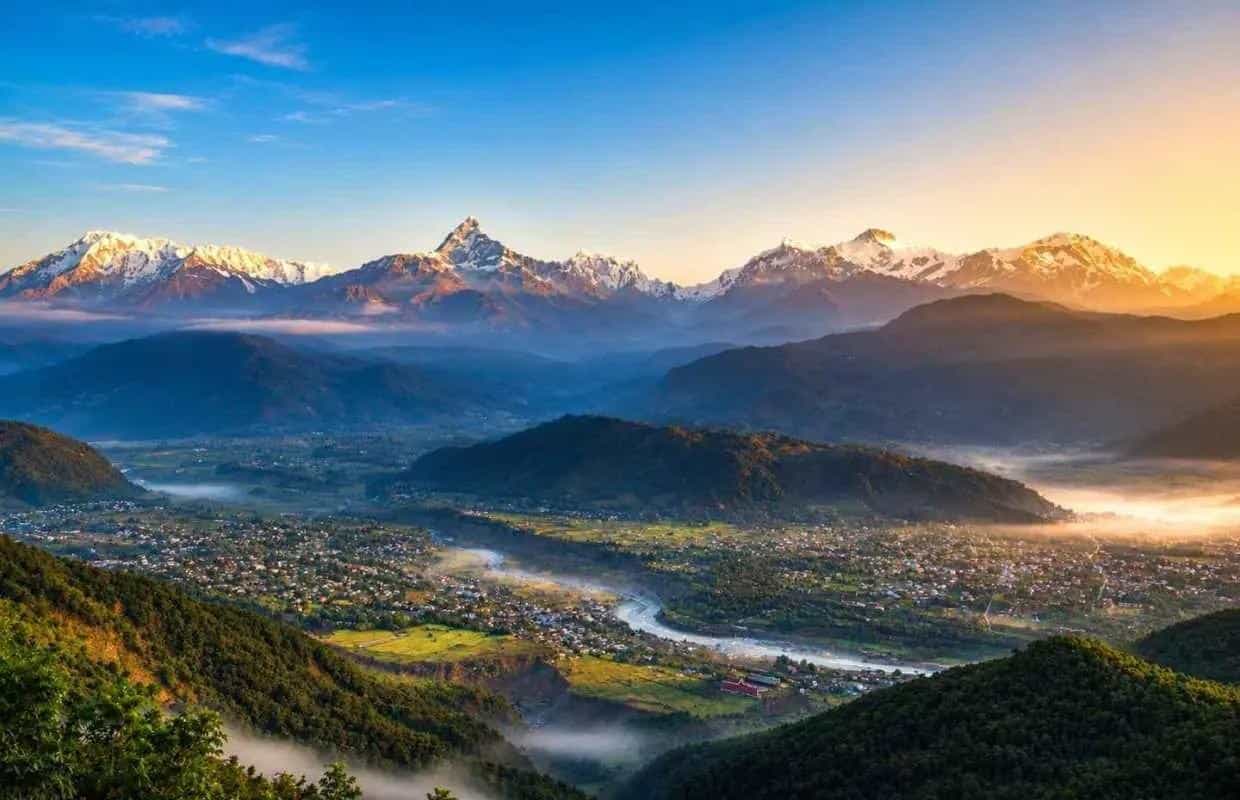
From Kathmandu, you’ll travel west to Pokhara, either on a 25-minute scenic flight or a 6–7 hour drive through river valleys and hillside villages. Set beside Phewa Lake with the Annapurna range rising behind it, Pokhara is Nepal’s most relaxing city and the starting point for your trek.
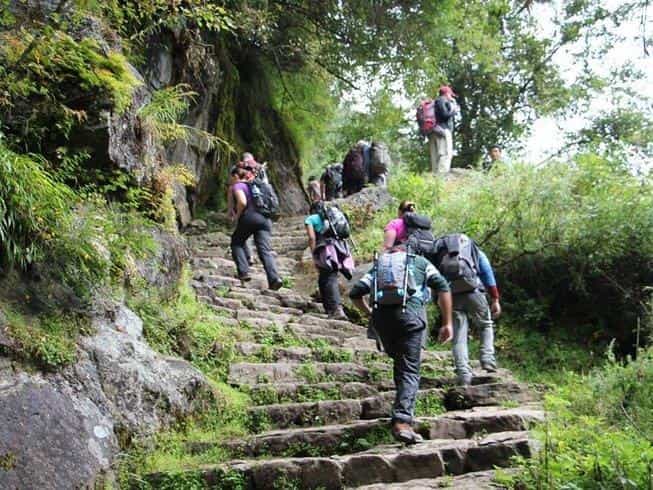
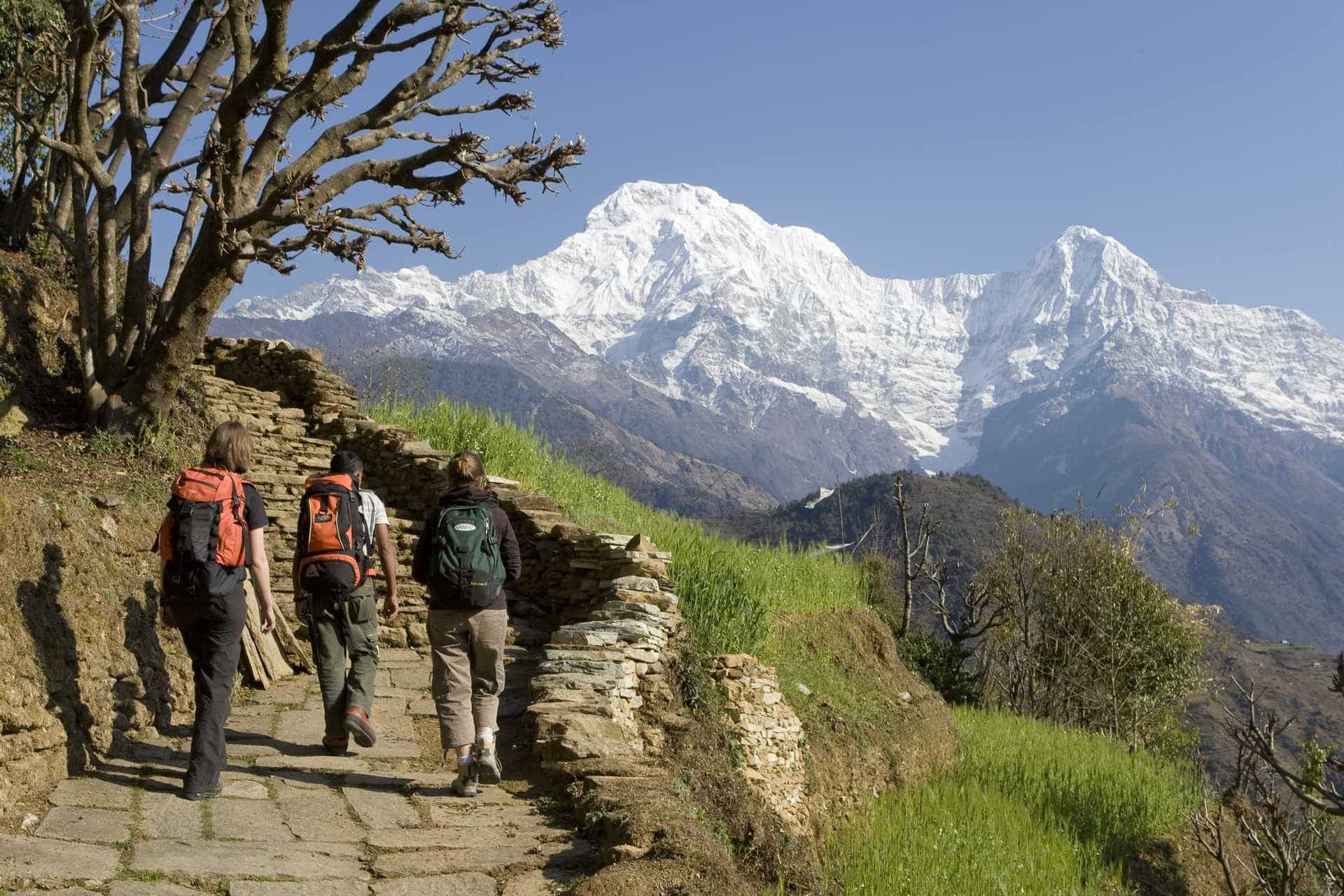
A jeep ride of about 3 to 4 hours takes you from Pokhara up into the hills to Ulleri, a village known for its long stone staircase. From here, you’ll begin trekking through terraced fields and thick forests of rhododendron and oak, climbing steadily for around 4 to 5 hours to Ghorepani (2,860 m). This lively village of colorful teahouses has views of the snowcapped peaks all around.
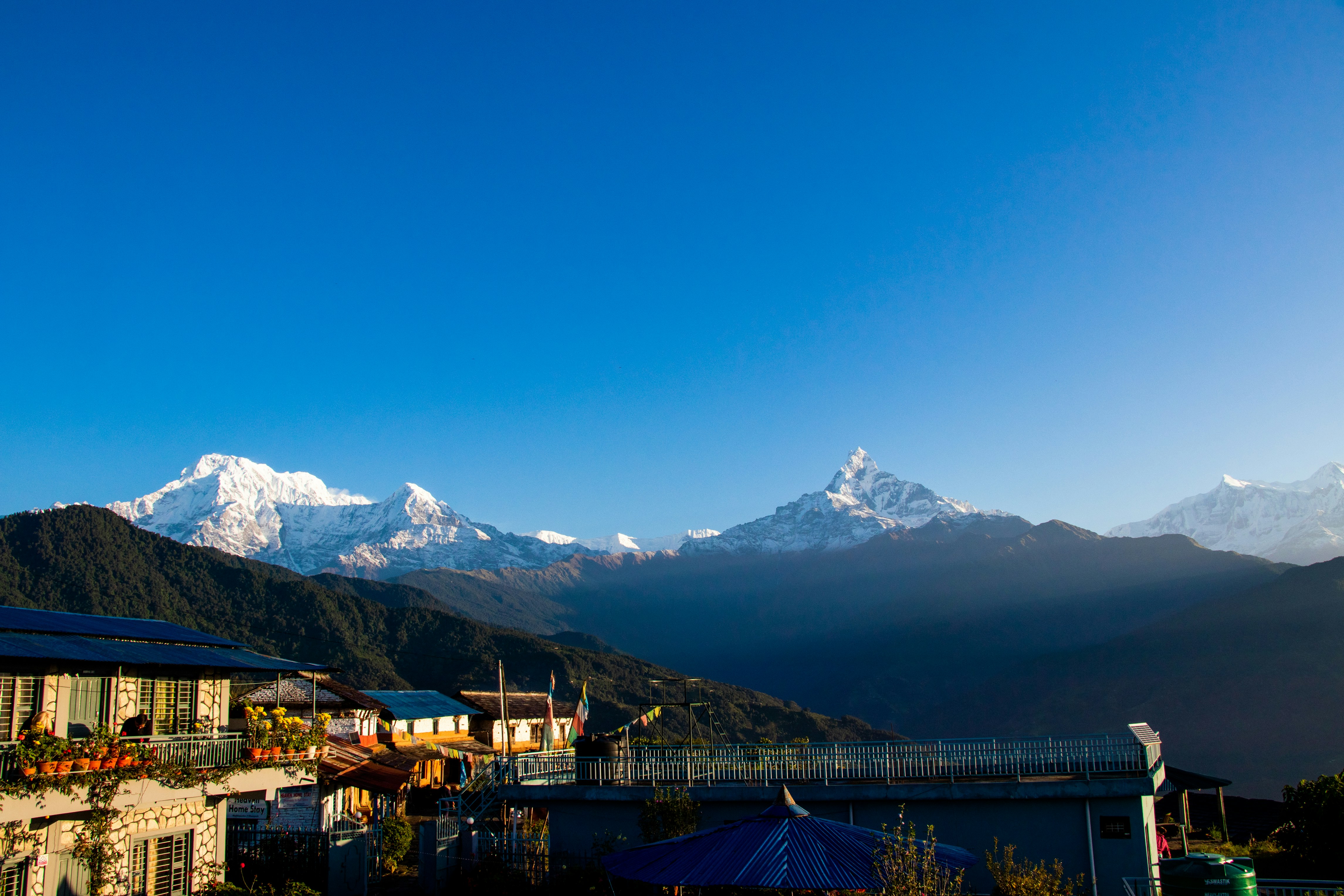
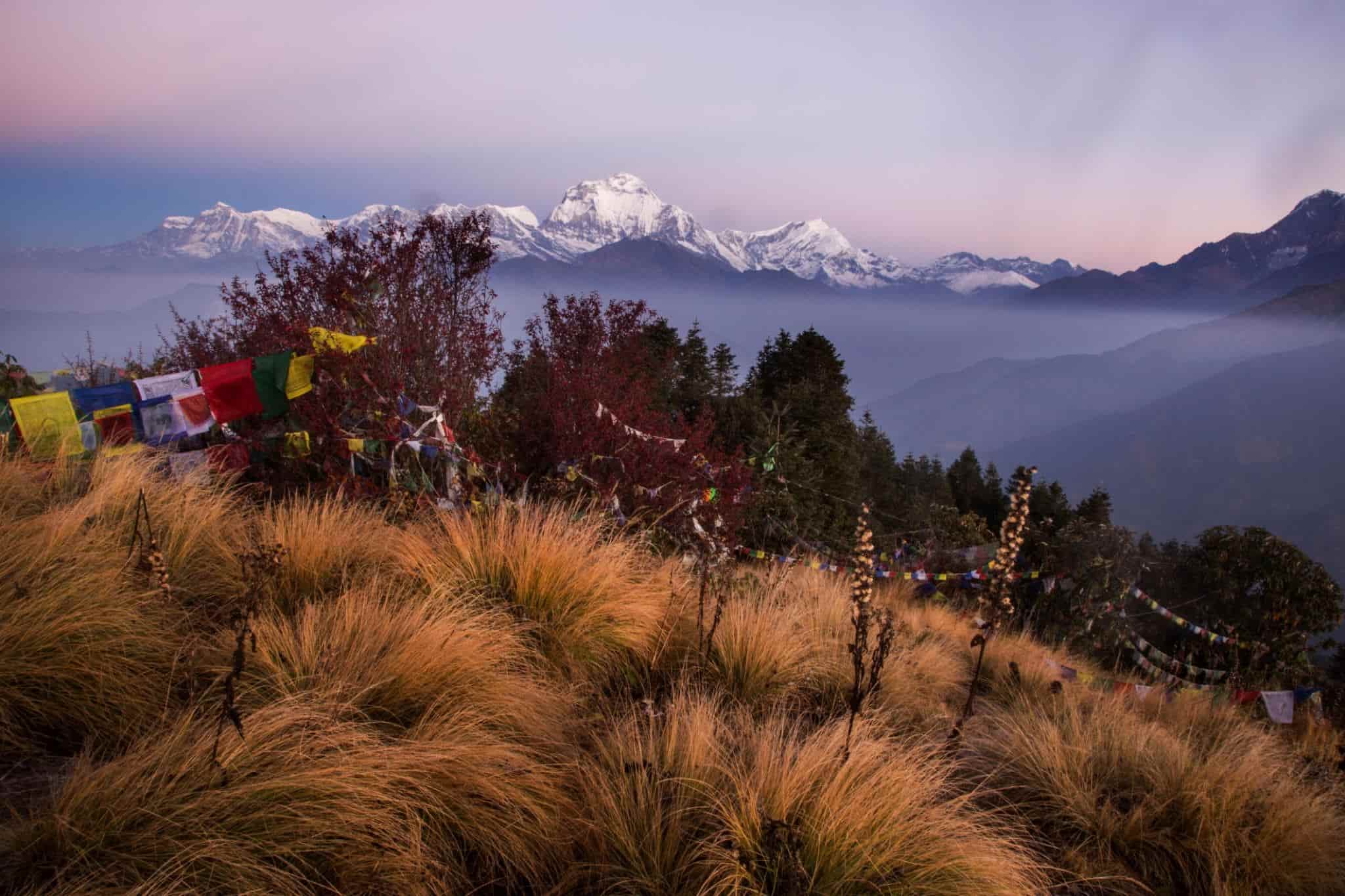
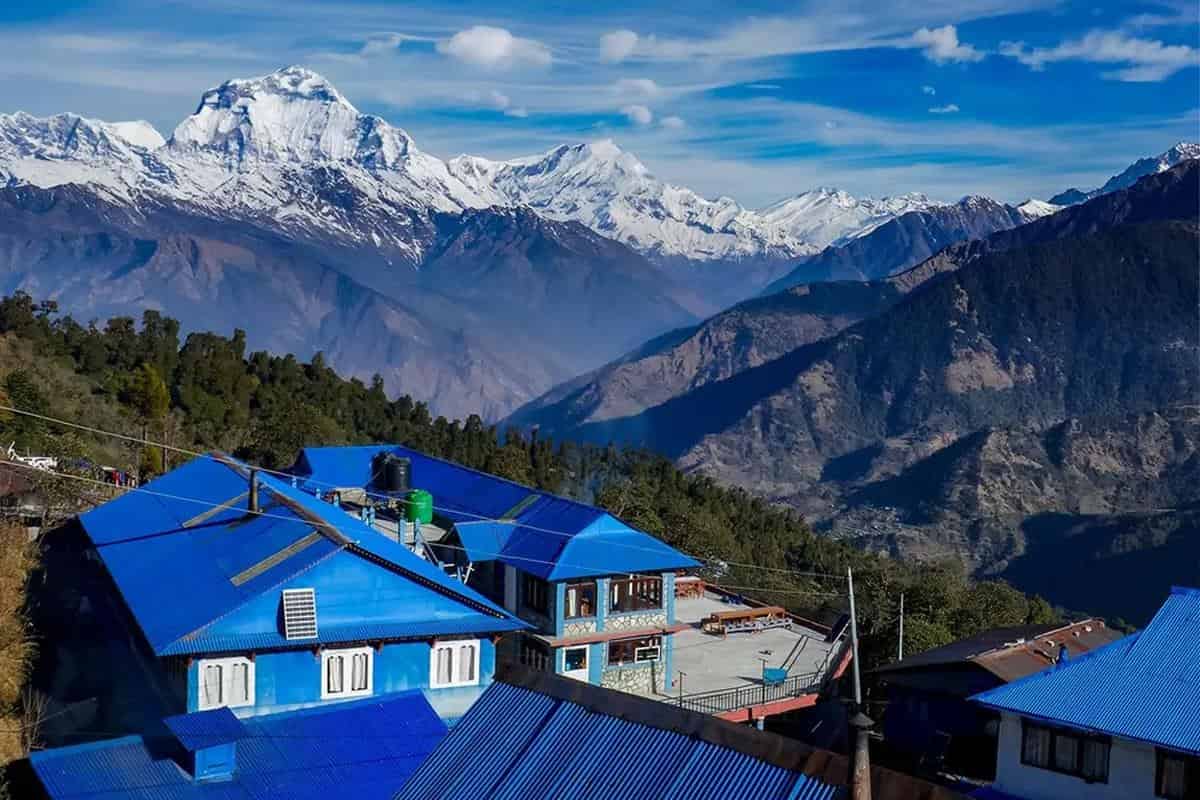
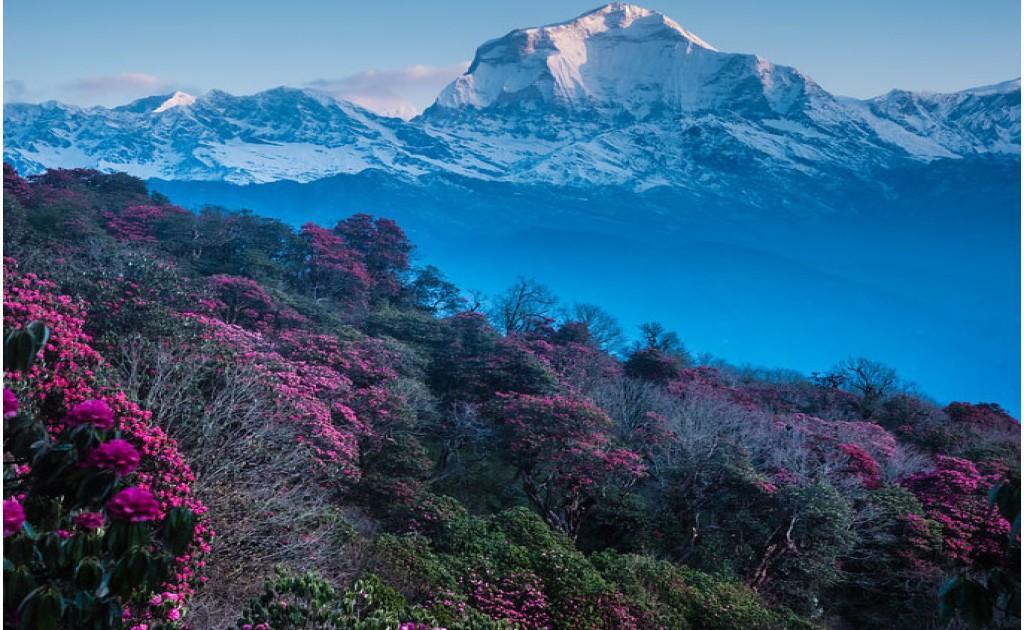
You’ll rise in the dark for the highlight of the trek. A steady climb of about 45 minutes to an hour brings you to the top of Poon Hill (3,210 m), just in time for sunrise. As the sky brightens, more than 20 peaks emerge in a vast panorama, including Dhaulagiri, Tukuche, Nilgiri, Annapurna South, Annapurna I, Hiunchuli and Machhapuchhre (Fishtail). It’s one of the most celebrated sunrise views in Nepal.
After breakfast back in Ghorepani, you’ll continue along a ridge trail through forests and open viewpoints to Tadapani (2,630 m), a peaceful spot facing the Annapurna range. This is the longest walking day, at around 5 to 6 hours.
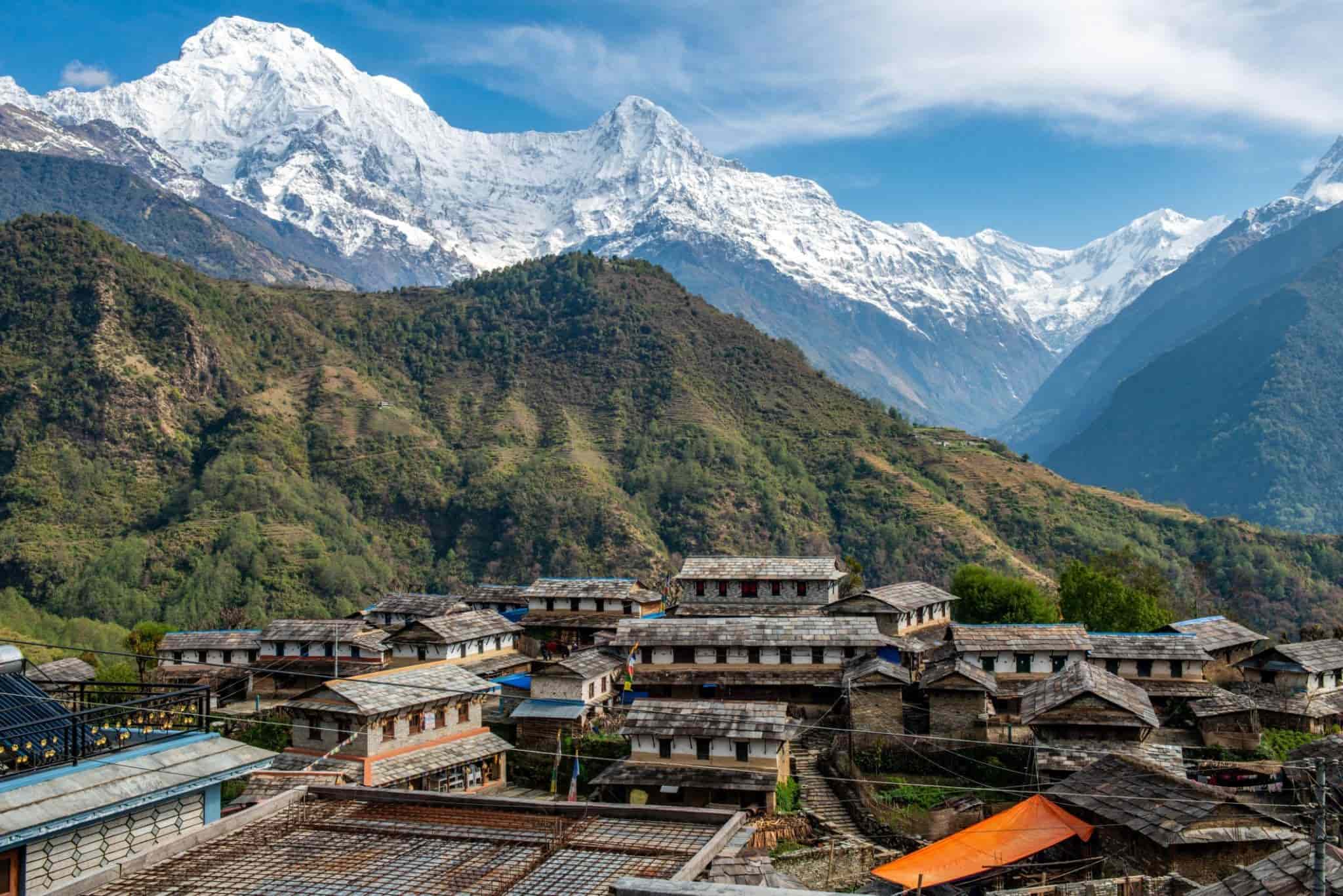
A shorter walk of about 2 to 3 hours leads downhill to Ghandruk (1,940 m), one of the largest and most beautiful Gurung villages in the Annapurna region. Its stone-paved lanes, slate-roofed houses and close-up views of Annapurna South and Machhapuchhre make it a perfect place to experience local mountain culture. From Ghandruk, you’ll drive back to Pokhara for a well-earned rest.
Throughout the trek, you’ll stay in cozy teahouses, simple mountain lodges serving warm meals such as dal bhat, noodles and soup. Experienced porters carry your main luggage, so you only need a light daypack.
After the trek, you’ll enjoy a relaxed day of sightseeing in Pokhara. You’ll take a peaceful boat ride on Phewa Lake to the island temple of Tal Barahi and enjoy some of the city’s highlights with your guide. In the evening, you can stroll along Lakeside, with its cafés, shops and views over the water.
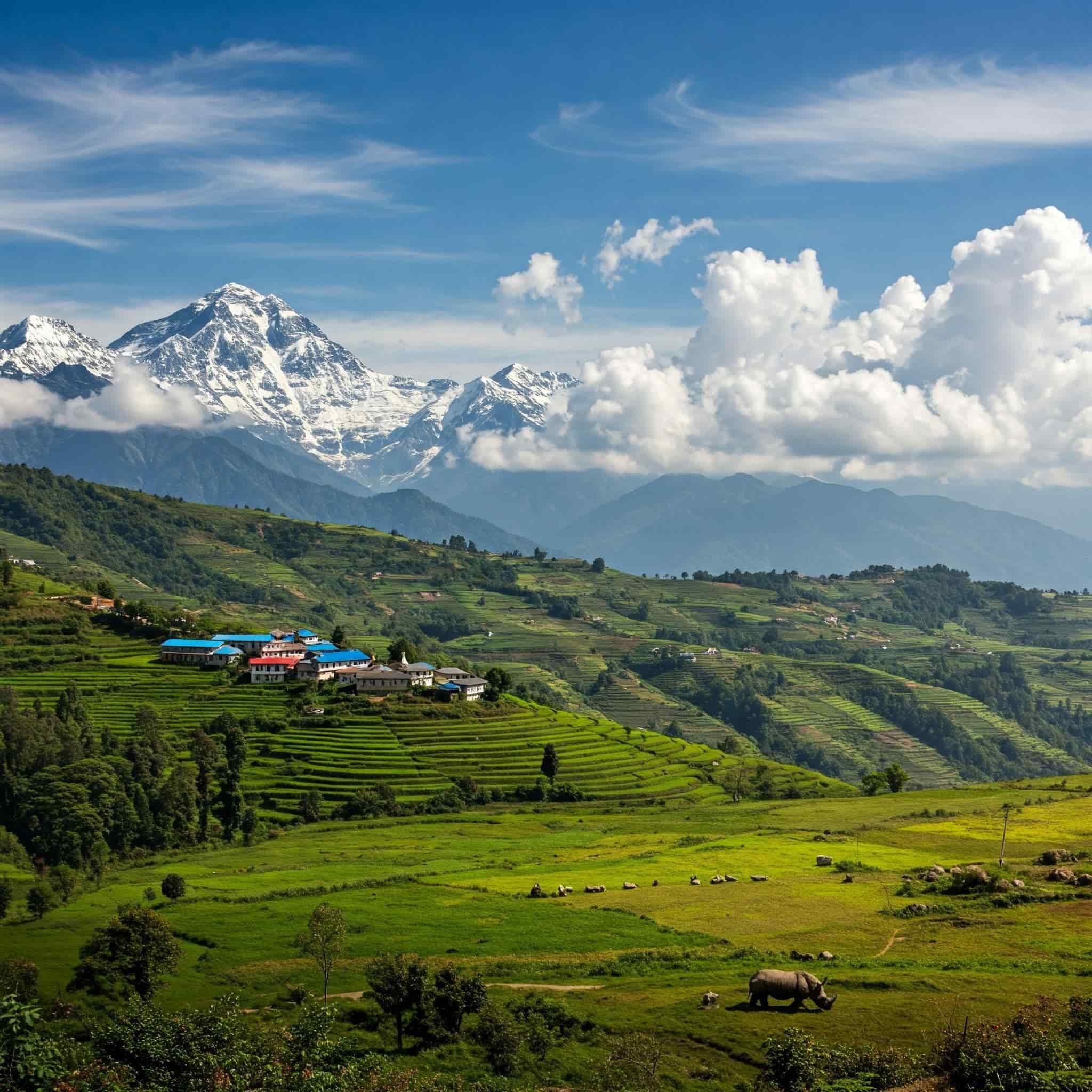
From Pokhara, you’ll drive south for about 5 hours to Chitwan National Park, as the mountains give way to the warm, green plains of the Terai. Chitwan is Nepal’s first national park and a UNESCO World Heritage Site, home to the one-horned rhinoceros, Bengal tigers, leopards, crocodiles and more than 500 species of birds.
After settling into your jungle lodge, you’ll visit a Tharu village to learn about the culture and traditions of the region’s indigenous people. The next day, you’ll set off on a jeep safari into the park in search of rhinos, deer and other wildlife, and glide along the Rapti River on a traditional dugout canoe, watching for crocodiles and colorful birds along the banks.
A short flight from Bharatpur to Kathmandu brings you back to the valley. In the afternoon, you’ll explore Bhaktapur, the best-preserved medieval city in Nepal, known for its royal square, the five-story Nyatapola Temple, Pottery Square and its famous juju dhau (king curd).
The following day takes you to Patan, the “City of Fine Arts,” with its elegant Durbar Square, beautifully carved temples and skilled metalworkers and woodcarvers. The rest of the day is free for shopping, relaxing or exploring Thamel. At the end of your journey, you’ll transfer to the airport for your flight home.
This tour offers a rare balance of culture, adventure and wildlife. In 12 days, you’ll visit seven UNESCO World Heritage Sites in the Kathmandu Valley and Chitwan. You’ll also trek through the Annapurna foothills, watch sunrise over the Himalayas from Poon Hill and come face to face with rhinos in the jungle.
The trek is short and graded easy to moderate. Walking days last about 4 to 6 hours, and the highest point is 3,210 m at Poon Hill, so altitude isn’t usually a concern for healthy travelers. No previous trekking experience is needed, which makes this a good choice for first-time trekkers, couples, friends and active families with reasonable fitness.
You’ll travel with a licensed English-speaking guide throughout, with porters on the trek and private transport for all road journeys. You’ll stay in comfortable 3-star hotels in Kathmandu and Pokhara, cozy teahouses on the trail and a jungle lodge in Chitwan. Your ACAP permit, TIMS card and entrance fees are all arranged for you. Because this is a private trip, you can also add extra days, upgrade your hotels or include extras such as paragliding in Pokhara or an Everest Base Camp Helicopter Tour.
The best seasons are autumn (October to November) and spring (March to April). Autumn brings the clearest skies and sharpest mountain views from Poon Hill. In spring, the forests around Ghorepani are covered in red and pink rhododendron blooms, and wildlife sightings in Chitwan are at their best. Winter (December to February) is quieter, with clear views, but nights in Ghorepani are cold and snow is possible. During the monsoon (June to August), the trails are lush and green but often wet, leeches are common and clouds may hide the mountains.
If you want to see the very best of Nepal in one journey, this tour gives you ancient temples, Himalayan sunrises and jungle adventures in just 12 days. Plan your trip with our Trip Planner or Contact Us, and the Nepal Trip Services team will tailor the journey to your travel style.
| Trip Info | Details |
|---|---|
| Altitude | Kathmandu: 1,400 m (4,593 ft) |
| Transfer | Airport to hotel, about 6 km (20–30 minutes) |
| Meals | Not included |
| Accommodation | 3-star hotel in Kathmandu |
Welcome to Nepal! As your flight descends into the Kathmandu Valley, you may catch your first glimpse of the Himalayas on the northern horizon. After you clear immigration and collect your luggage at Tribhuvan International Airport, a Nepal Trip Services representative will greet you in the arrival hall and take you to your hotel in a private vehicle.
Once you’ve checked in, take time to rest after your journey. Later in the day, your guide will meet you for a short briefing about the tour, the trek, local customs and what to expect over the next 12 days. It’s also a good chance to check your trekking gear. If you’re missing anything, Thamel’s many outdoor shops are just a short walk away. In the evening, explore the lively streets of Thamel, full of cafés, restaurants and colorful prayer flags.
| Trip Info | Details |
|---|---|
| Altitude | Kathmandu: 1,400 m (4,593 ft) / Swayambhunath: about 1,420 m (4,659 ft) |
| Sightseeing | About 25 km of driving around the valley |
| Duration | Full day (6–7 hours) |
| Meals | Breakfast |
| Accommodation | 3-star hotel in Kathmandu |
After breakfast, set out with your licensed guide to explore four of the Kathmandu Valley’s UNESCO World Heritage Sites.
Begin at Swayambhunath Stupa, the famous “Monkey Temple,” set on a hilltop west of the city. Climb the steps past prayer wheels, shrines and playful monkeys to the great white stupa, where the painted eyes of the Buddha look out in all four directions. The views across Kathmandu are wonderful, especially in the morning light.
Next, visit Kathmandu Durbar Square, the old royal palace complex in the heart of the city. Wander among pagoda temples, carved wooden windows and quiet courtyards. If you’re lucky, you’ll catch a glimpse of the Kumari, Nepal’s living goddess, at her ornate home, the Kumari Ghar.
In the afternoon, head to Pashupatinath Temple, Nepal’s holiest Hindu shrine, on the banks of the sacred Bagmati River. Only Hindus may enter the main temple, but you can explore the wider complex, see wandering sadhus (holy men) and respectfully watch ancient rituals from the opposite bank.
End the day at Boudhanath Stupa, one of the largest stupas in the world and the heart of Tibetan Buddhism in Nepal. Join pilgrims as they walk clockwise around the stupa, spinning prayer wheels as monks chant in the surrounding monasteries. A rooftop café overlooking the stupa is the perfect place to watch the sunset before returning to your hotel.
| Trip Info | Details |
|---|---|
| Altitude | Pokhara: 822 m (2,697 ft) |
| By road | About 200 km, 6–7 hours by private vehicle |
| By air (optional) | About 25 minutes |
| Meals | Breakfast |
| Accommodation | 3-star hotel in Pokhara |
After breakfast, travel west to Pokhara, the gateway to the Annapurna region.
By road: Your private vehicle follows the Prithvi Highway out of the Kathmandu Valley and along the Trishuli River for much of the way. You’ll pass terraced farmland, riverside towns and hillside villages, with stops for tea, lunch and photos. As you get closer to Pokhara, the Annapurna range appears on the horizon.
By air (optional, at extra cost): A 25-minute scenic flight offers views of the Ganesh Himal, Manaslu and Annapurna ranges from the right-hand side of the plane on clear days.
On arrival, check into your hotel in the Lakeside area. Spend the rest of the day relaxing by Phewa Lake or strolling along the lakeside promenade. In the evening, your guide will go over the trek plan with you. Pack a small bag for the trek and leave your extra luggage safely at the hotel.
| Trip Info | Details |
|---|---|
| Altitude | Ulleri: about 2,070 m (6,791 ft) / Ghorepani: 2,860 m (9,383 ft) |
| Drive | Pokhara to Ulleri, about 55–60 km by private jeep (3–4 hours) |
| Trek | Ulleri to Ghorepani, about 7–8 km (4–5 hours) |
| Meals | Breakfast, Lunch & Dinner |
| Accommodation | Teahouse in Ghorepani |
After an early breakfast, meet your porters and set off by private jeep from Pokhara. The road passes through Nayapul and winds up along the Bhurungdi River valley to Ulleri, a village set on a steep hillside and known for its long stone staircase. The final stretch of road is rough and bumpy, but the views are well worth it.
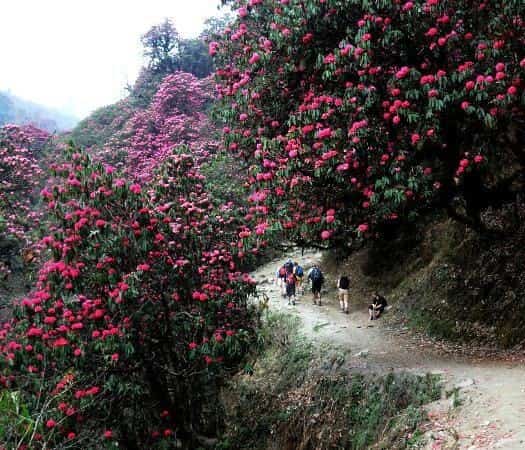
From Ulleri, your trek begins. The trail climbs steadily through terraced fields and small villages, then enters thick forests of rhododendron, oak and magnolia. In spring, the rhododendrons burst into red, pink and white blooms. After a lunch stop at Banthanti or Nangethanti, continue climbing gently through the forest to Ghorepani (2,860 m).
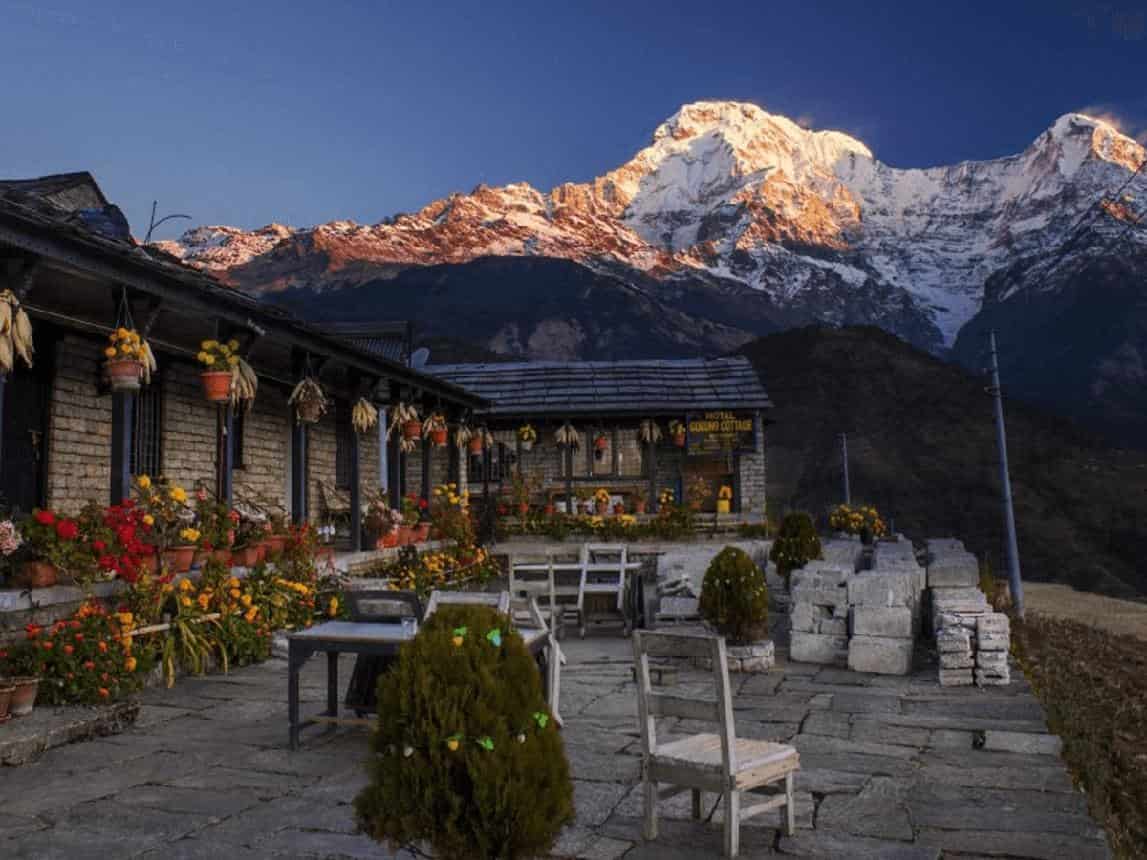
Ghorepani is a lively village of colorful teahouses, with views of Dhaulagiri and Annapurna South on clear evenings. Settle into your teahouse, warm up by the fire and enjoy a hearty dinner. Go to bed early, as tomorrow begins before dawn.
| Trip Info | Details |
|---|---|
| Altitude | Poon Hill: 3,210 m (10,531 ft) / Deurali Pass: about 3,100 m (10,171 ft) / Tadapani: 2,630 m (8,629 ft) |
| Poon Hill hike | About 1.5 km each way (45 minutes–1 hour up) |
| Trek | Ghorepani to Tadapani, about 10 km (5–6 hours) |
| Meals | Breakfast, Lunch & Dinner |
| Accommodation | Teahouse in Tadapani |
Rise at around 4:30–5:00 am and climb with a headlamp along a stone stairway through the forest to the top of Poon Hill (3,210 m), the highest point of your trip.
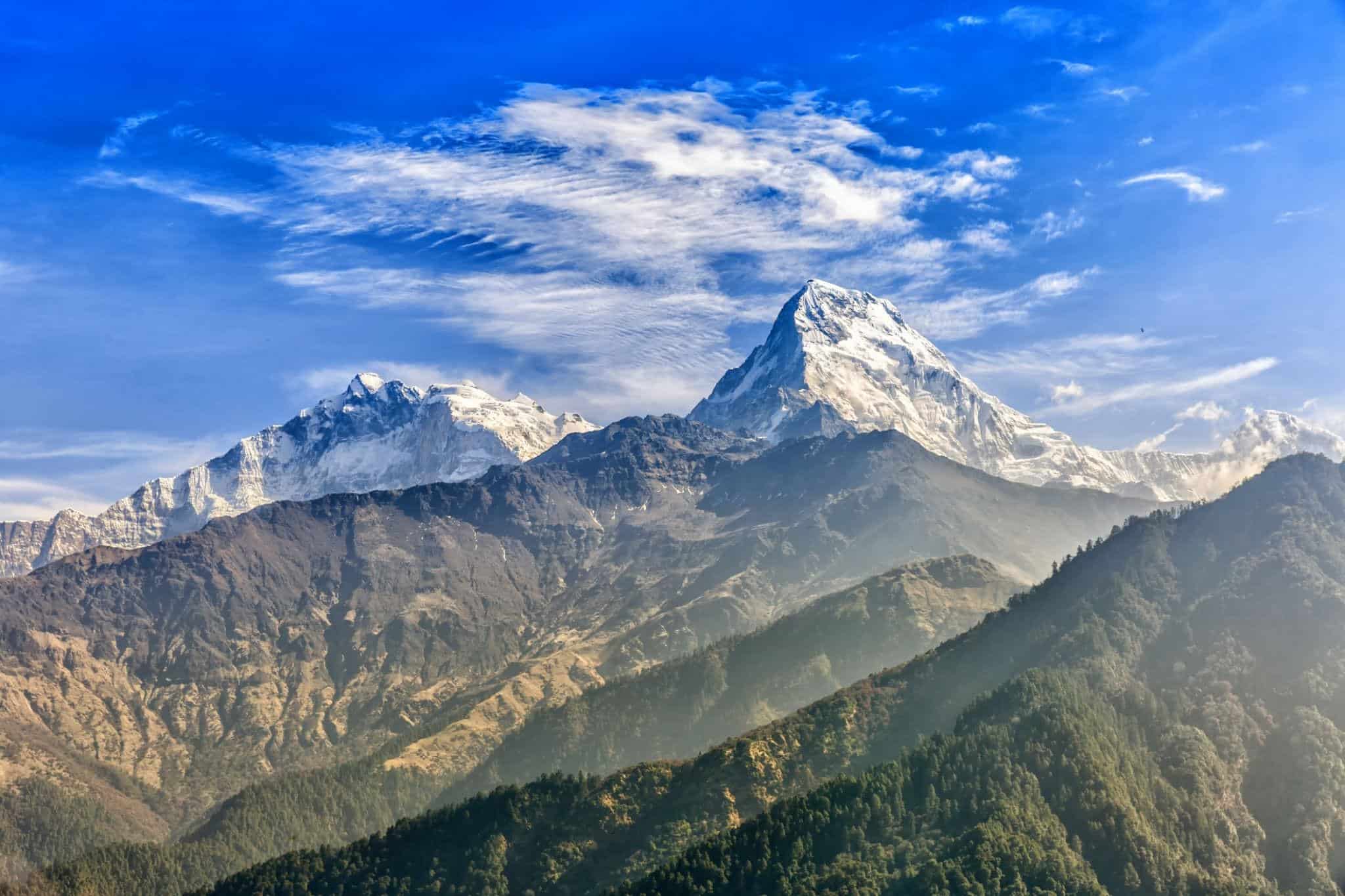
As the sky turns from deep blue to pink and gold, a sweeping Himalayan panorama comes to life. You’ll see more than 20 peaks, including Dhaulagiri (8,167 m), Tukuche Peak, Nilgiri, Annapurna South, Annapurna I (8,091 m), Hiunchuli and the sharp, pyramid-shaped Machhapuchhre (Fishtail). On clear mornings, you’ll also look down over the deep Kali Gandaki Valley, one of the deepest gorges in the world. It’s a moment many travelers remember for a lifetime.
Return to Ghorepani for a warm breakfast, then set off toward Tadapani. The trail climbs to the Deurali Pass (about 3,100 m), with more wonderful mountain views along the ridge. It then drops through peaceful rhododendron forests, past streams and small waterfalls. This is the longest walking day of the trek, but the varied scenery makes the hours pass quickly.
You’ll reach Tadapani (2,630 m) in the afternoon. This quiet forest settlement faces Annapurna South and Machhapuchhre, which glow beautifully at sunset.
| Trip Info | Details |
|---|---|
| Altitude | Tadapani: 2,630 m (8,629 ft) / Ghandruk: 1,940 m (6,365 ft) / Pokhara: 822 m (2,697 ft) |
| Trek | Tadapani to Ghandruk, about 5 km (2–3 hours) |
| Drive | Ghandruk to Pokhara, about 50 km by private jeep (2.5–3 hours) |
| Meals | Breakfast & Lunch |
| Accommodation | 3-star hotel in Pokhara |
Wake up early for a last sunrise over Annapurna South and Machhapuchhre from Tadapani. After breakfast, trek gently downhill through rhododendron and oak forests, then past terraced fields, to Ghandruk (1,940 m), one of the largest and most beautiful Gurung villages in the Annapurna region.
Spend some time exploring Ghandruk’s stone-paved lanes, slate-roofed houses and small courtyards. Many men from Ghandruk and the surrounding villages have served as Gurkha soldiers. You can visit a small local museum to learn about Gurung culture and traditions, and enjoy close-up views of Annapurna South, Hiunchuli and Machhapuchhre.
After lunch in Ghandruk, say goodbye to your porters and board a private jeep back to Pokhara. Check into your hotel, enjoy a hot shower and celebrate the end of your trek with dinner by Phewa Lake.
| Trip Info | Details |
|---|---|
| Altitude | Pokhara: 822 m (2,697 ft) / World Peace Pagoda: about 1,100 m (3,609 ft) |
| Sightseeing | About 30–40 km of driving |
| Duration | Half to full day (5–6 hours) |
| Meals | Breakfast |
| Accommodation | 3-star hotel in Pokhara |
After a relaxed breakfast, set out for a day of sightseeing in Pokhara.
Start with a peaceful boat ride on Phewa Lake in a traditional wooden boat. Glide across the calm water to the Tal Barahi Temple, a two-story pagoda temple dedicated to the goddess Durga, set on a small island in the lake.
Then drive up to the World Peace Pagoda, a gleaming white Buddhist stupa high on a ridge above the lake, with sweeping views of Pokhara, Phewa Lake and the Annapurna range. Continue to Davis Falls, where the water plunges into an underground tunnel, and step inside the nearby Gupteshwor Mahadev Cave, home to a sacred Shiva shrine. You’ll also stop at the Seti River Gorge, where the milky-white river rushes through a deep, narrow channel.
The rest of the afternoon is free to relax at your hotel, browse the shops and cafés of Lakeside, or try an optional adventure such as tandem paragliding, zip flying or an ultralight flight (at extra cost).
| Trip Info | Details |
|---|---|
| Altitude | Chitwan (Sauraha): about 200 m (656 ft) |
| Drive | Pokhara to Chitwan, about 150 km by private vehicle (about 5 hours) |
| Meals | Breakfast, Lunch & Dinner |
| Accommodation | Jungle lodge near Chitwan National Park |
After breakfast, leave Pokhara and drive south through green hills and river valleys. The road follows the Seti and Trishuli rivers before descending into the warm, flat plains of the Terai. You’ll notice the change in climate as rice fields, mustard fields and banana trees replace the mountain terraces.
On arrival at your jungle lodge, enjoy a welcome drink and lunch, then take some time to relax. In the late afternoon, join a local naturalist for a walk through a nearby Tharu village. The Tharu are the indigenous people of the Terai, and you’ll learn about their traditional mud-and-thatch homes, farming life and centuries-old relationship with the jungle. If you like, you can also stroll to the banks of the Rapti River to watch the sun set over the national park. Enjoy dinner at the lodge in the evening.
| Trip Info | Details |
|---|---|
| Altitude | Chitwan (Sauraha): about 200 m (656 ft) |
| Activities | Canoe ride on the Rapti River and jeep safari in Chitwan National Park |
| Duration | Full day |
| Meals | Breakfast, Lunch & Dinner |
| Accommodation | Jungle lodge near Chitwan National Park |
Today is all about wildlife in Chitwan National Park, Nepal’s first national park and a UNESCO World Heritage Site.
Start the morning with a peaceful canoe ride on the Rapti River in a traditional dugout canoe. As the mist lifts off the water, look for mugger crocodiles and the rare, long-snouted gharial basking on the sandbanks, along with kingfishers, egrets, storks and many other birds.
After lunch at the lodge, set off on a jeep safari deep into the park, through tall grasslands, sal forests and riverine jungle. This is your best chance to spot the endangered one-horned rhinoceros, along with spotted deer, sambar deer, wild boar and monkeys. With patience and a little luck, you may even see a sloth bear, a leopard or the elusive Bengal tiger. Return to the lodge in the evening for dinner and your final night in the jungle.
| Trip Info | Details |
|---|---|
| Altitude | Kathmandu: 1,400 m (4,593 ft) / Bhaktapur: about 1,400 m (4,593 ft) |
| Transfer | Lodge to Bharatpur Airport, about 15 km (30 minutes) |
| Flight | Bharatpur to Kathmandu, about 25 minutes |
| Drive | Kathmandu Airport to Bhaktapur, about 12 km (30–45 minutes) |
| Meals | Breakfast |
| Accommodation | 3-star hotel in Kathmandu |
Enjoy a final breakfast in the jungle. Early risers can take an optional bird-watching walk near the lodge. You’ll then transfer to Bharatpur Airport for a short, scenic flight back to Kathmandu, with views of the hills and, on clear days, the Himalayas to the north.
On arrival in Kathmandu, drive east to Bhaktapur, the “City of Devotees” and the best-preserved medieval city in the Kathmandu Valley. Explore Bhaktapur Durbar Square with its famous 55-Window Palace and Golden Gate. Then visit Taumadhi Square, home to the five-story Nyatapola Temple, and Pottery Square, where artisans shape clay pots by hand. Don’t miss a cup of juju dhau, Bhaktapur’s famous creamy “king curd.” In the late afternoon, return to your hotel in Kathmandu.
| Trip Info | Details |
|---|---|
| Altitude | Kathmandu & Patan: 1,400 m (4,593 ft) |
| Sightseeing | About 5–7 km from Thamel to Patan |
| Duration | Half day (3–4 hours), then free time |
| Meals | Breakfast & Farewell Dinner |
| Accommodation | 3-star hotel in Kathmandu |
After breakfast, cross the Bagmati River to Patan, also known as Lalitpur, the “City of Fine Arts.” Explore Patan Durbar Square, filled with beautiful temples and palaces, including the stone Krishna Mandir and the richly decorated Golden Temple (Hiranya Varna Mahavihar). Wander through Patan’s quiet lanes, where skilled craftsmen still make metal statues and woodcarvings using centuries-old techniques. If you like, you can also visit the excellent Patan Museum, inside the old royal palace (entry at extra cost).
The afternoon is free for last-minute shopping or relaxing. Thamel is the perfect place to pick up pashmina shawls, singing bowls, thangka paintings, Nepali tea and handicrafts.
In the evening, join us for a farewell dinner at a traditional Nepali restaurant, where you’ll enjoy authentic Nepali cuisine and a cultural performance as you celebrate the end of your journey.
| Trip Info | Details |
|---|---|
| Altitude | Kathmandu: 1,400 m (4,593 ft) |
| Transfer | Hotel to Tribhuvan International Airport, about 6 km (20–30 minutes) |
| Meals | Breakfast |
| Accommodation | Not included |
Enjoy a relaxed breakfast at your hotel. About three hours before your international flight, a Nepal Trip Services representative will transfer you to Tribhuvan International Airport for your journey home.
We hope you leave Nepal with wonderful memories of ancient temples, Himalayan sunrises and jungle adventures, and that you’ll come back to explore more of this beautiful country. Namaste and safe travels!
Are you interested in planning a custom trip? It only takes 2 minutes.
Essential packing and gear checklist tailored for this trek.


This tour runs year-round, but the season shapes your mountain views, trail conditions and wildlife sightings. Here’s a quick guide to help you choose the best time to go.
| Season | Months | Ghorepani Temperature (Day / Night) | Mountain Views | Rating |
|---|---|---|---|---|
| Autumn | Oct – Nov | 10°C to 15°C / 0°C to 5°C | Excellent | ★★★★★ Best |
| Spring | Mar – Apr | 12°C to 18°C / 2°C to 6°C | Very good (clearest in the mornings) | ★★★★★ Best |
| Winter | Dec – Feb | 5°C to 10°C / -5°C to -10°C | Very good | ★★★★☆ Great |
| Monsoon | Jun – Aug | 15°C to 20°C / 10°C to 14°C | Limited | ★★★☆☆ Good |
Temperatures are approximate. Kathmandu and Pokhara are milder, and Chitwan is warmer throughout the year.
Autumn is the most popular time for this tour. Skies are clear after the monsoon, so the sunrise from Poon Hill over Dhaulagiri and the Annapurnas is at its sharpest. Days are pleasant for trekking, and Chitwan is comfortably warm. Trails and hotels are busy, so book early.
Spring is the most colorful season. The forests around Ghorepani and Tadapani burst into red, pink and white rhododendron blooms. It’s also the best time for wildlife in Chitwan, as the tall grass is cut back and rhinos are easier to spot. Mountain views are best early in the morning, before haze builds up.
Winter brings crisp, clear skies and quieter trails. Days are often sunny, but nights at Ghorepani and the Poon Hill sunrise are below freezing, and snow is possible. Morning fog sometimes covers Chitwan. With warm gear, it’s a peaceful and rewarding time to travel.
The monsoon turns the hills lush and green, with flowing waterfalls and very few trekkers. Expect rain most afternoons, slippery trails and leeches in the forests. Clouds often hide the mountains, roads can be slower and some activities in Chitwan may be limited.
The Poon Hill trek is one of the easiest and most rewarding short treks in Nepal. It’s ideal for first-time trekkers, but a little preparation will make the uphill sections much more enjoyable.
Grade: Easy to Moderate
The hardest part: The first trek day from Ulleri to Ghorepani involves a long uphill climb of about 800 m on stone steps. Take it slowly and enjoy regular breaks.
| Day | Route | Distance | Walking Time | Elevation |
|---|---|---|---|---|
| Day 4 | Ulleri → Ghorepani | About 7–8 km | 4–5 hours | Ascent of about 790 m |
| Day 5 | Ghorepani → Poon Hill → Ghorepani | About 3 km round trip | 1.5–2 hours | Ascent of about 350 m |
| Day 5 | Ghorepani → Tadapani | About 10 km | 5–6 hours | Up to Deurali Pass, then down |
| Day 6 | Tadapani → Ghandruk | About 5 km | 2–3 hours | Descent of about 690 m |
Total trek distance: About 25 km over 3 days
Times are approximate and depend on your pace and the weather.
Start preparing 4 to 6 weeks before your trip:
The Poon Hill trek reaches moderate altitudes, so serious altitude sickness is rare. Some trekkers may still feel mild effects above 2,800 m, and knowing the signs helps you stay safe and enjoy the trek.
| Place | Altitude | Tour Day | Note |
|---|---|---|---|
| Kathmandu | 1,400 m (4,593 ft) | Days 1–2 | Starting point |
| Pokhara | 822 m (2,697 ft) | Day 3 | Base for the trek |
| Ulleri | About 2,070 m (6,791 ft) | Day 4 | Trek begins |
| Ghorepani | 2,860 m (9,383 ft) | Day 4 | Overnight (highest sleeping point) |
| Poon Hill | 3,210 m (10,531 ft) | Day 5 | Highest point of the trip |
| Deurali Pass | About 3,100 m (10,171 ft) | Day 5 | On the way to Tadapani |
| Tadapani | 2,630 m (8,629 ft) | Day 5 | Overnight |
| Ghandruk | 1,940 m (6,365 ft) | Day 6 | Trek ends |
Good to know: You’ll climb to Poon Hill early in the morning and come back down the same day, and you’ll sleep no higher than 2,860 m. This “climb high, sleep low” pattern helps your body adjust naturally.
Common mild symptoms:
Warning signs (rare at this altitude):
If you notice any warning signs, tell your guide straight away. Going down to a lower altitude is the best treatment, and your guide is trained to help.
How to prevent altitude sickness:
You’ll need permits to trek in the Annapurna region, and Nepal Trip Services arranges all of them for you before the trek. Here’s what each permit is and why it matters.
The ACAP is required for all trekkers entering the Annapurna Conservation Area, which includes Ghorepani, Poon Hill, Tadapani and Ghandruk. The fees help protect the region’s forests, wildlife and mountain communities.
| Visitor | ACAP Fee |
|---|---|
| Foreign nationals | NPR 3,000 per person |
| SAARC nationals | NPR 1,000 per person |
| Children under 10 | Free |
The TIMS card (Trekkers’ Information Management System) records trekkers’ details for safety and rescue purposes.
Since April 2023, Nepal’s rules require foreign trekkers in most national parks and conservation areas, including the Annapurna region, to trek with a government-licensed guide through a registered trekking agency.
Permit fees and rules may change, so we’ll confirm the latest requirements before your trek.
Before publishing, please check the TIMS rule. Sources disagree on whether TIMS is currently enforced in the Annapurna region, so the TIMS section avoids giving a fee. Your Cost Includes list also lists the TIMS card, so that line may need the same “if required” wording.
Getting into Nepal is simple. Most visitors can get a tourist visa on arrival at Tribhuvan International Airport in Kathmandu, and Nepal Trip Services will guide you through every step before you travel.
| Visa Duration | Fee (Multiple Entry) |
|---|---|
| 15 days | US$30 |
| 30 days | US$50 |
| 90 days | US$125 |
The 15-day visa covers this 12-day tour. Fees may change, so check with the Department of Immigration, Nepal, before you travel.
On this tour, you’ll stay in comfortable city hotels, cozy mountain teahouses and a peaceful jungle lodge. Each stay suits its destination and is chosen for comfort, cleanliness and location.
Kathmandu: 4 nights | Pokhara: 3 nights | Breakfast included
Ghorepani & Tadapani: 2 nights | All meals included
Teahouses are simple, family-run mountain lodges, and staying in them is part of the trekking experience.
2 nights | All meals included
Upgrades cost extra and depend on availability.
Good food keeps you going on the trail, and Nepali food is warm, filling and full of flavor. This tour includes daily breakfast, all meals on the trek and in Chitwan, and a farewell dinner in Kathmandu.
| Day | Destination | Meals Included |
|---|---|---|
| Day 1 | Kathmandu (arrival) | — |
| Day 2 | Kathmandu | Breakfast |
| Day 3 | Pokhara | Breakfast |
| Day 4 | Ghorepani (trek) | Breakfast, Lunch & Dinner |
| Day 5 | Tadapani (trek) | Breakfast, Lunch & Dinner |
| Day 6 | Ghandruk & Pokhara | Breakfast & Lunch |
| Day 7 | Pokhara | Breakfast |
| Day 8 | Chitwan | Breakfast, Lunch & Dinner |
| Day 9 | Chitwan | Breakfast, Lunch & Dinner |
| Day 10 | Kathmandu | Breakfast |
| Day 11 | Kathmandu | Breakfast & Farewell Dinner |
| Day 12 | Departure | Breakfast |
Total: 11 breakfasts, 5 lunches and 5 dinners
Other lunches and dinners in Kathmandu and Pokhara aren’t included, so you’re free to try local restaurants and cafés.
Teahouse menus offer a good mix of Nepali and international dishes:
On this tour, you’ll travel in comfortable private vehicles, rugged jeeps for the mountain roads and a short domestic flight at the end. Every transfer is arranged for you, so you can sit back and enjoy the scenery.
| Route | Mode | Distance | Duration | Day |
|---|---|---|---|---|
| Airport → Kathmandu hotel | Private vehicle | About 6 km | 20–30 minutes | Day 1 |
| Kathmandu → Pokhara | Private vehicle (or optional flight) | About 200 km | 6–7 hours (25 minutes by air) | Day 3 |
| Pokhara → Ulleri | Private jeep | About 55–60 km | 3–4 hours | Day 4 |
| Ghandruk → Pokhara | Private jeep | About 50 km | 2.5–3 hours | Day 6 |
| Pokhara → Chitwan | Private vehicle | About 150 km | About 5 hours | Day 8 |
| Chitwan lodge → Bharatpur Airport | Private vehicle | About 15 km | About 30 minutes | Day 10 |
| Bharatpur → Kathmandu | Domestic flight | — | About 25 minutes | Day 10 |
| Kathmandu Airport → Bhaktapur | Private vehicle | About 12 km | 30–45 minutes | Day 10 |
| Hotel → Airport | Private vehicle | About 6 km | 20–30 minutes | Day 12 |
By road (included): A scenic drive along the Prithvi Highway, following the Trishuli River past terraced fields, riverside towns and hillside villages. You’ll stop for tea, lunch and photos, and see the Annapurna range come into view near Pokhara.
By air (optional, at extra cost): A quick 25-minute flight saves around 6 hours. On clear days, sit on the right-hand side for views of the Ganesh Himal, Manaslu and Annapurna ranges.
Our experienced team looks after you from the moment you land in Kathmandu until your departure. A dedicated guide, hardworking porters and well-planned luggage arrangements mean you can focus on enjoying the journey.
| Detail | Information |
|---|---|
| Porter ratio | 1 porter for every 2 trekkers |
| Weight per porter | Up to about 20 kg in total |
| Your allowance | About 10 kg per trekker |
| Your daypack | Carried by you, ideally 4–6 kg |
| Porter welfare | Fair wages, meals, accommodation, insurance and proper gear |
What to carry in your daypack: Water, snacks, a warm layer, a rain jacket, sunscreen, a camera, your permits and other personal items you’ll need during the day.
Need more help? Extra porters can be arranged at extra cost if you’re carrying more gear or trekking with children.
Watching sunrise from Poon Hill is the highlight of the trek and one of the most famous mountain views in Nepal. As the first light touches the snowy peaks, the whole Himalayan range turns pink, orange and gold. It’s a moment many travelers remember for the rest of their lives.
| Mountain | Height |
|---|---|
| Dhaulagiri I | 8,167 m (26,795 ft), the world’s 7th-highest mountain |
| Annapurna I | 8,091 m (26,545 ft), the world’s 10th-highest mountain |
| Annapurna South | 7,219 m (23,684 ft) |
| Machhapuchhre (Fishtail) | 6,993 m (22,943 ft) |
| Tukuche Peak | 6,920 m (22,703 ft) |
| Nilgiri | Up to 7,061 m (23,166 ft) |
| Hiunchuli | 6,441 m (21,132 ft) |
You’ll also see the deep Kali Gandaki Gorge between Dhaulagiri and Annapurna, one of the deepest gorges in the world. On clear mornings, more than 20 peaks are visible.
After the mountains, Chitwan National Park offers a completely different side of Nepal. The cool trails give way to warm grasslands, sal forests and slow-moving rivers. Chitwan is Nepal’s first national park and a UNESCO World Heritage Site, and it’s one of the best places in Asia to see wildlife in the wild.
| Activity | When | What to Expect |
|---|---|---|
| Tharu Village Visit | Day 8, late afternoon | A walk through a traditional village with a local naturalist |
| Riverside Sunset (optional) | Day 8, evening | A peaceful sunset over the Rapti River and the national park |
| Canoe Ride on the Rapti River | Day 9, morning | A quiet ride in a dugout canoe, spotting crocodiles and birds |
| Jeep Safari | Day 9, afternoon | A drive deep into the park in search of rhinos, deer and other wildlife |
All activities are included. Timing may change depending on weather and park rules.
The Tharu are the indigenous people of the Terai lowlands, and they’ve lived alongside Chitwan’s forests for centuries. On your village visit, you’ll see their traditional mud-and-thatch homes, often decorated with colorful paintings. You’ll also learn about their farming life, fishing traditions and close bond with the jungle. Walk through rice fields, meet local families and discover a way of life very different from the mountain villages you saw on the trek.
Entrance fees for every site in the itinerary are included in your tour price, and your guide will handle all tickets for you. The fees below are approximate rates for foreign visitors, shown for reference only.
| Site | Approx. Fee (Foreigners) | UNESCO Site | Tour Day |
|---|---|---|---|
| Swayambhunath (Monkey Temple) | NPR 500 | Yes | Day 2 |
| Kathmandu Durbar Square | NPR 1,000 | Yes | Day 2 |
| Pashupatinath Temple | NPR 1,000 | Yes | Day 2 |
| Boudhanath Stupa | NPR 400 | Yes | Day 2 |
| Bhaktapur Durbar Square | NPR 1,500 | Yes | Day 10 |
| Patan Durbar Square | NPR 1,000 | Yes | Day 11 |
| Attraction | Approx. Fee (Foreigners) |
|---|---|
| Phewa Lake boat ride & Tal Barahi Temple | Included |
| World Peace Pagoda | Free |
| Davis Falls | NPR 100 |
| Gupteshwor Mahadev Cave | NPR 100–200 |
| Seti River Gorge | Free |
| Visitor | Fee |
|---|---|
| Foreign nationals | NPR 2,000 |
| SAARC nationals | NPR 1,000 |
Included in your tour: The national park permit, jeep safari, canoe ride and Tharu village visit.
Your trekking permits (ACAP and TIMS) are also included. See the Trekking Permits & Rules section above.
Entrance fees are revised from time to time, so the amounts above are a guide only.
Good preparation helps you enjoy every part of this journey, from the stone steps of Ulleri to the jungles of Chitwan. Here’s what you need to know about insurance and staying healthy.
Travel insurance isn’t included in the tour price, but it’s strongly recommended for this trip. Make sure your policy covers:
Please send us a copy of your policy and the emergency contact number before your trek.
Most of your costs are already covered, including hotels, trek meals, permits, transport and entrance fees. You’ll mainly need money for extra meals in Kathmandu and Pokhara, teahouse extras, drinks, shopping and tips.
| Item | Typical Cost |
|---|---|
| Hot shower | NPR 200–300 |
| Wi-Fi | NPR 200–300 per day |
| Phone or camera charging | NPR 200–300 per device |
| Boiled or filtered water | NPR 100–150 per liter |
| Bottled water | NPR 100–200 per liter |
| Snacks, drinks and chocolate | NPR 150–500 |
Prices usually rise the higher you go. Budget around US$15–25 per person per day on the trek for extras.
Tipping isn’t compulsory, but it’s an important and appreciated way to thank your team for their hard work.
| Who | Suggested Guideline |
|---|---|
| Tour & trekking guide | Around US$10–15 per day (per group) |
| Porter | Around US$7–10 per day (per porter) |
| Driver | Around US$5–8 per day (per group) |
| Chitwan naturalists | A small tip at the end of activities |
| Hotel staff | NPR 100–200 per service |
These are guidelines only, so please tip based on your satisfaction. Tips are usually given at the end of the trek and the tour.
The teahouse prices are typical market ranges rather than verified current rates. Please adjust them with your team’s latest figures from the trail.
Staying connected on this tour is easier than many travelers expect. Wi-Fi is available at hotels and most teahouses, and mobile coverage is good across most of the route, including much of the trek.
Local SIM cards
Mobile coverage on the route
| Place | Coverage |
|---|---|
| Kathmandu, Pokhara & Chitwan | Good 4G coverage |
| Ulleri & Ghorepani | Usually available |
| Poon Hill | Often available at the top |
| Tadapani & Ghandruk | Usually available, but may be weaker in forest sections |
eSIM option: If your phone supports eSIM, buy a travel data plan online before your trip and activate it when you land.
Plug type: Nepal uses 230V electricity with Type C, D and M plugs.
This tour covers city sightseeing, a short Himalayan trek and a jungle safari, so pack versatile layers that work in every setting. Porters carry about 10 kg per trekker, so pack smart and light.
Upper body
Lower body
Head, hands & feet
For the tour
Footwear
Bags
Trail essentials
Health & personal care
Electronics
Documents
On this journey, you’ll visit sacred temples, mountain villages and indigenous communities. A little respect for local customs and the environment makes your trip more meaningful and helps protect these special places for future travelers.
Gurung villages (Ghorepani, Tadapani & Ghandruk)
Tharu villages (Chitwan)
The Best of Nepal Tour with Poon Hill Trek is a private trip, so you can easily shape it around your interests, time and budget. Add extra days, include new destinations or swap the Poon Hill trek for a longer Himalayan adventure. Nepal Trip Services will plan it all for you.
If you’d like more time on the trail, you can replace the Poon Hill trek with a longer adventure:
| Trek | Duration | Highlight |
|---|---|---|
| Mardi Himal Trek | 9 days | Ridge trails with close-up views of Machhapuchhre |
| Annapurna Base Camp Trek | 11 days | Stand inside the Annapurna Sanctuary at 4,130 m |
| Annapurna Circuit Trek | 13 days | Cross Thorong La Pass, one of the world’s classic treks |
| Everest View Trek | 7 days | Short trek with views of Mount Everest |
Longer treks change the total trip length and price. Ask us for a combined itinerary.
The trek durations in the table come from your current package pages: Mardi Himal 9 days, Annapurna Base Camp 11 days, Annapurna Circuit 13 days and Everest View 7 days. If those package lengths change, update the table to match.
Your safety comes first on every Nepal Trip Services journey. From the busy streets of Kathmandu to the forest trails of the Annapurna region and the jungles of Chitwan, our experienced team is with you every step of the way.
Yes. The Poon Hill trek is one of the safest and most popular treks in Nepal. The trails are well marked and busy with trekkers, and the villages along the route have teahouses, local people and regular checkpoints.
The Best of Nepal Tour with Poon Hill Trek is a 12-day private journey that combines Nepal’s three most loved experiences: culture, Himalayan trekking and wildlife. You’ll explore UNESCO World Heritage Sites in Kathmandu, Bhaktapur and Patan, and trek for three days through the Annapurna foothills to watch sunrise from Poon Hill (3,210 m). You’ll also relax in lakeside Pokhara and go on safari in Chitwan National Park. It’s the perfect “best of” trip for travelers who want a real taste of Nepal in under two weeks.
The tour runs for 12 days and 11 nights, starting and ending in Kathmandu. You’ll spend 4 nights in Kathmandu, 3 nights in Pokhara, 2 nights in teahouses on the trek and 2 nights at a jungle lodge in Chitwan. Airport pick-up on arrival and drop-off for your departure are included.
The tour includes three days of trekking. You’ll trek from Ulleri to Ghorepani, climb Poon Hill at sunrise and continue to Tadapani, then walk down to Ghandruk before driving back to Pokhara. It’s a short trek that gives you a true Himalayan experience without spending weeks on the trail.
The Poon Hill trek is graded easy to moderate. You’ll walk around 4 to 6 hours a day on well-used trails, with plenty of stone steps, especially on the climb from Ulleri to Ghorepani. You don’t need any technical skills or previous trekking experience, but you should be comfortable walking uphill for several hours with regular breaks.
No previous trekking experience is needed. The Poon Hill trek is one of the most popular first treks in Nepal because it’s short, well marked and doesn’t go to high altitude. Your guide will set a comfortable pace, and porters will carry your main luggage, so you only need a light daypack.
You need a reasonable level of fitness. If you can walk for 4 to 6 hours with breaks and climb stairs comfortably, you’ll enjoy the trek. To prepare, try regular walks, hikes, stair climbing, cycling or swimming for 4 to 6 weeks before the trip. It will make the uphill sections much more enjoyable.
The highest point is Poon Hill, at 3,210 m (10,531 ft), reached early on Day 5. You’ll sleep at Ghorepani (2,860 m) and Tadapani (2,630 m). The rest of the trip is at lower altitudes: Kathmandu is at about 1,400 m, Pokhara at 822 m and Chitwan at about 200 m.
Serious altitude sickness is rare at these heights, but some people may feel mild symptoms such as a headache, tiredness or shortness of breath, especially above 2,800 m. To reduce the risk, walk slowly, drink plenty of water and avoid alcohol on the trek. Tell your guide straight away if you feel unwell. Your guide is trained in first aid and carries a first-aid kit.
This tour suits first-time trekkers, couples, honeymooners, friends, solo travelers and active families. It’s also ideal for anyone who wants culture, mountains and wildlife in one trip. Older travelers with good fitness can enjoy it too. If you’d rather not trek, our Kathmandu, Pokhara & Chitwan Tour offers a similar route with no trekking.
Yes. Children with good fitness and an interest in walking, usually aged 8 and above, can enjoy this tour. The trek is short, and the trails are busy and well maintained. We can adjust the pace, add an extra night on the trek, or arrange extra porters to carry children’s gear. Please tell us your children’s ages when you book.
Nepal Trip Services runs this as a private trip for you, your family or your group. You’ll have your own guide, porters and private vehicle, so you can travel at your own pace and adjust plans along the way. Groups of up to 9 travelers are standard, and larger groups can be arranged on request.
Yes, solo travelers are very welcome. You’ll still receive a private guide, a porter and private transport throughout. The cost per person is higher for one traveler because the costs aren’t shared, and the price for solo travelers already includes a private room.
Yes. Under Nepal’s trekking rules, foreign trekkers in most protected areas, including the Annapurna Conservation Area, must trek with a licensed guide. On this tour, an experienced, government-licensed guide accompanies you for the whole trip, from Kathmandu to the mountains and the jungle.
Yes. Porters carry your main luggage during the trek, with one porter for every two trekkers. Each porter carries up to about 20 kg in total, which means around 10 kg per trekker. You’ll only need to carry a small daypack with water, snacks, a camera, a jacket and personal items. Extra luggage can be stored safely at your Pokhara hotel.
You’ll need two permits for the trek: the Annapurna Conservation Area Permit (ACAP) and the TIMS card (Trekkers’ Information Management System). Both are included in the tour price, and we’ll arrange them for you before the trek. Please bring a copy of your passport and two passport-size photos.
Teahouses are simple, family-run mountain lodges. Rooms usually have twin beds with blankets and pillows, and bathrooms may be shared or attached. Each teahouse has a warm dining room, often with a stove, where trekkers gather to eat and chat. Hot showers, Wi-Fi and phone charging are usually available for a small extra fee.
In Kathmandu and Pokhara, you’ll stay in comfortable 3-star hotels with private bathrooms, hot showers and Wi-Fi. In Chitwan, you’ll stay at a jungle lodge near the national park. Rooms are on a twin-sharing basis. We can upgrade you to 4-star or 5-star hotels on request, at extra cost.
The tour includes daily breakfast, full-board meals (breakfast, lunch and dinner) during the trek and at the Chitwan jungle lodge, and a farewell dinner in Kathmandu. Lunches and dinners in Kathmandu and Pokhara aren’t included, which gives you the freedom to explore the many restaurants and cafés in both cities.
Teahouse menus are surprisingly varied. You’ll find Nepali dal bhat (rice, lentils and vegetables), noodles, fried rice, pasta, soups, momos, pancakes, eggs, porridge and Tibetan bread. Vegetarian meals are widely available and are the safest choice in the mountains. Hot drinks such as masala tea, ginger-lemon-honey tea and coffee are perfect after a day of walking.
Don’t drink untreated tap or stream water. Instead, you can buy bottled water, refill your bottle with boiled or filtered water at teahouses, or bring water purification tablets or a filter bottle. Refilling instead of buying plastic bottles also helps protect the Annapurna region’s environment.
The best seasons are autumn (October to November) and spring (March to April). Autumn brings the clearest mountain views from Poon Hill. In spring, the rhododendron forests around Ghorepani burst into bloom, and wildlife sightings in Chitwan are excellent. December to February is also possible, with clear skies but cold nights.
Yes. In winter (December to February), skies are often clear, but mornings and nights at Ghorepani and Poon Hill can be below freezing, and snow is possible. In the monsoon (June to August), the trails are green and quiet but often wet and slippery, leeches are common and clouds may hide the mountains. Some jungle activities in Chitwan may also be limited.
At Poon Hill and Ghorepani, days are usually mild and sunny in spring and autumn, but early mornings are cold, often close to freezing. Bring warm layers, a down jacket, gloves and a hat for the sunrise climb. Kathmandu and Pokhara are mild, while Chitwan is warm and humid, and very hot from April to June.
The sunrise view depends on the weather, so it can’t be guaranteed. October and November offer the best chances of clear skies, followed by spring mornings. Even on cloudy days, the clouds often clear for a few moments, and you’ll also see great mountain views from Ghorepani, Tadapani and Ghandruk.
You’ll travel in a comfortable private vehicle for all road journeys, including Kathmandu to Pokhara and Pokhara to Chitwan, plus all sightseeing. Private jeeps take you from Pokhara to Ulleri and from Ghandruk back to Pokhara. At the end of the trip, you’ll take a short domestic flight from Bharatpur (Chitwan) to Kathmandu.
Yes. You can upgrade to a 25-minute domestic flight from Kathmandu to Pokhara at extra cost. On clear days, the flight offers beautiful views of the Ganesh Himal, Manaslu and Annapurna ranges, and it saves around 6 hours of driving.
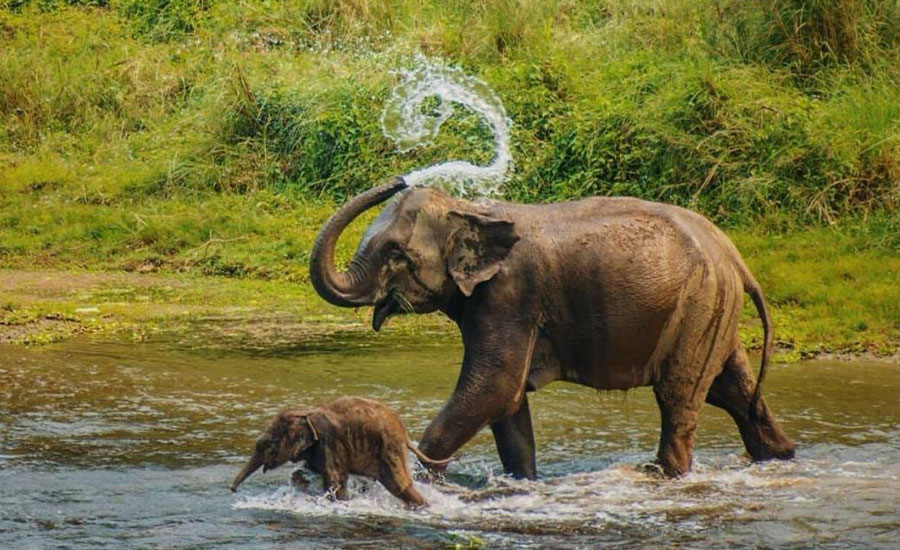
Chitwan National Park is one of Asia’s best wildlife destinations. You have a very good chance of seeing the one-horned rhinoceros, spotted deer, wild boar, monkeys and crocodiles, including the rare gharial. The park is also home to more than 500 species of birds. Bengal tigers, leopards and sloth bears live here too, but they’re shy, so sightings need some luck.
Pack comfortable trekking boots, breathable layers, a fleece, a warm down jacket, a waterproof jacket, a warm hat, gloves, sunglasses, sunscreen and a headlamp for the Poon Hill sunrise. Bring a small daypack, a reusable water bottle and a basic first-aid kit. For Chitwan, light, neutral-colored clothes and insect repellent are ideal. You can buy or rent most trekking gear in Kathmandu or Pokhara.
Teahouses provide blankets, but we recommend a sleeping bag for extra warmth and hygiene, especially from November to March, when nights at Ghorepani are cold. You can easily rent a good sleeping bag in Kathmandu or Pokhara at a low cost.
Yes, travel insurance is strongly recommended. Your policy should cover trekking up to at least 3,500 m, medical treatment, emergency helicopter evacuation, trip cancellation, flight delays and lost baggage. Please share your insurance details with us before the trek.
Most international visitors need a tourist visa, which you can get on arrival at Tribhuvan International Airport or apply for online before you travel. The 15-day visa costs US$30 and covers this 12-day tour. Your passport must be valid for at least six months. Indian citizens don’t need a visa, and citizens of other SAARC countries, except Afghanistan, receive a free 30-day visa.
There are no ATMs on the Poon Hill trek, so withdraw enough Nepali rupees in Pokhara for drinks, snacks, hot showers and Wi-Fi. Most teahouses offer Wi-Fi for a small fee, although it can be slow. Mobile signal from Nepal Telecom and Ncell is available in most villages along the route, including Ghorepani and Ghandruk.
Yes. As a private tour, the itinerary is fully flexible. You can add extra nights, upgrade hotels, fly instead of drive, include a sunrise at Sarangkot, add Lumbini, the birthplace of the Buddha, or add an Everest Base Camp Helicopter Tour. You can also add a longer trek, such as the Annapurna Base Camp Trek. Just tell us your ideas.
The cost depends on your group size, travel dates, hotel category and any upgrades you choose, and larger groups pay less per person. To book, send us your preferred dates and number of travelers through our Trip Planner or Contact Us page. Once your itinerary is confirmed, a deposit secures your booking, and the balance is paid before or on arrival.
Tipping isn’t mandatory, but it’s a common and appreciated way to thank your guide, porters and driver for their hard work. Most travelers tip at the end of the trek and the tour, and the amount is entirely up to you. If you’d like guidance, our team will happily suggest a fair range before you travel.
You may also like