Larkya La Pass (5,160m): Complete Guide, Difficulty, Altitude & Tips
By Nepal Trip Services On 20 Sep 2026

By Nepal Trip Services On 20 Sep 2026
Every trekker attempting the Manaslu Circuit Trek eventually arrives at the same defining question: what does it actually take to cross Larkya La Pass? This complete guide answers everything — altitude, difficulty, route conditions, weather, preparation, and exact crossing times — so you can approach this legendary high-altitude crossing with genuine confidence.
For many trekkers, Larkya La Pass exists as little more than a name on an itinerary until the days leading up to it, when the reality of what's actually involved starts to sink in. Unlike a scenic viewpoint you can simply admire and move past, this is a genuine physical undertaking — an 8 to 9 hour trekking day at altitudes where the air holds roughly half the oxygen found at sea level, tackled in freezing pre-dawn temperatures with no teahouse, shelter, or easy retreat along the way. It's precisely this combination of remoteness, altitude, and commitment that makes proper research and preparation so essential before you ever set foot on the trail.
What makes this guide different from a simple day-by-day itinerary description is its focus on the practical realities trekkers actually need to know: how cold does it genuinely get, how early should you really start, what happens if weather turns mid-crossing, and how does this compare to other high-altitude crossings in Nepal. Whether you're still deciding if the Manaslu Circuit is right for you, or you're already deep into trip preparation with Larkya La Pass looming on your itinerary, this guide is designed to replace uncertainty with a clear, honest picture of exactly what to expect on the most demanding — and most rewarding — day of the entire trek.
Larkya La Pass is the highest point of the Manaslu Circuit Trek, connecting the Manaslu region to the Annapurna region via a dramatic, glacier-flanked traverse. It stands as the undisputed climax of the entire trek — the single day every trekker builds toward across nearly two weeks of walking.
| Detail | Information |
|---|---|
| Altitude | 5,160m/16,929ft |
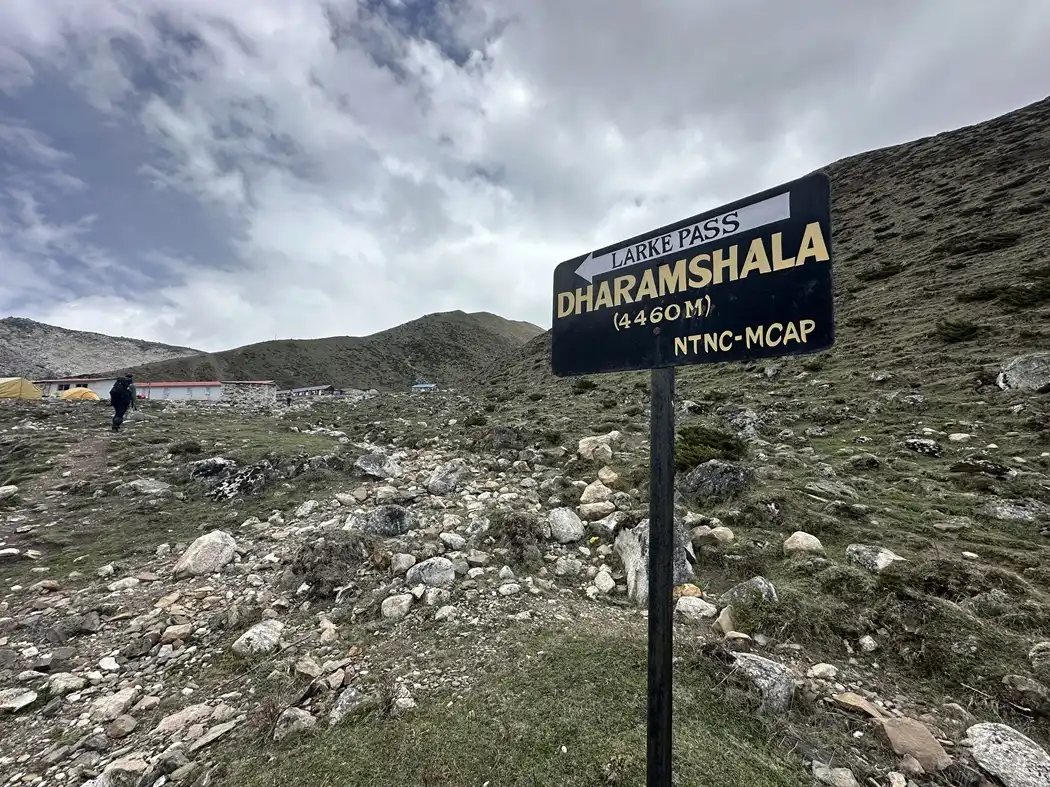
| Location | Between Dharamsala and Bimthang |
| Region | Manaslu Conservation Area / Gorkha-Manang border |
| Crossing Direction | East to west (Dharamsala → Bimthang) |
| Typical Crossing Day | Day 12 of standard itinerary |
| Surrounding Peaks | Manaslu, Himlung Himal, Cheo Himal, Annapurna II |
At 5,160 meters (16,929 feet), Larkya La Pass sits high enough that oxygen levels are roughly half of what they are at sea level. This altitude is comparable to Kala Patthar on the Classic Everest Base Camp Trek, making it one of the highest points reached on any of Nepal's popular teahouse trekking routes. The approach itself begins from Dharamsala at 4,500m, meaning trekkers gain over 650 meters of elevation on crossing day alone, before descending more than 1,400 meters to Bimthang on the far side.
Larkya La Pass is rated very challenging, and it's genuinely the most physically and mentally demanding single day of the entire Manaslu Circuit Trek. Several factors combine to make this crossing tough:
Unlike moderate treks where difficulty builds gradually, Larkya La Pass compresses nearly all of the trek's hardest demands into a single, unavoidable day.
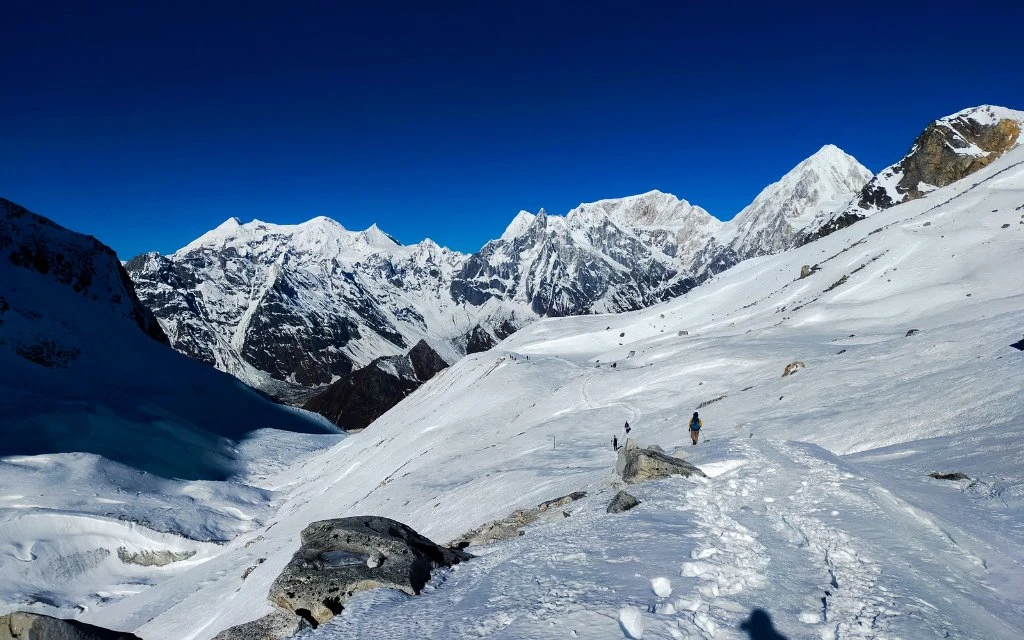
The route begins at Dharamsala (4,500m), climbing steadily through rocky, exposed terrain before reaching the pass itself. The trail crosses sections of glacial moraine — loose, uneven rock left behind by retreating glaciers — requiring careful footing throughout. After reaching the summit of the pass, the route descends sharply on the western side, dropping through icy, occasionally snow-covered terrain before eventually reaching more stable ground and continuing down to Bimthang (3,720m).
Weather at this altitude is notoriously unpredictable and can shift dramatically within hours. Mornings typically offer the calmest, clearest conditions, which is precisely why crossings begin well before sunrise.
| Season | Conditions at the Pass | Crossing Recommendation |
|---|---|---|
| Autumn (Sep–Nov) | Stable, clear, cold | Best and safest season |
| Spring (Mar–May) | Generally stable, occasional cloud | Good, second-best option |
| Winter (Dec–Feb) | Heavy snow risk, extreme cold | High risk of pass closure |
| Monsoon (Jun–Aug) | Poor visibility, unstable | Not recommended |
Temperatures at the pass can drop well below -15°C even during peak season, especially in the early morning hours before sunrise.
Proper preparation genuinely determines whether crossing day feels manageable or miserable. Key preparation steps include:
Most trekkers begin the crossing between 3:00 AM and 5:00 AM, well before sunrise, to take advantage of calmer weather and firmer, frozen ground underfoot. The full crossing — from Dharamsala to Bimthang — typically takes 8 to 9 hours, broken down roughly as follows:
Starting later significantly increases the risk of encountering afternoon wind, cloud buildup, or shifting snow conditions, which is why early departure isn't optional — it's essential.
While the entire Manaslu Circuit offers remarkable scenery and cultural depth, Larkya La Pass is what transforms this trek from a memorable journey into a genuine mountaineering-adjacent achievement. Standing at the summit, surrounded by Manaslu, Himlung Himal, Cheo Himal, and Annapurna II in a single sweeping panorama, delivers a sense of accomplishment that few other trekking days in Nepal can match. It's also the geographic and symbolic turning point of the trek — the moment you leave the Manaslu region behind and begin your descent toward Bimthang and, eventually, the Annapurna region near Dharapani.
Larkya La Pass sits at 5,160 meters (16,929 feet), making it the highest point of the entire Manaslu Circuit Trek and comparable in altitude to Kala Patthar on the Everest Base Camp Trek.
The crossing is rated very challenging, combining high altitude, an 8–9 hour trekking day, cold temperatures, glacial moraine terrain, and no shelter along the route, making it the most demanding single day of the entire trek.
Most trekkers depart Dharamsala between 3:00 AM and 5:00 AM to take advantage of calmer morning weather and firmer, frozen ground before afternoon conditions potentially deteriorate.
The full crossing from Dharamsala to Bimthang typically takes 8 to 9 hours, including approximately 3–4 hours of ascent and 4–5 hours of descent.
Autumn (September to November) offers the safest and most stable conditions, with spring (March to May) serving as a strong second choice. Winter carries a high risk of the pass becoming snow-blocked.
While not technically dangerous under normal conditions, the combination of altitude, cold, and remote terrain means genuine risks exist, particularly if weather deteriorates or trekkers push through worsening altitude symptoms.
Essential gear includes a warm down jacket, insulated waterproof gloves, thermal layers, trekking poles, sturdy boots, and a headlamp for the pre-dawn start, given how cold temperatures genuinely get at this altitude.
It's possible but risky, since the pass frequently becomes snow-blocked or impassable during winter months (December–February), making autumn or spring far safer choices for most trekkers.
The summit offers sweeping panoramic views of Manaslu, Himlung Himal, Cheo Himal, and Annapurna II, considered one of the most spectacular high-altitude panoramas found on any trekking route in Nepal.
No, there is no teahouse or shelter directly on the pass, so trekkers must carry sufficient water and snacks, since the crossing involves several hours without any rest stop infrastructure.
If weather conditions are unfavorable, guides will typically recommend delaying the crossing by a day rather than risking poor visibility or dangerous conditions at the pass, even if it means an extra night at Dharamsala.
Both sit at similar altitudes (around 5,160–5,550m), but Larkya La Pass involves a longer, more physically demanding crossing with glacial terrain, compared to Kala Patthar's shorter, out-and-back hike.
While not strictly mandatory, prior high-altitude trekking experience is genuinely recommended, given the demanding nature of this crossing compared to more moderate treks.
Given the compressed acclimatization schedule leading up to the pass, Acute Mountain Sickness (AMS) remains a genuine risk, making proper pacing and acclimatization in the days beforehand essential.
The western side of the pass descends steeply toward Bimthang (3,720m), transitioning from glacial, high-alpine terrain into greener, more forested landscape as you continue toward Dharapani and the Annapurna region.
Larkya La Pass represents everything that makes the Manaslu Circuit Trek genuinely special — a demanding, high-altitude challenge rewarded with some of the most spectacular mountain panoramas in the Himalaya. With proper acclimatization, the right gear, an early start, and trust in your guide's judgment, well-prepared trekkers can successfully cross this legendary pass and complete one of Nepal's most rewarding off-the-beaten-path adventures.
Ready to experience Larkya La Pass for yourself? Explore the complete Manaslu Circuit Trek itinerary and start planning your journey to one of the Himalaya's most unforgettable high-altitude crossings.
Discover more articles that match your interests! Explore these similar blogs packed with insights, tips, and stories to keep you inspired.
Discover Samagaon, Nepal — the Manaslu region\'s Tibetan-influenced gem. Complete guide to culture, altitude, things t...
Discover Samdo, Nepal — the last village before Larkya La Pass on the Manaslu Circuit Trek. Complete guide to culture,...
Discover Pungyen Gompa, Nepal — the sacred monastery beneath Manaslu\\'s south face. Complete guide to history, altitu...
Discover Dharamsala, Manaslu — the last stop before Larkya La Pass. Complete guide to altitude, accommodation & crossi...
Discover Nubri Valley families in Nepal — Tibetan culture, traditions, polyandry & daily life in the Manaslu region. C...
Complete guide on how to prepare for the Manaslu Circuit Trek — training, gear, permits, insurance & mental readiness ...