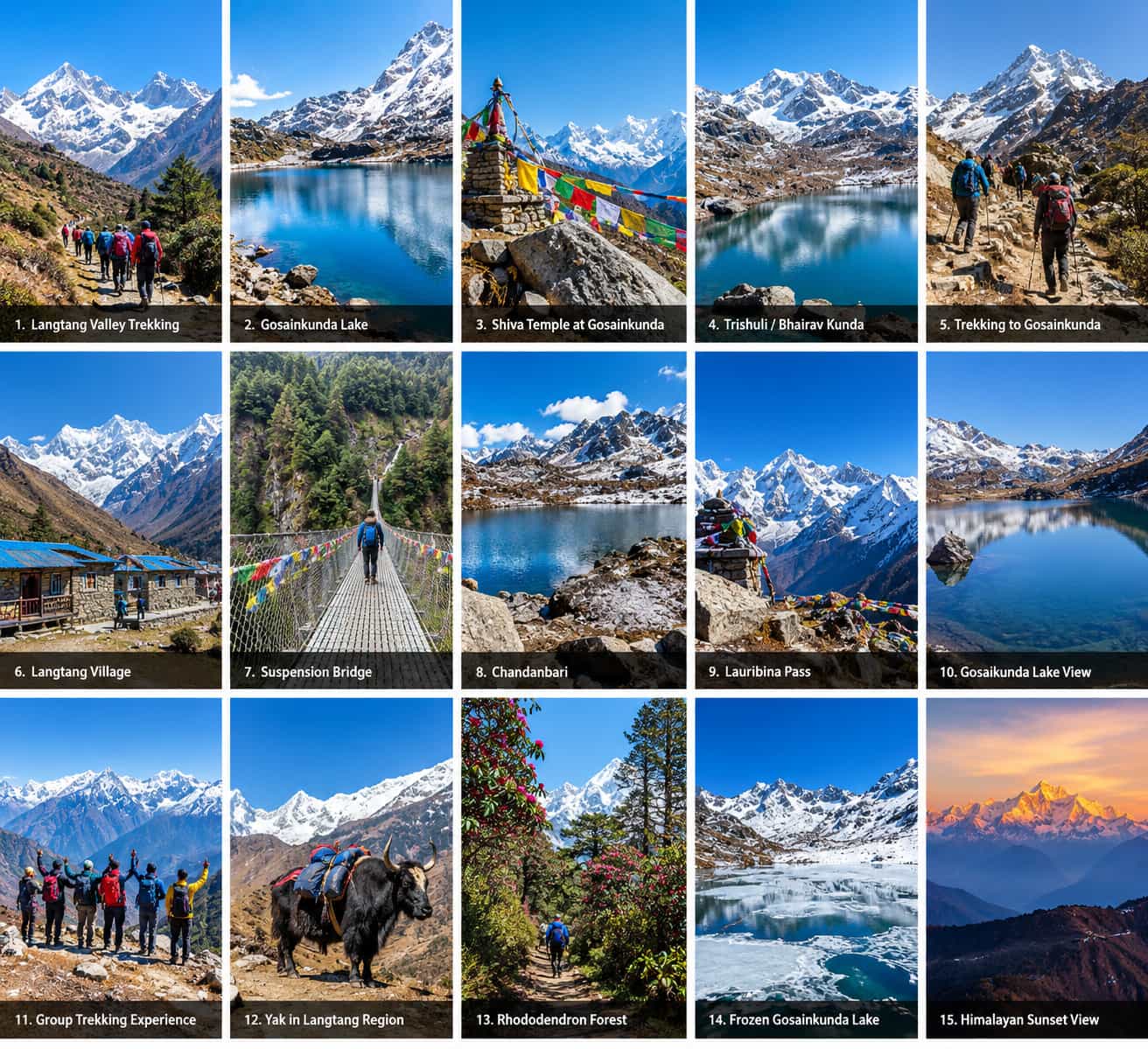
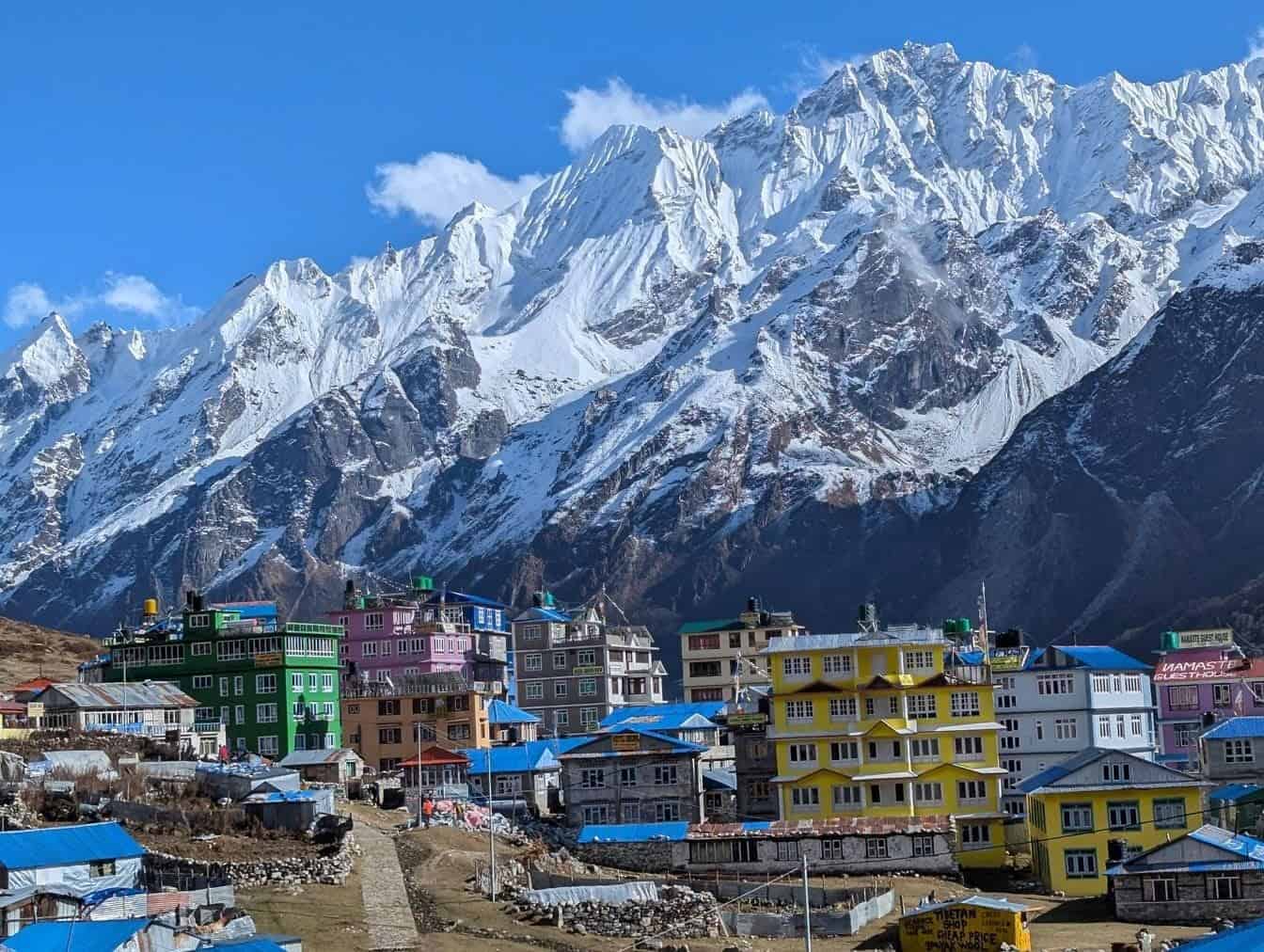
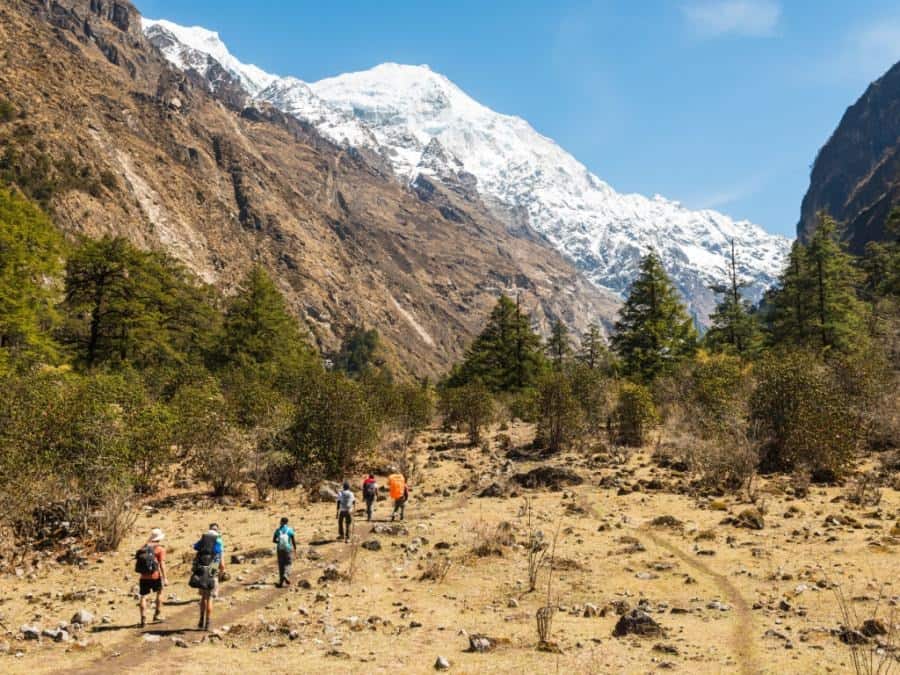
Langtang Gosainkunda Lake Trek: More Info
Langtang Gosainkunda Lake Trek Route and Map
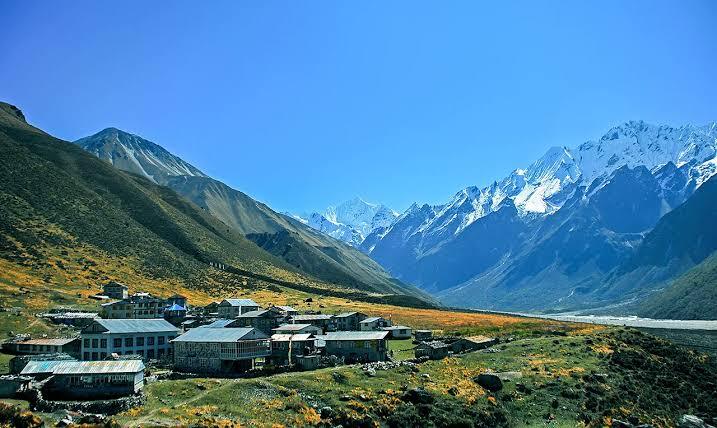
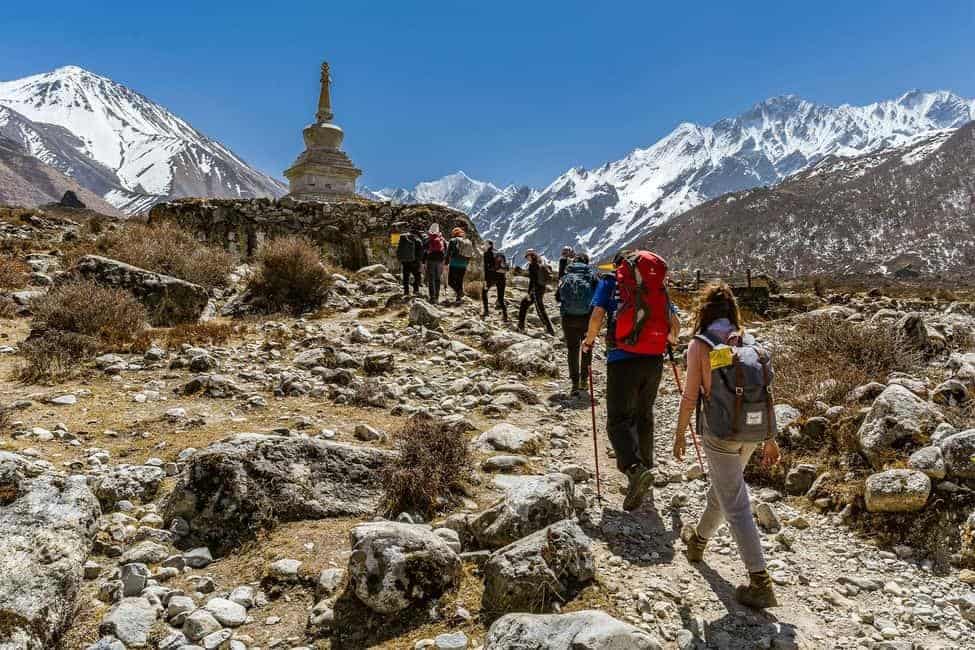
The Langtang Gosainkunda Lake Trek follows a natural loop through Langtang National Park. It starts in Syabrubesi (1,470 m), climbs up the Langtang Valley to Kyanjin Gompa (3,870 m), then crosses to the sacred lakes of Gosainkunda (4,380 m) before ending in Dhunche (1,950 m). You never walk the same stretch twice for scenery, and the route gives you forest, glacier views, Tamang culture and holy alpine lakes in one trip.
Route at a Glance
Kathmandu → Syabrubesi → Lama Hotel → Mundu → Kyanjin Gompa → Lama Hotel → Thulo Syabru → Sing Gompa → Gosainkunda → Cholangpati → Dhunche → Kathmandu
What to Know About the Route
- Start and finish: A scenic drive from Kathmandu to Syabrubesi begins the trek, and a drive from Dhunche returns you to Kathmandu.
- Up the Langtang Valley: The first four walking days follow the Langtang River upstream, gaining height gradually through forest and yak pastures, which helps your body adjust.
- Acclimatization day: At Kyanjin Gompa, a day hike to Tserko Ri (4,985 m) or Kyanjin Ri (4,773 m) gives you great views and helps you adapt before heading higher.
- Crossing to the lakes: After retracing the valley to Lama Hotel, the trail climbs through Thulo Syabru and Sing Gompa to Gosainkunda, the highest overnight stop on the trek’s second half.
- Descent: An optional Surya Peak hike (5,145 m) is followed by a long downhill walk via Cholangpati to Dhunche.
Trail Conditions
The trail is well-marked and used daily by trekkers, locals and pilgrims, with teahouses at each stop. Expect stone steps, forest paths and some steep, rocky sections near the lakes. Landslides or snow can occasionally affect parts of the route, so your guide may adjust the plan for safety.
Langtang Gosainkunda Trek Distance and Daily Walking Hours
The Langtang Gosainkunda Lake Trek covers roughly 80 to 100 km on foot over nine walking days, with an average of 4 to 6 hours of trekking a day. The exact distance depends on side hikes like Tserko Ri and Surya Peak, and on trail conditions. The longer days come early in the Langtang Valley and on the final descent to Dhunche, while the days near Kyanjin Gompa and Sing Gompa are shorter to help you acclimatize.
Daily Walking Hours at a Glance
| Day |
Route |
Walking / Driving Time |
Overnight Altitude |
| 1 |
Kathmandu to Syabrubesi |
8-9 hrs drive |
1,470 m |
| 2 |
Syabrubesi to Lama Hotel |
5-6 hrs |
2,324 m |
| 3 |
Lama Hotel to Mundu |
5-6 hrs |
3,330 m |
| 4 |
Mundu to Kyanjin Gompa |
3-4 hrs |
3,870 m |
| 5 |
Day hike to Tserko Ri or Kyanjin Ri |
4-6 hrs |
3,870 m |
| 6 |
Kyanjin Gompa to Lama Hotel |
5-6 hrs |
2,324 m |
| 7 |
Lama Hotel to Thulo Syabru |
5-6 hrs |
2,260 m |
| 8 |
Thulo Syabru to Sing Gompa |
3-4 hrs |
3,330 m |
| 9 |
Sing Gompa to Gosainkunda |
4-5 hrs |
4,380 m |
| 10 |
Optional Surya Peak hike, then on to Cholangpati |
Varies |
3,654 m |
| 11 |
Cholangpati to Dhunche |
6-7 hrs |
1,950 m |
| 12 |
Dhunche to Kathmandu |
5-6 hrs drive |
1,400 m |
What to Expect on the Trail
- Early days: Steady uphill walking through forest along the Langtang River, with gradual altitude gain that lets your body adjust.
- Kyanjin Gompa days: Short walking time and an easy pace, perfect for resting, exploring the monastery or doing the Tserko Ri sunrise hike.
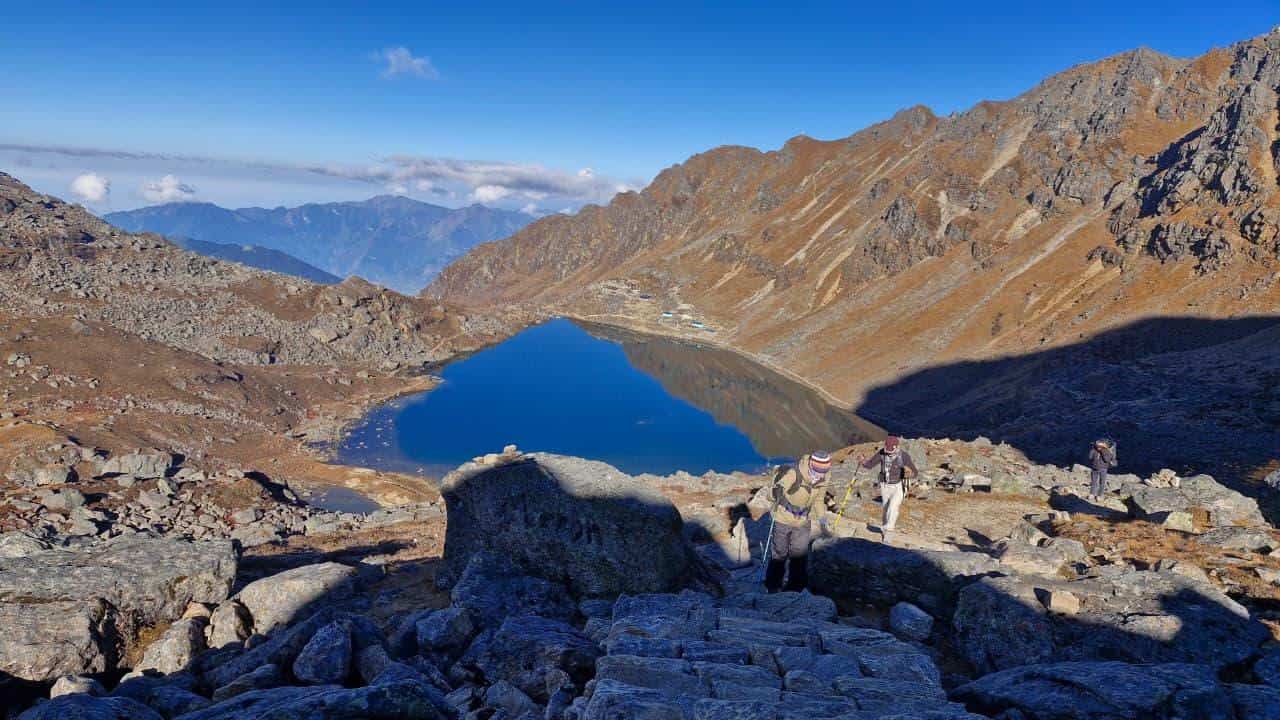
- Gosainkunda climb: The steepest and most demanding section, with a steady uphill walk to the lakes at high altitude.
- Final descent: A long downhill day that is tough on the knees, so trekking poles are a big help.
Helpful Tips
- Walking hours include short breaks but not long lunch stops, so allow extra time.
- Start early each morning for clearer views and calmer weather.
- Pace matters more than speed. Walk slowly and let your guide set the rhythm.
Langtang Gosainkunda Trek Difficulty
The Langtang Gosainkunda Lake Trek is rated moderate to challenging. The trail is well-established and needs no technical skills or climbing experience, but the high altitude, long walking days and steep climbs call for good general fitness. The hardest part is the section between Sing Gompa and Gosainkunda, where the trail climbs steeply to over 4,300 m. Most fit beginners can complete the trek with proper preparation and a steady pace.
Difficulty at a Glance
| Factor |
Details |
| Overall grade |
Moderate to challenging |
| Duration |
12 days (about 9 walking days) |
| Daily walking |
3 to 7 hours |
| Maximum altitude |
4,985 m (Tserko Ri day hike) |
| Highest overnight stop |
Gosainkunda, 4,380 m |
| Technical skills |
None required |
What Makes the Trek Challenging
- Altitude: Several nights are spent above 3,800 m, so altitude sickness is a real risk, even for fit trekkers.
- Steep climbs: The ascent to Gosainkunda and the climbs near Thulo Syabru involve long stretches of stone steps and rocky trail.
- Long descents: The final walk down to Dhunche takes 6 to 7 hours and can be hard on the knees.
- Cold nights: Temperatures drop below freezing at Kyanjin Gompa and Gosainkunda, especially in spring and late autumn.
- Basic facilities: Teahouses get simpler at higher altitude, with limited hot water, charging and Wi-Fi.
What Makes It Manageable
- Gradual altitude gain in the Langtang Valley helps your body adapt.
- A rest-and-hike day at Kyanjin Gompa builds acclimatization.
- Teahouses at every stop mean you carry only a light daypack.
- Your guide monitors health daily and adjusts the pace if needed.
Fitness Level Needed
You should comfortably walk 5 to 6 hours a day on uneven ground with a light pack. Start training 6 to 8 weeks before the trek with:
- Regular hiking or brisk walking, ideally on hills or stairs
- Cardio such as running, cycling or swimming, 3 to 4 times a week
- Leg and core strengthening exercises like squats and lunges
- At least one or two long practice hikes with your boots and daypack
Who Can Do This Trek
- First-time trekkers who are reasonably fit and well prepared
- Experienced hikers looking for a culture-rich trek close to Kathmandu
- Active travelers aged roughly 16 to 65 in good health, with a doctor’s approval if you have any medical conditions
It is less suitable for anyone with serious heart or lung conditions, or for people unable to walk several hours a day. If you are unsure, ask us, and we can suggest a shorter or lower-altitude alternative such as the Langtang Valley trek alone.
Best Time for Langtang Gosainkunda Trek
The best time for the Langtang Gosainkunda Lake Trek is autumn (September to November) and spring (March to May). During these months the skies are clear, the weather is stable and the trails are at their best. Winter is possible with extra preparation, and the monsoon is the least suitable season, except for pilgrims visiting Gosainkunda during the Janai Purnima festival.
Season at a Glance
| Season |
Months |
Weather |
Views |
Trail Crowds |
Rating |
| Autumn |
Sept to Nov |
Clear, dry, stable |
Excellent |
Busy |
Best |
| Spring |
Mar to May |
Warm, occasional afternoon clouds |
Very good |
Moderate |
Best |
| Winter |
Dec to Feb |
Cold, dry, snow at altitude |
Crisp and clear |
Very quiet |
Fair |
| Monsoon |
June to Aug |
Wet, humid, cloudy |
Limited |
Quiet |
Challenging |
Autumn (September to November)
Autumn is the most popular season, and for good reason. Skies are clear after the monsoon rains, the air is fresh, and the views of Langtang Lirung and the surrounding peaks are sharp. Daytime temperatures are comfortable, though nights at Kyanjin Gompa and Gosainkunda are cold. This is also the season for local festivals like Dashain and Tihar, but teahouses fill up fast, so book early.
Spring (March to May)
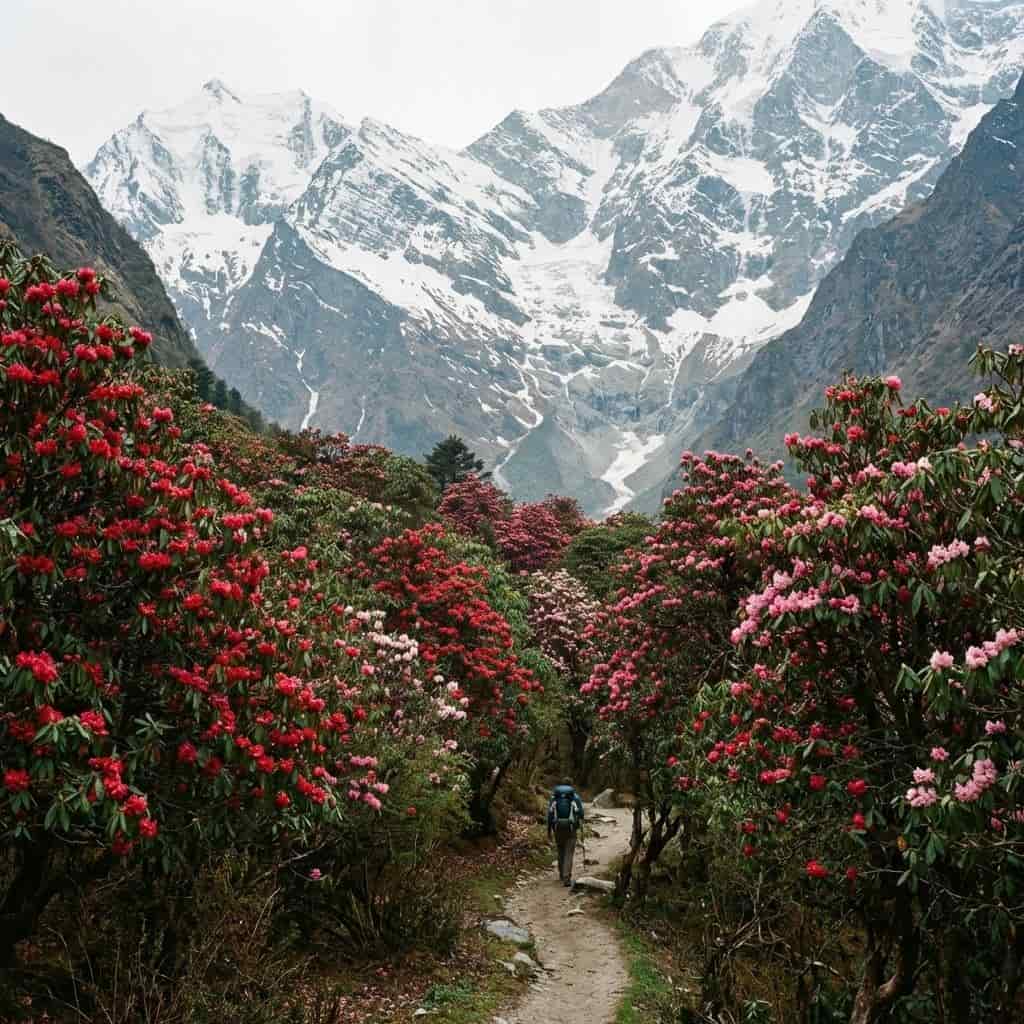
Spring brings warm days, green hillsides and rhododendron forests in bloom, especially in April. Wildlife is more active, and the trail feels alive with color. Mornings are usually clear, while afternoons can turn hazy or cloudy, so start early for the best mountain views. Snow may linger near Gosainkunda in March.
Winter (December to February)
Winter offers quiet trails, crisp air and clear skies, but it is cold. Temperatures at high altitude fall well below freezing, and snow can block the Laurebina Pass and the Gosainkunda area. If you trek in winter, bring a high-quality down jacket and sleeping bag, and be ready for a flexible itinerary. Many experienced trekkers prefer to do only the Langtang Valley section at this time.
Monsoon (June to August)
The monsoon brings heavy rain, leeches, slippery trails and a higher risk of landslides, and clouds often hide the mountains. Most trekkers avoid this season. The exception is Janai Purnima (usually in August), when thousands of Hindu and Buddhist pilgrims travel to Gosainkunda for a holy bath, a unique cultural experience if you are prepared for wet conditions.
Our Recommendation
- Best views and stable weather: October to November
- Best flowers and wildlife: April to early May
- Fewest crowds: early December or late February (with proper gear)
- Cultural experience: August for Janai Purnima, with a flexible schedule
Helpful Tips
- Book teahouses and guides early for October and April, the busiest months.
- Pack layers in every season, because mornings, afternoons and nights feel very different.
- Check the weather forecast before departure, and allow an extra buffer day in your schedule.
Weather and Temperature on the Langtang Gosainkunda Trek
Weather on the Langtang Gosainkunda Lake Trek changes with both the month and the altitude. Syabrubesi (1,470 m) is mild and green, Kyanjin Gompa (3,870 m) is cool and crisp, and Gosainkunda (4,380 m) is cold even in the best seasons. As a rule, temperatures drop by about 6°C for every 1,000 m you climb, and mornings are usually clearer than afternoons. The figures below are approximate and can vary from year to year.
Temperature by Altitude
| Location |
Altitude |
Daytime (Autumn/Spring) |
Night (Autumn/Spring) |
| Syabrubesi |
1,470 m |
18 to 24°C |
10 to 15°C |
| Lama Hotel |
2,324 m |
12 to 18°C |
3 to 8°C |
| Mundu |
3,330 m |
8 to 14°C |
-2 to 3°C |
| Kyanjin Gompa |
3,870 m |
6 to 12°C |
-5 to 0°C |
| Gosainkunda |
4,380 m |
3 to 10°C |
-8 to -2°C |
Weather by Month
| Month |
Conditions |
Trekking Suitability |
| January |
Very cold, dry, snow at high altitude |
Challenging |
| February |
Cold, clear mornings, some snow |
Fair |
| March |
Warming up, clear days, snow near the lakes |
Good |
| April |
Warm, rhododendrons in bloom, occasional afternoon clouds |
Excellent |
| May |
Warm, hazier views, pre-monsoon showers possible |
Good |
| June |
Hot and humid at low altitude, rain begins |
Not recommended |
| July |
Heavy rain, leeches, cloudy views |
Not recommended |
| August |
Wet, with landslide risk (Janai Purnima pilgrimage at Gosainkunda) |
Challenging |
| September |
Rain tapering off, lush and green |
Good |
| October |
Clear, dry and stable, with the best mountain views |
Excellent |
| November |
Cold nights, crisp clear days |
Excellent |
| December |
Very cold at altitude, quiet trails, clear skies |
Fair |
What to Expect Through the Day
- Morning: Usually the clearest and calmest time, best for mountain views and photos
- Midday: Warm in sunshine, even at altitude, so layers you can remove are useful
- Afternoon: Clouds and wind often roll in, especially in spring and at higher camps
- Night: Temperatures drop quickly above 3,300 m, often below freezing
Helpful Tips
- Dress in layers: a base layer, a fleece, a down jacket and a waterproof shell
- Bring a sleeping bag rated to at least -10°C for Kyanjin Gompa and Gosainkunda
- Wear sun protection at all times, because UV is strong at altitude even on cool days
- Start early each day to enjoy the best weather and arrive before afternoon clouds
- Keep one or two buffer days in your plans in case of weather delays
Altitude Sickness and Acclimatization on the Langtang Gosainkunda Trek
Altitude sickness, also called Acute Mountain Sickness (AMS), can affect any trekker above about 2,500 m, regardless of age or fitness. On this trek you sleep at Kyanjin Gompa (3,870 m) and Gosainkunda (4,380 m), and day hikes reach nearly 5,000 m, so understanding the risks is an important part of preparing. With a gradual ascent, good hydration and an experienced guide, most trekkers adapt well.
Symptoms of Altitude Sickness
| Level |
Common Signs |
What to Do |
| Mild AMS |
Headache, nausea, dizziness, loss of appetite, poor sleep, fatigue |
Rest, drink water, do not go higher until symptoms ease |
| Moderate AMS |
Persistent headache, vomiting, weakness, shortness of breath at rest |
Stop ascending and descend if no improvement |
| Severe (HAPE/HACE) |
Breathlessness at rest, wet cough, confusion, loss of balance, extreme drowsiness |
Descend immediately and arrange emergency evacuation |
Prevention Tips
- Walk slowly and steadily. Never rush, even if you feel strong.
- Drink 3 to 4 liters of water a day, and avoid alcohol and smoking.
- Eat well, especially carbohydrates like dal bhat, even if your appetite drops.
- Climb high, sleep low. Day hikes to higher points followed by sleeping lower help your body adapt.
- Tell your guide about any symptom right away, however small.
- Do not take sleeping pills, and avoid ascending with unresolved symptoms.
- Ask your doctor before the trip about medication such as acetazolamide (Diamox). It can help some trekkers but is not a substitute for gradual ascent.
Our Safe Ascent Plan
- Gradual valley climb: The first days follow the Langtang River upstream (Syabrubesi, Lama Hotel, Mundu, Kyanjin Gompa), so altitude builds steadily.
- Acclimatization day: At Kyanjin Gompa you spend two nights, with a day hike to Tserko Ri or Kyanjin Ri before heading back down.
- Descent before the second ascent: Dropping back to Lama Hotel and Thulo Syabru gives your body a recovery period before the climb to Gosainkunda.
- Daily health checks: Your guide checks how everyone is feeling each morning and evening, and adjusts the pace or route when needed.
- Flexible decisions: If symptoms appear, we rest, slow down or descend. Safety always comes before the itinerary.
- Emergency support: Our guides carry a first-aid kit, and we can arrange emergency descent or helicopter evacuation.
Before You Go
- Get a medical check-up if you have heart, lung or blood pressure conditions.
- Buy travel insurance that covers trekking to 5,000 m and helicopter evacuation.
- Be honest about any past altitude problems when you book.
Langtang Gosainkunda Trek Permits and Entry Fees
The Langtang Gosainkunda Lake Trek needs two permits: the Langtang National Park entry permit and the TIMS card. The same permits cover the Langtang Valley, Gosaikunda and Helambu. The route passes through no restricted areas, so no special permit is needed. There are no restricted-area permits for this region. Nepal Trip Services arranges both permits for you, so you only need to bring your passport and passport-size photos.
Permit Fees at a Glance
| Permit |
Foreign Nationals |
SAARC Nationals |
Where It Is Issued |
| Langtang National Park entry permit |
NPR 3,000 (about US$22) |
NPR 1,500 |
Kathmandu or the Dhunche checkpoint |
| TIMS card |
NPR 1,000 to 2,000 (about US$8 to 17) |
Reduced rate |
Kathmandu only |
| Estimated total |
About NPR 4,000 to 5,000 (US$30 to 40) |
Lower |
Arranged by your trekking agency |
The national park fee is NPR 3,000 for foreigners, and TIMS is NPR 2,000 for an individual card, making about NPR 5,000 in total. Group TIMS cards for two or more trekkers cost around NPR 1,000 per person. Fees are set in Nepali rupees, so the US dollar amount changes slightly with exchange rates.
What Each Permit Covers
- Langtang National Park entry permit: It is issued by Nepal’s Department of National Parks and Wildlife Conservation and is required because the trail from Syabrubesi to Kyanjin Gompa runs through protected park land. The park fee supports wildlife protection, trail maintenance and local conservation programs. Children under 10 enter free.
- TIMS card (Trekkers’ Information Management System): This registers your trek for safety and tracking. It cannot be bought on the trail, so Kathmandu is the only place to get it.
Documents You Need
- A valid passport with at least six months’ validity
- Passport-size photos for the TIMS card
- Your trek dates and itinerary
- Travel insurance details
Helpful Tips
- Make sure the date on your permit matches your actual trek start date.
- Keep your permits and passport copy in an easy-to-reach pocket, because they are checked at the park gate and some checkpoints.
- Include a few extra days of fee flexibility in your budget, because permit prices can be revised.
- Remember that the permit cost is already part of a guided package, so check your inclusions list to avoid paying twice.
Guide Requirement
Recent regulations have tightened rules for trekking alone in Langtang. One source states that solo, unguided trekking in Langtang National Park has been prohibited since 2025 and remains enforced in 2026. Trekking with a licensed local guide is the safest and most reliable option, and our team handles this for you.
Langtang Gosainkunda Trek Cost
The Langtang Gosainkunda Lake Trek with Nepal Trip Services starts from US$949 per person, and the price falls as your group grows. Every package covers the essentials: a licensed guide, porter support, permits, meals on the trail, teahouse stays and ground transport. This keeps your budget simple, with no surprise fees once you are on the trail.
Price by Group Size
| Group Size |
Price Per Person |
| 1 person |
US$999 |
| 2 people |
US$949 |
| 3 to 6 people |
US$849 |
| 7 to 10 people |
US$800 |
Larger groups and private departures can be arranged on request, so contact us for a custom quote.
What Affects the Price
- Group size: Costs like the guide, transport and porters are shared, so larger groups pay less per person.
- Season: Autumn (October and November) and spring (April) are the busiest months, so book early for the best teahouse availability.
- Trip length and customization: Extra acclimatization days, a Helambu extension or private departures change the final cost.
- Kathmandu stay: Hotel choice before and after the trek is not part of the base price, so your budget depends on the standard you prefer.
- Gear and personal spending: Hired equipment, drinks, charging, Wi-Fi and tips are paid by you on the trail.
- Insurance and emergencies: High-altitude travel insurance with helicopter evacuation is a personal cost, but it is essential protection.
Cost Includes
- Transportation: Airport pickup and drop-off, Kathmandu to Syabrubesi transfer, and Dhunche to Kathmandu transfer
- Accommodation: Teahouse or lodge stays on a twin-sharing basis during the trek
- Meals: Breakfast, lunch and dinner on the trail, with tea or coffee
- Guide and porter: A licensed English-speaking guide, plus one porter for every two trekkers (25 kg limit in total), with their salary, meals, accommodation and insurance
- Permits and fees: Langtang National Park entry permit, required trekking permits, government taxes and service charges
- Safety and extras: First-aid kit and a trip completion certificate
Cost Excludes
- International travel: International flights and the Nepal entry visa fee
- Kathmandu services: Hotels, meals and sightseeing in Kathmandu before and after the trek
- Insurance and emergencies: Travel and medical insurance, helicopter evacuation and extra costs from weather, landslide or illness delays
- Personal expenses: Drinks, bottled or boiled water, snacks, hot showers, charging, Wi-Fi, laundry and personal gear
- Tips: Gratuities for the guide and porters, appreciated but not mandatory
Money-Saving Tips
- Join a group departure or invite friends to unlock a lower per-person price.
- Rent gear in Kathmandu instead of buying new equipment.
- Carry a water filter or purification tablets to reduce bottled water costs.
- Keep some Nepali rupees in cash for drinks, snacks and charging on the trail.
- Book early for peak months to secure your preferred dates.
Accommodation on the Langtang Gosainkunda Trek
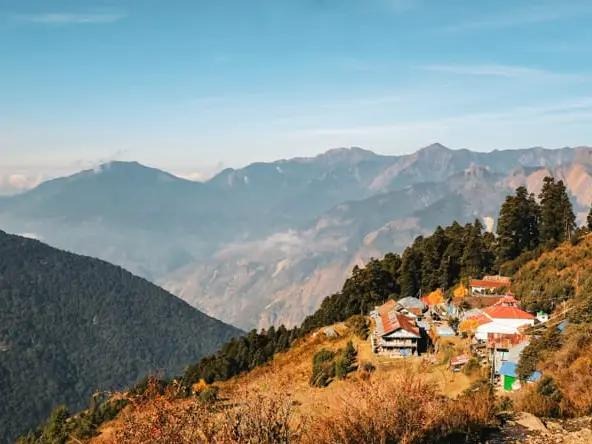
Accommodation on the Langtang Gosainkunda Lake Trek is simple, friendly and comfortable. You stay in family-run teahouses (mountain lodges) in every village along the route, so there is no need to carry a tent. Rooms are basic but clean, meals are served on site, and the dining hall is where trekkers gather to warm up, charge devices and swap stories. Facilities get simpler as you climb, which is normal on any high Himalayan trek.
Where You Stay
| Stop |
Altitude |
What to Expect |
| Syabrubesi |
1,470 m |
Larger lodges with the most facilities on the trek |
| Lama Hotel |
2,324 m |
Forest lodges, simple rooms, hot meals |
| Mundu |
3,330 m |
Basic lodges in a small village, colder nights |
| Kyanjin Gompa |
3,870 m |
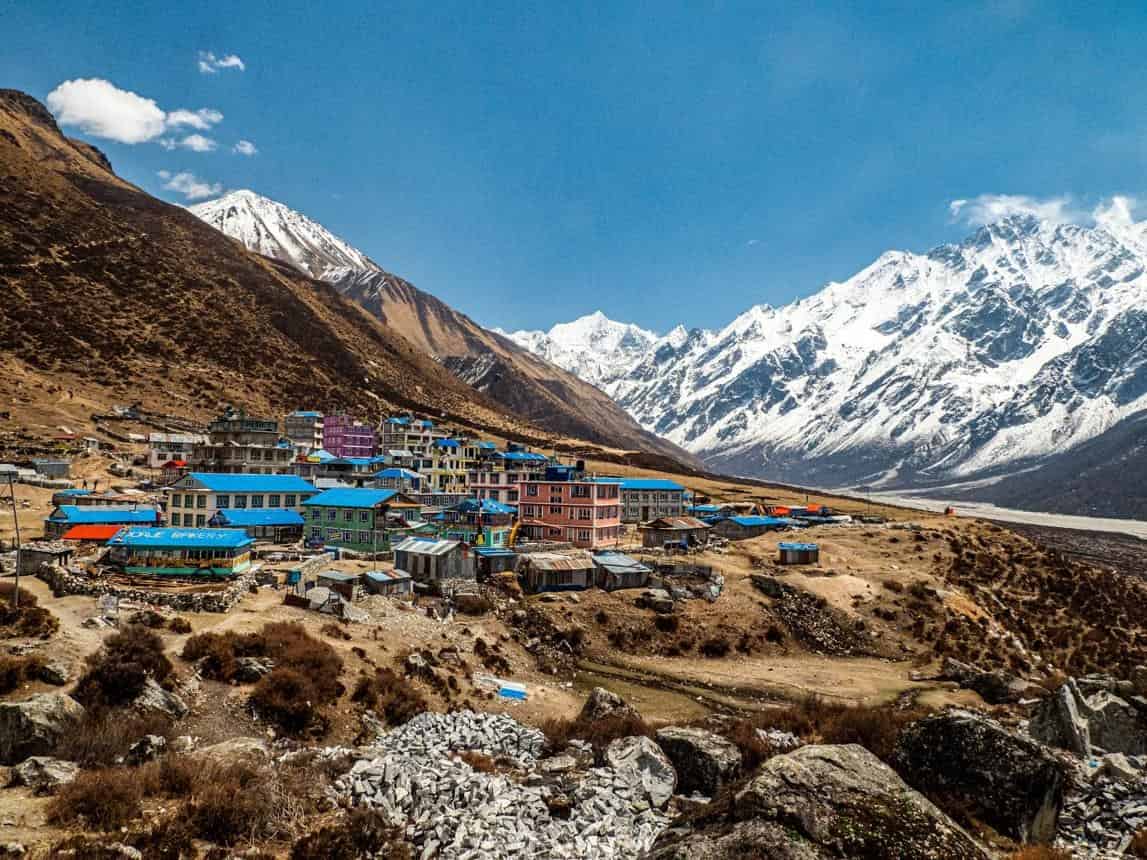
The biggest settlement in the upper valley, with several lodges, a bakery and a yak cheese factory |
| Thulo Syabru |
2,260 m |
A lively Tamang village with comfortable lodges and views |
| Sing Gompa |
3,330 m |
A small settlement with simple lodges and local cheese |
| Gosainkunda |
4,380 m |
Very basic lodges beside the holy lakes, with the coldest nights of the trek |
| Dhunche |
1,950 m |
A district town with more comfortable rooms |
Teahouse Rooms
- Twin-sharing rooms: Two single beds with a mattress, pillow and blanket, shared with your trekking partner
- Shared bathrooms: Squat or Western-style toilets are usually shared, and en-suite rooms are rare, especially at higher altitude
- Thin walls: Rooms are often built from wood, so bring earplugs for light sleepers
- No heating in rooms: The only heated space is the dining hall, which often has a stove in colder months
Facilities You Can Expect
- Dining hall: Warm common area with meals, hot drinks and a place to charge your devices
- Hot showers: Often available at lower stops for an extra fee, but limited at higher altitude
- Charging and Wi-Fi: Usually paid services that are slower and less reliable higher up
- Drinking water: Boiled or filtered water is sold at teahouses, and bottled water is more costly as you climb
- Laundry: Not available at most stops, so pack quick-dry clothing
What Changes at Higher Altitude
- Colder rooms: Above 3,300 m, nights fall below freezing, and rooms are not heated
- Fewer facilities: Hot showers, Wi-Fi and charging become scarce or more expensive
- Simpler lodges: At Gosainkunda, expect small rooms, thin mattresses and a limited menu
- Higher prices: Everything has to be carried up by porters, so snacks, water and charging cost more
- Busy lodges in peak season: Teahouses at Kyanjin Gompa and Gosainkunda can fill up in October and April, which is why advance booking by your agency helps
Helpful Tips
- Bring a sleeping bag rated to about -10°C for Kyanjin Gompa and Gosainkunda
- Pack a light liner, earplugs, a headlamp, wet wipes and a small towel
- Keep a power bank and spare cash for charging and hot showers
- Wear warm layers and thick socks to bed on the coldest nights
- Be kind to teahouse owners, who work hard to keep the lodges running in a remote area
Accommodation in Kathmandu
Kathmandu hotel nights before and after the trek are not part of the base package. If you’d like, Nepal Trip Services can arrange a hotel that suits your budget and comfort level.
Food and Drinking Water on the Langtang Gosainkunda Trek
Food on the Langtang Gosainkunda Lake Trek is simple, hearty and freshly cooked in family-run teahouses. Menus are similar from village to village, with plenty of energy-rich dishes to fuel long days of walking. Langtang is also known for its local yak cheese, a treat you will not want to miss. Safe drinking water is just as important as good food, especially at altitude, where staying hydrated helps prevent altitude sickness.
Typical Teahouse Menu
| Meal |
Common Choices |
| Breakfast |
Porridge, muesli, eggs, Tibetan bread, pancakes, toast, chapati, hot drinks |
| Lunch |
Dal bhat, fried rice, noodles, momos, soups, pasta, potato dishes |
| Dinner |
Dal bhat, vegetable curry, spaghetti, pizza, fried noodles, thukpa |
| Snacks |
Biscuits, chocolate bars, local cheese, fruit, tea or coffee |
Dal Bhat: The Trekker’s Favorite
Dal bhat (rice, lentil soup, vegetable curry and pickle) is the classic mountain meal. It is nutritious, filling and often comes with free refills, which makes it a smart choice after a long day on the trail. Guides and porters eat it for good reason: it gives steady energy for hours.
Local Yak Cheese
Langtang has long been known for its yak cheese, produced in the high pastures around Kyanjin Gompa and Sing Gompa. You can try it fresh in a cheese sandwich, in a local dish or by the slice, and it is a good way to support local farming families. Tasting it with hot tea at Kyanjin Gompa is one of the highlights of the trek.
Vegetarian and Special Diets
- Vegetarian: Easy to follow, because most teahouse dishes are vegetable-based, including dal bhat, vegetable curry, noodles, momos and soups.
- Vegan: Possible with advance notice. Ask for dishes without cheese, egg or butter, and let your guide know your needs early.
- Gluten-free or allergies: Options are limited in remote villages. Tell us at booking so your guide can plan, and carry your own snacks and medication.
- Meat: Chicken and eggs are sometimes available, but we recommend sticking to vegetarian dishes at higher altitude, because meat is carried up for days and may not be fresh.
Safe Drinking Water
- Never drink untreated water from taps, streams or lakes.
- Boiled water is sold at most teahouses and is usually cheaper and more eco-friendly than bottled water.
- Water purification tablets or a filter bottle are an excellent low-cost backup.
- Bottled water costs more with every step up, and plastic waste is a real problem in the mountains, so refill when you can.
- Aim to drink 3 to 4 liters a day at altitude, and add herbal tea, ginger tea or garlic soup, which locals say helps with the mountains.
Helpful Tips
- Order your dinner early, because teahouse kitchens cook everything fresh and meals can take time.
- Stay with simple, familiar dishes if your stomach is sensitive.
- Pack trail snacks such as nuts, energy bars and dried fruit for long walking days.
- Wash or sanitize your hands before eating.
- Be careful with raw salads and unpeeled fruit, which can upset your stomach.
- Bring a reusable water bottle and keep it filled.
What Your Package Covers
Your Nepal Trip Services package includes breakfast, lunch and dinner during the trek, with tea or coffee with meals. Drinks like soft drinks, alcohol, bottled water and snacks are extra and are paid directly on the trail.
Langtang Gosainkunda Trek Packing List
A smart packing list keeps you warm, comfortable and light on the trail. For the Langtang Gosainkunda Lake Trek, think in layers, because temperatures swing from mild days in Syabrubesi to freezing nights at Kyanjin Gompa and Gosainkunda. Your porter carries up to 25 kg shared between two trekkers, so aim for about 10 to 12 kg each and keep a small daypack for water, snacks, a rain jacket, camera and valuables.
Clothing
| Item |
Details |
| Base layers |
2 to 3 moisture-wicking tops and 1 to 2 thermal bottoms |
| Mid layer |
Fleece jacket or warm pullover |
| Insulation |
Down or synthetic jacket for evenings and high altitude |
| Outer shell |
Waterproof, windproof jacket and rain pants |
| Trekking pants |
2 pairs of quick-dry pants, plus shorts for lower sections |
| Underwear |
3 to 4 pairs of quick-dry underwear, plus sports bras if needed |
| Socks |
3 to 4 pairs of wool or trekking socks, plus 1 thick pair for sleeping |
| Hat and gloves |
Warm beanie, sun hat or cap, and warm gloves with a thin liner pair |
| Neck gaiter |
A buff or scarf for wind, dust and cold |
Footwear
- Sturdy, broken-in trekking boots with good ankle support and grip
- Lightweight sandals or camp shoes for teahouses
- Gaiters (optional, useful in snow or mud)
Trekking Gear
- Sleeping bag rated to about -10°C (rentable in Kathmandu)
- Daypack of 25 to 35 liters with a rain cover
- Duffel bag for your porter to carry
- Trekking poles, which help a lot on the steep climbs and long descents
- Headlamp with spare batteries
- Reusable water bottle (1 liter or more) or hydration bladder
- Sunglasses with UV protection
- Water purification tablets or a filter
Personal Care and Health
- Sunscreen (SPF 50+) and lip balm with SPF
- Toiletries, wet wipes, hand sanitizer and a small quick-dry towel
- Personal first-aid kit: blister plasters, pain relief, antiseptic, rehydration salts and any prescription medicine
- Altitude medication only if your doctor recommends it
- Toilet paper, earplugs and a small trash bag
Documents and Money
- Passport with at least six months’ validity, plus photocopies
- Passport-size photos
- Travel insurance policy details, including high-altitude and helicopter evacuation cover
- Nepali rupees in cash for drinks, snacks, charging and hot showers
- Emergency contacts and copies of your booking confirmation
Electronics
- Phone with offline maps
- Power bank (10,000 mAh or more), because charging costs extra and gets scarce with altitude
- Universal travel adapter and charging cables
- Camera and spare memory cards (optional)
What to Rent or Buy in Kathmandu
Thamel has many shops where you can rent or buy trekking gear at reasonable prices, so you do not need to bring everything from home.
| Easy to Rent |
Easy to Buy |
| Sleeping bag |
Trekking poles |
| Down jacket |
Gloves, hats and socks |
| Trekking poles |
Thermal layers |
| Duffel bag |
Rain gear |
| Crampons (for winter trips) |
Headlamp and batteries |
Helpful Tips
- Avoid cotton, which stays wet and cold, and choose wool or synthetic fabrics.
- Break in your boots before the trip to prevent blisters.
- Pack by weight, and leave extra items in Kathmandu hotel storage.
- Put essentials like medicine, documents and valuables in your daypack, not your duffel.
- Use dry bags or plastic liners to keep clothes dry in rain.
Physical Training and Preparation Tips for the Langtang Gosainkunda Trek
You do not need to be an athlete to complete the Langtang Gosainkunda Lake Trek, but good fitness makes every day safer and more enjoyable. With 5 to 7 hours of walking on several days, steep climbs to Gosainkunda and long descents to Dhunche, the goal is steady endurance and strong legs. Six to eight weeks of consistent training is enough for most healthy trekkers to feel confident on the trail.
Your 8-Week Training Plan
| Weeks |
Focus |
Weekly Plan |
| 1 to 2 |
Build a base |
3 cardio sessions of 30 to 40 minutes (brisk walking, cycling or swimming), plus 2 short strength sessions |
| 3 to 4 |
Add endurance |
3 to 4 cardio sessions of 45 to 60 minutes, 2 strength sessions, plus one 2 to 3 hour hike on weekends |
| 5 to 6 |
Build hill strength |
4 cardio sessions with hills or stairs, 2 strength sessions, plus a 3 to 5 hour hike with a loaded daypack |
| 7 |
Peak week |
Your longest hike (5 to 6 hours) with your trek boots and daypack, plus easy cardio and light strength |
| 8 |
Taper and rest |
Short walks and stretching, so you arrive in Nepal fresh and injury-free |
If you only have six weeks, begin with the plan at week 3 and keep up the same rhythm.
What to Train
- Cardio endurance: Brisk walking, jogging, cycling, swimming or the stair machine builds the stamina you need for long days at altitude.
- Hill and stair training: Walking up and down hills or stairs trains the muscles you use on the climb to Gosainkunda and protects your knees on the descent.
- Leg strength: Squats, lunges, step-ups and calf raises, 2 to 3 times a week, prepare you for steep stone steps.
- Core and back: Planks, bridges and back extensions help you carry a daypack with less strain.
- Balance and flexibility: Single-leg balance work and stretching reduce the risk of slips and sore muscles.
Practice Hikes
- Do at least 3 to 4 long hikes, gradually building from 2 to 6 hours.
- Wear the boots, socks and daypack you will use on the trek, loaded with about 5 to 7 kg.
- Practice on uneven ground and hills if possible, and use trekking poles on downhill stretches.
- Walk at a slow, steady pace. Trekking is about endurance, not speed.
Prepare Beyond Fitness
- Break in your boots: New boots are a common cause of blisters, so wear them for several weeks before you fly.
- Test your gear: Try your daypack, layers and sleeping bag before the trip, so you know what works.
- Train your mind: Long days, cold nights and basic facilities are part of the adventure. A patient, flexible attitude makes a big difference.
- Eat and sleep well: Good nutrition and rest during training help your body recover and adapt.
- Get a health check: See your doctor before the trek, especially if you have heart, lung, blood pressure or joint concerns, and ask about altitude.
Tips for the Trail Itself
- Start slowly and keep a steady rhythm. Your guide will set a pace that suits the group.
- Drink water regularly and snack often to keep your energy up.
- Stretch gently each evening to ease tired legs.
- Listen to your body, and tell your guide early if something feels wrong.
Good Signs You Are Ready
- You can walk 5 to 6 hours on hilly terrain with a light daypack and still feel good the next day.
- You can climb several flights of stairs without feeling overly out of breath.
- Your boots feel comfortable after long hikes.
Travel Insurance for the Langtang Gosainkunda Trek
Travel insurance is one of the most important things to arrange before the Langtang Gosainkunda Lake Trek. You sleep as high as 4,380 m at Gosainkunda, and day hikes such as Tserko Ri reach nearly 5,000 m. The trail is remote, so a medical emergency can mean a long walk or a helicopter flight to get help. The right policy covers these costs and gives you peace of mind. Nepal Trip Services requires all trekkers to have insurance before starting the trek.
What Your Policy Should Cover
| Coverage |
Why It Matters |
| High-altitude trekking up to at least 5,000 m |
Tserko Ri (4,985 m) and the optional Surya Peak hike (5,145 m) go above many standard limits |
| Emergency helicopter evacuation |
Helicopters are often the fastest way off the mountain, and the flight can be very expensive |
| Medical treatment and hospital costs |
Covers clinics and hospitals in Nepal and, ideally, treatment at home |
| Repatriation |
Returns you home if you are seriously ill or injured |
| Trip cancellation and interruption |
Protects your booking if you get sick or cannot travel |
| Delays and missed flights |
Useful when weather or landslides disrupt travel |
| Lost, stolen or damaged baggage and gear |
Covers personal equipment, cameras and valuables |
Helicopter Evacuation Explained
In a serious emergency such as severe altitude sickness (HAPE or HACE), a major injury or sudden illness, a helicopter can fly you from the trail to a hospital in Kathmandu. This service can cost thousands of dollars if you have no cover. Before you buy a policy, check these points:
- The policy clearly covers helicopter rescue and evacuation, not just ambulance transport.
- The evacuation is covered at the altitude you will reach, including above 4,000 m.
- Your insurer pays the helicopter company directly or tells you how to claim.
- The policy does not exclude “trekking” or require a guide only for certain activities.
High-Altitude Coverage: What to Check
- Many standard travel policies stop covering at 3,000 to 4,500 m, which is too low for this trek.
- Look for wording such as “trekking up to 5,000 m” or “high-altitude trekking without ropes or technical equipment.”
- Confirm that altitude sickness treatment is included, not excluded.
- Make sure the maximum altitude on your policy matches or exceeds your highest planned point.
- If you add Surya Peak (5,145 m), check that your policy goes above 5,000 m.
- Read the fine print for exclusions on pre-existing medical conditions and tell your insurer about any.
When to Buy
Buy your policy as soon as you book your trip, not just before departure. Early cover protects your trip cancellation costs, and some benefits apply only if you purchase within a few days of your first payment.
What to Carry on the Trek
- A copy of your policy, with the policy number and emergency phone number
- Your insurer’s 24-hour assistance contact details
- Your passport copy and emergency contacts
- Details about any medical conditions or medicine you take
If an Emergency Happens
- Tell your guide immediately, and follow their advice about descent or evacuation.
- Your guide will contact the right services and arrange the helicopter if needed.
- Notify your insurance company as soon as possible, because many require early notice.
- Keep all receipts, medical reports and flight details for your claim.
Helpful Tips
- Compare several policies, because the cheapest one is often not the best for high-altitude trekking.
- Choose a policy that lists Nepal and trekking above 5,000 m clearly, and ask the insurer to confirm it in writing if you are unsure.
- Insure your valuable gear, such as cameras and phones, if you carry them.
- Share your insurance details with Nepal Trip Services before the trek starts.
Guide and Porter Services on the Langtang Gosainkunda Trek
A good guide and porter team turns a hard trek into a safe, enjoyable adventure. On the Langtang Gosainkunda Lake Trek, you walk through remote forests, cross high alpine terrain and sleep above 4,000 m, so local knowledge matters. Every Nepal Trip Services package includes a licensed, English-speaking guide and porter support, so you can focus on the mountains while we handle the details.
Why a Local Guide Matters
- Safety first: Your guide watches the weather, trail conditions and your health every day, and decides when to rest, slow down or turn back.
- Altitude awareness: Guides know the early signs of altitude sickness, check on you each morning and evening, and act quickly if symptoms appear.
- Emergency response: They carry a first-aid kit, know the nearest clinics and can arrange descent or helicopter evacuation.
- Navigation: Trails can be confusing near forks, snowfields and landslide areas, especially around Gosainkunda and Laurebina.
- Local culture: Guides explain Tamang traditions, Buddhist monasteries, Hindu pilgrimage customs and local etiquette, which makes the trek far richer.
- Smooth logistics: They book teahouses, order meals, manage permits at checkpoints and solve problems along the way.
- Rules and regulations: Trekking rules in national park areas can change, and a licensed guide helps you stay on the right side of them.
- Support for local communities: Hiring local guides and porters brings income to mountain families and helps the local economy.
Your Guide Team
| Role |
What They Do |
| Lead guide |
Licensed and English-speaking. Sets the pace, leads the route, monitors health and makes safety decisions |
| Assistant guide (for larger groups) |
Supports the group, walks with slower trekkers and helps with logistics |
| Porters |
Carry your main luggage, with one porter for every two trekkers |
How Porters Help
- Each porter carries up to 25 kg shared between two trekkers, so about 12 to 13 kg each.
- You walk with only a light daypack for water, snacks, a rain jacket, camera and valuables.
- Porters often move ahead to reach the next teahouse before you, so your bags are waiting when you arrive.
- Porters are paid fairly, with meals, accommodation and insurance covered in your package.
How Our Team Supports You
- Before the trek: We help with permits, trip planning, packing advice and any questions about fitness, altitude or gear.
- In Kathmandu: Our team arranges airport pickup, a pre-trek briefing and the drive to Syabrubesi.
- On the trail: Your guide manages the pace, meals, rooms and daily health checks, and keeps the group safe and comfortable.
- In an emergency: We coordinate evacuation, medical help and insurance communication from the mountain to Kathmandu.
- After the trek: You get a smooth return transfer to Kathmandu and a trip completion certificate.
Good Guide-Trekker Etiquette
- Follow your guide’s advice about pace, weather and altitude.
- Tell your guide early about any pain, illness or concern.
- Treat guides and porters as members of the team, and share the trail with kindness.
- Pack within the weight limit so porters are not overloaded.
- Tipping is appreciated but not mandatory. It is a common way to say thank you at the end of the trek, and the amount is up to you.
Why Trek With Nepal Trip Services
Our guides and porters know the Langtang and Gosainkunda routes well, and our team prepares each trek with careful planning, flexible decision-making and attention to your comfort. Safety comes before the itinerary, and every trekker gets a friendly, professional experience from first message to final goodbye.
Safety on the Langtang Gosainkunda Trek
Safety is the first priority on the Langtang Gosainkunda Lake Trek. The route climbs to 4,380 m at Gosainkunda, with day hikes close to 5,000 m, through remote mountain terrain where weather and conditions can change quickly. Good preparation, an experienced guide and a flexible plan keep risks low. At Nepal Trip Services, the itinerary always comes second to your wellbeing.
Main Risks on the Trek
| Risk |
What It Means |
How We Manage It |
| Altitude sickness |
Headache, nausea and fatigue above about 3,000 m |
Gradual ascent, acclimatization day, daily health checks |
| Weather changes |
Sudden rain, snow, strong wind or cold |
Early starts, forecast checks, flexible schedule |
| Landslides and rockfall |
More common after heavy rain or in monsoon |
Route monitoring, avoiding risky sections, local information |
| Cold exposure |
Freezing nights at Kyanjin Gompa and Gosainkunda |
Proper clothing advice, warm sleeping bags, early rest |
| Slips and injuries |
Steep stone steps, icy patches and long descents |
Poles, good boots, careful pacing |
| Stomach illness |
Caused by untreated water or unfamiliar food |
Safe water, simple meals, hand hygiene |
Our Emergency Plan
- Guide leadership: Your licensed guide is trained to respond to altitude problems, injuries and sudden changes in conditions.
- Descent first: If symptoms of altitude sickness get worse, the safest treatment is to go down, and your guide will make that call without hesitation.
- Communication: Your guide carries a phone and keeps in contact with our Kathmandu office, who can coordinate rescue, transport and insurance.
- Helicopter evacuation: In serious cases, we arrange evacuation from the nearest suitable landing point. Your insurance should cover this, so please share your policy details before the trek.
- Clinics and medical help: Your guide knows where the nearest health posts and clinics are along the route, and can arrange transport to a hospital in Kathmandu if needed.
First Aid on the Trail
Your guide carries a basic first-aid kit for common trekking problems such as blisters, minor cuts, sprains, headaches and stomach upsets. We also recommend a small personal kit:
- Blister plasters and antiseptic wipes
- Pain relief and rehydration salts
- Any prescription medicine you use, in your daypack
- Sun protection and lip balm
- Elastic bandage for sprains
Tell your guide about any medicine, allergy or health condition before you start.
Weather Decisions
Weather in the mountains can change within hours, so your guide decides daily whether to continue, delay or change the plan.
- Early starts: We usually leave early, because mornings are clearer and calmer than afternoons.
- Snow and storms: Heavy snow, strong wind or poor visibility near Laurebina and Gosainkunda may mean waiting a day or taking a lower route.
- Rain and landslide risk: After heavy rain, we may adjust the route or pace to avoid unstable slopes.
- Optional hikes: Tserko Ri and Surya Peak are only attempted in safe conditions, and your guide may turn back if the weather or your health says so.
- Buffer days: Keeping an extra day in your travel plans gives us flexibility if the weather delays progress.
Safety Tips for Every Trekker
- Walk slowly, drink plenty of water and eat well, even when your appetite drops.
- Report any symptom to your guide right away, however small.
- Never trek ahead of your guide or split from the group in poor weather.
- Stay on marked trails, and take extra care on steep, icy or wet sections.
- Do not drink alcohol at high altitude, and avoid sleeping pills.
- Keep your phone charged, and store your insurance and emergency details where your guide can find them.
- Respect your guide’s decisions, even if it means changing the plan.
Before You Go
- Get a medical check-up if you have any health concerns.
- Buy travel insurance that covers trekking up to at least 5,000 m and helicopter evacuation.
- Train for the trek, and pack suitable layers, boots and a good sleeping bag.
Culture and Religion in Langtang and Gosainkunda
The Langtang Gosainkunda Lake Trek is as rich in culture as it is in scenery. In this part of Nepal, Tibetan Buddhism and Hindu devotion meet in the same mountains. You walk through Tamang villages with prayer flags and mani walls, visit hillside monasteries, and reach lakes that pilgrims have honored for centuries. Understanding these traditions makes the journey far more meaningful.
Tamang Heritage
The Tamang people are the main community of the Langtang region and the villages along the trail, including Syabrubesi, Thulo Syabru and the upper valley settlements. Their way of life is closely tied to the mountains.
- Language and dress: Tamang has its own language, and many people also speak Nepali. Traditional clothing and jewelry are still worn, especially during festivals.
- Tibetan influence: Their religion, art and customs are closely linked to Tibet, which lies just across the border.
- Farming and herding: Families grow potatoes, barley and buckwheat, and keep yaks, cows and goats. Yak cheese from the high pastures is a local specialty.
- Hospitality: Many teahouses are family-run, and a warm welcome is part of everyday life.
- Festivals: Lhosar (the Tamang New Year, usually in winter) is one of the biggest celebrations, with music, dancing and community feasts.
- Resilience: The region was hit hard by the 2015 earthquake, and the rebuilt villages and lodges today are a reminder of the community’s strength. Staying in local teahouses directly supports their recovery.
Buddhist Monasteries and Sacred Symbols
Buddhism shapes daily life along the Langtang trail, and you will see its symbols at almost every turn.
- Kyanjin Gompa: This monastery in the upper valley is a peaceful spot to visit, set below huge snow peaks. It is the cultural heart of the upper Langtang Valley.
- Sing Gompa: Another well-known monastery, set in a quiet forest area on the route toward Gosainkunda and surrounded by local cheese-making.
- Mani walls and chortens: Long walls of carved stones and small stupas carry prayers and mantras.
- Prayer flags and wheels: Colorful flags carry blessings on the wind, and prayer wheels are spun clockwise as a form of devotion.
- Mountain reverence: Many peaks and lakes are considered sacred, which is why locals treat the landscape with great respect.
Hindu Pilgrimage Traditions at Gosainkunda
Gosainkunda (4,380 m) is one of the most important Hindu pilgrimage sites in Nepal.
- Sacred legend: According to tradition, Lord Shiva created the lake by striking the ground with his trident to cool his throat after drinking poison. This is why the area is closely linked to Shiva and the lake is believed to hold healing and purifying powers.
- Janai Purnima: Every year on the full moon in August, thousands of pilgrims climb to Gosainkunda for a holy bath and rituals. The festival also draws Buddhists, so the lakeside becomes a rare shared space for two faiths.
- The lakes: Besides Gosainkunda itself, nearby lakes such as Saraswati Kunda, Bhairav Kunda and Surya Kunda are also considered sacred.
- A peaceful atmosphere: Even outside festival season, quiet prayer, small shrines and still blue water create a calm, spiritual feeling.
Respectful Trekking Tips
- Walk clockwise: Pass mani walls, chortens and prayer wheels on the left, so you move around them clockwise.
- Dress modestly: Cover shoulders and knees when visiting monasteries and sacred lakes.
- Ask before photos: Always ask permission before photographing people, rituals or religious items.
- Remove shoes and hats: Follow local custom when entering a monastery or shrine, and keep your voice low.
- Do not touch sacred objects: Avoid touching prayer flags, statues or offerings, and never step over them.
- Keep the lakes clean: Do not wash, swim or throw litter in the sacred lakes, and carry your trash out.
- Greet kindly: A smile and a “Namaste” or “Tashi Delek” go a long way.
- Support local people: Buy local products, stay in family teahouses and tip fairly.
Why It Matters
On this trek, you walk through a living culture, not just a landscape. Quiet moments in a mountain monastery, a conversation over tea with a Tamang host, or sunrise at a holy lake often become the memories trekkers value most. Your guide from Nepal Trip Services can share stories, explain customs and help you connect with the people and places along the way.
Gosainkunda Lake and Janai Purnima Festival
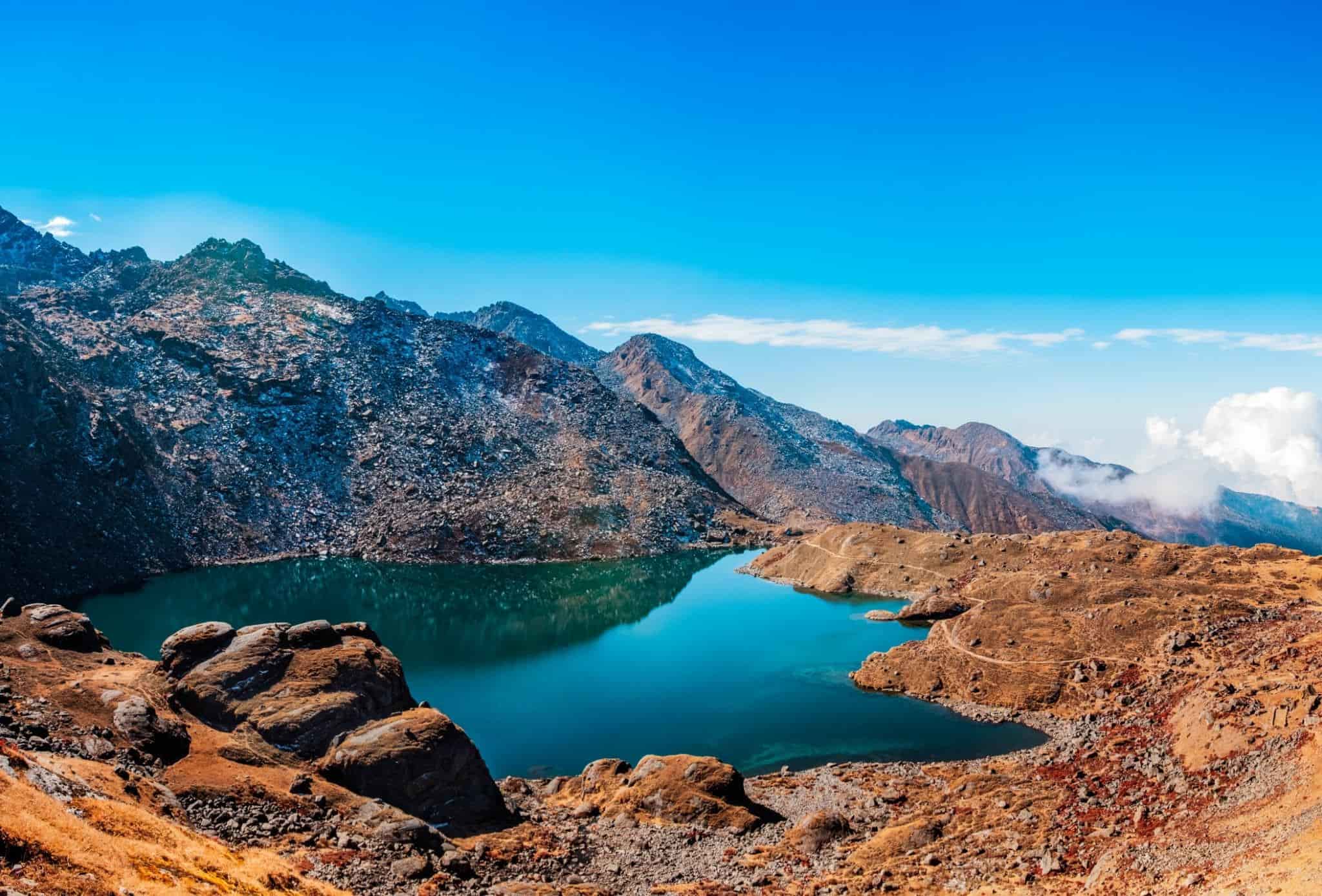
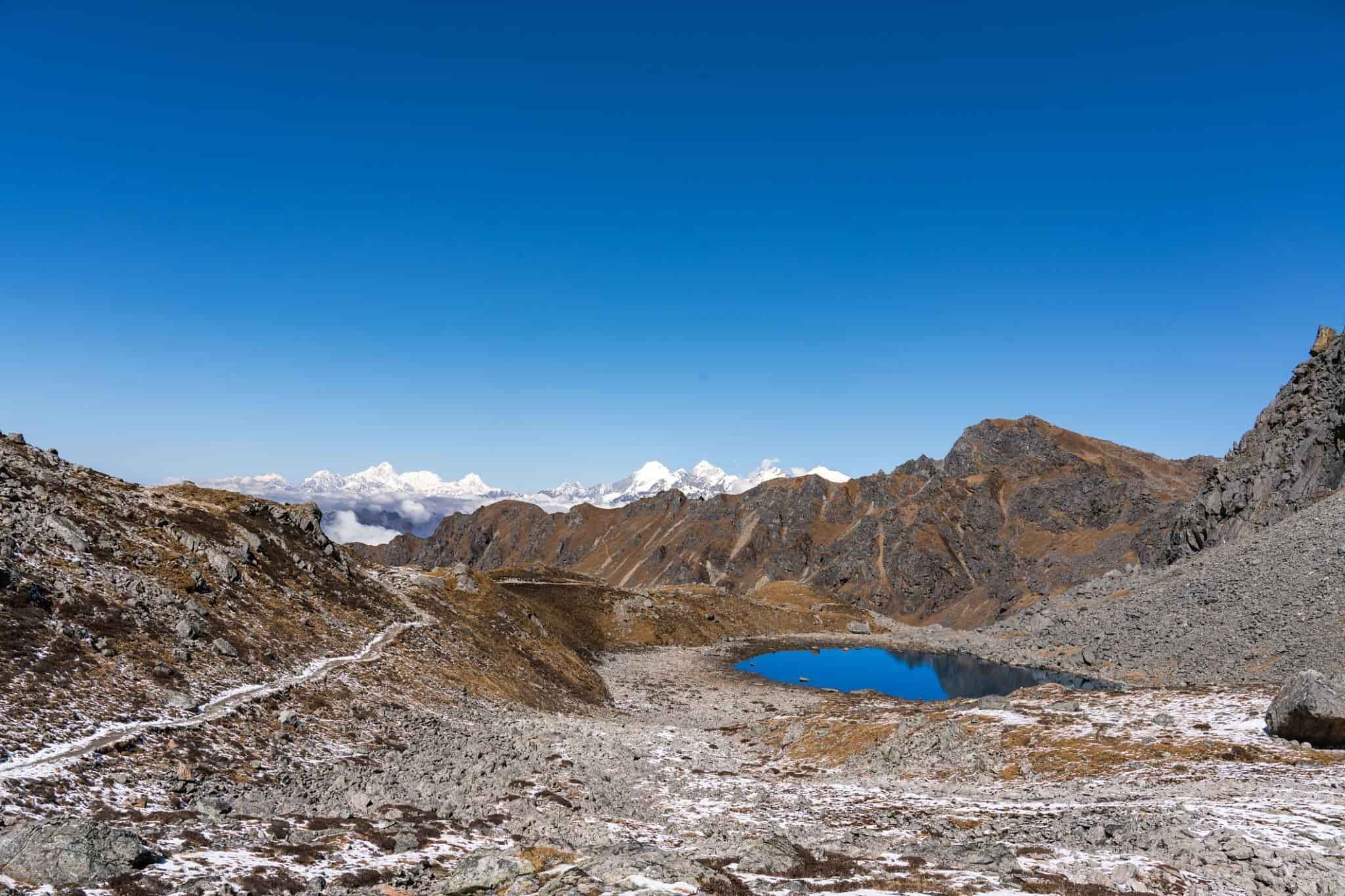
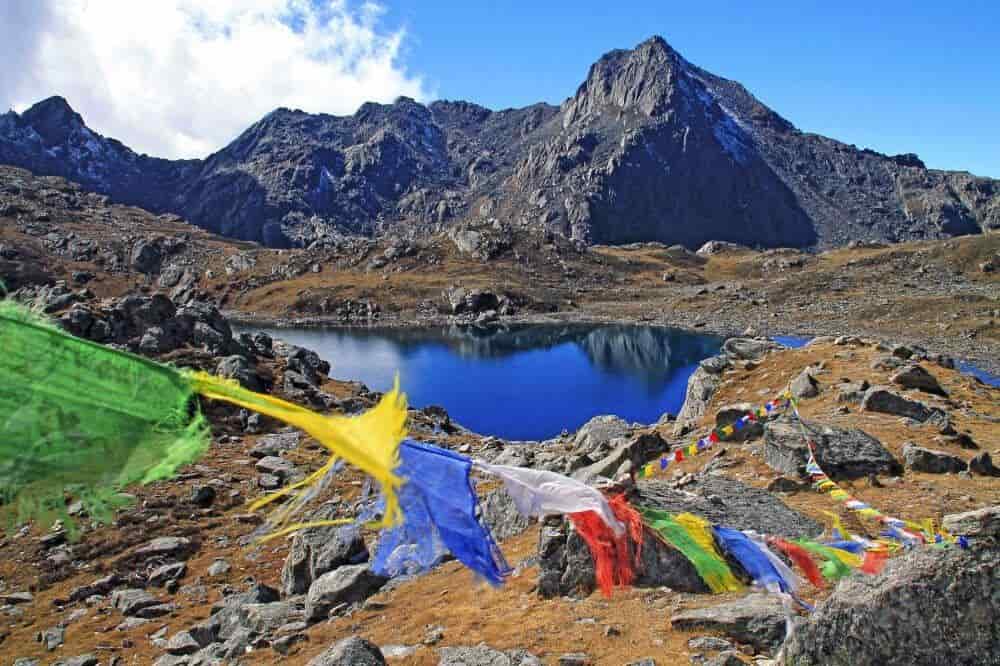
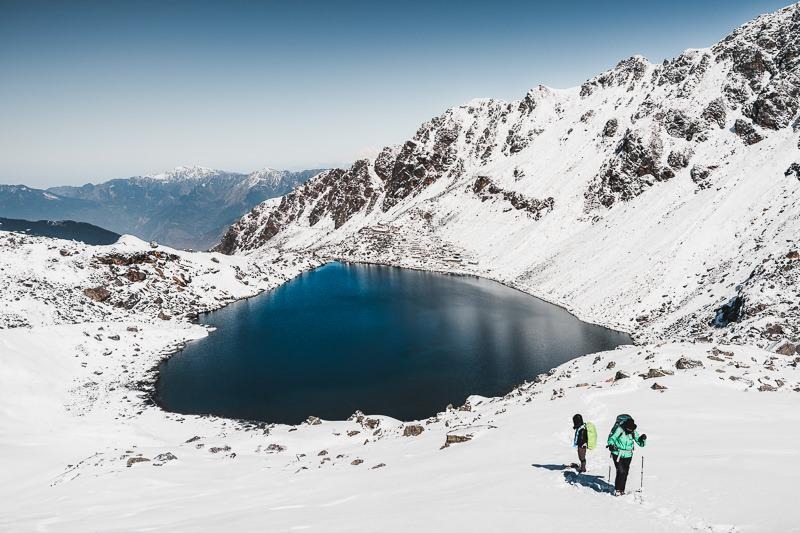
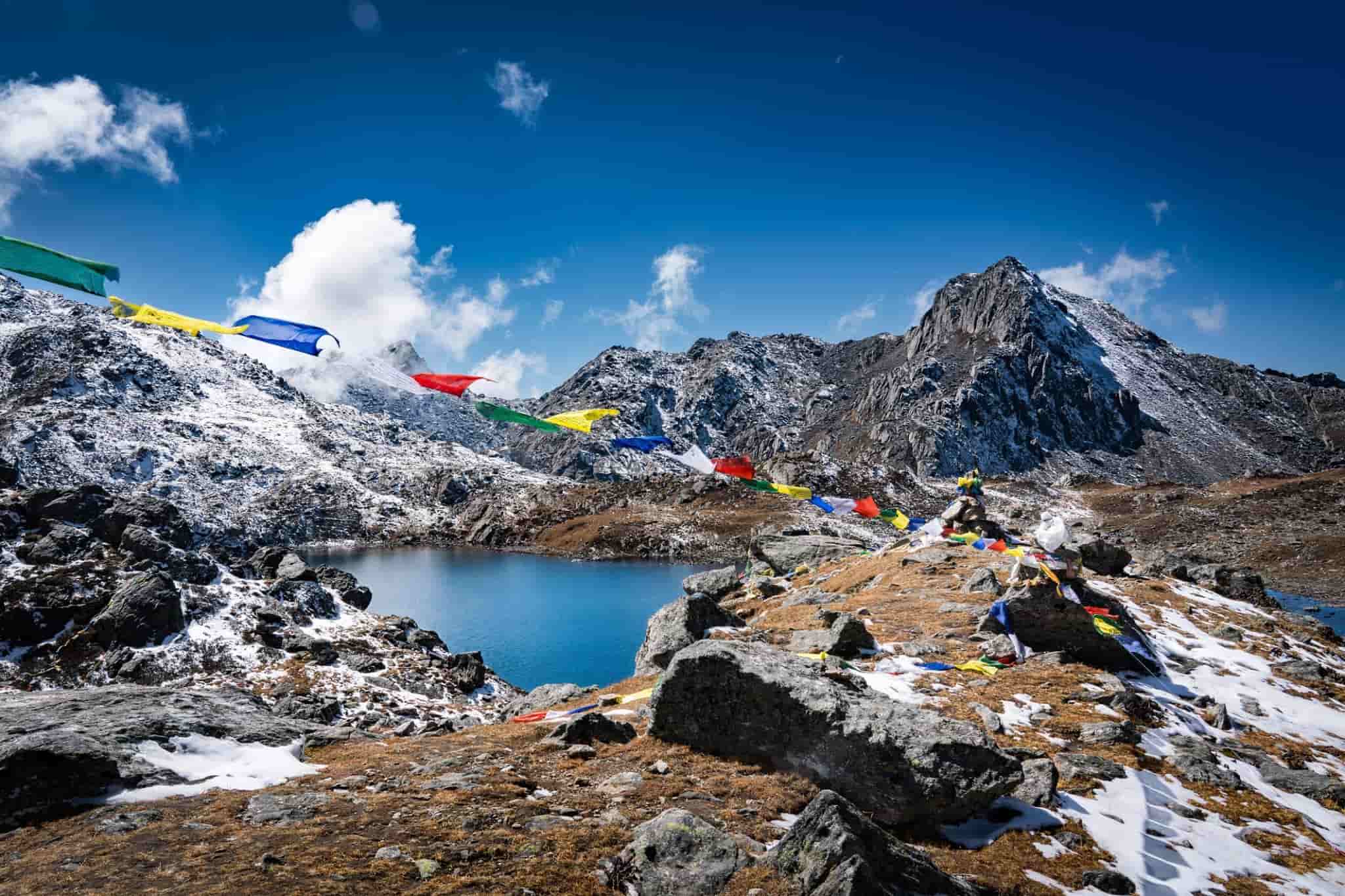
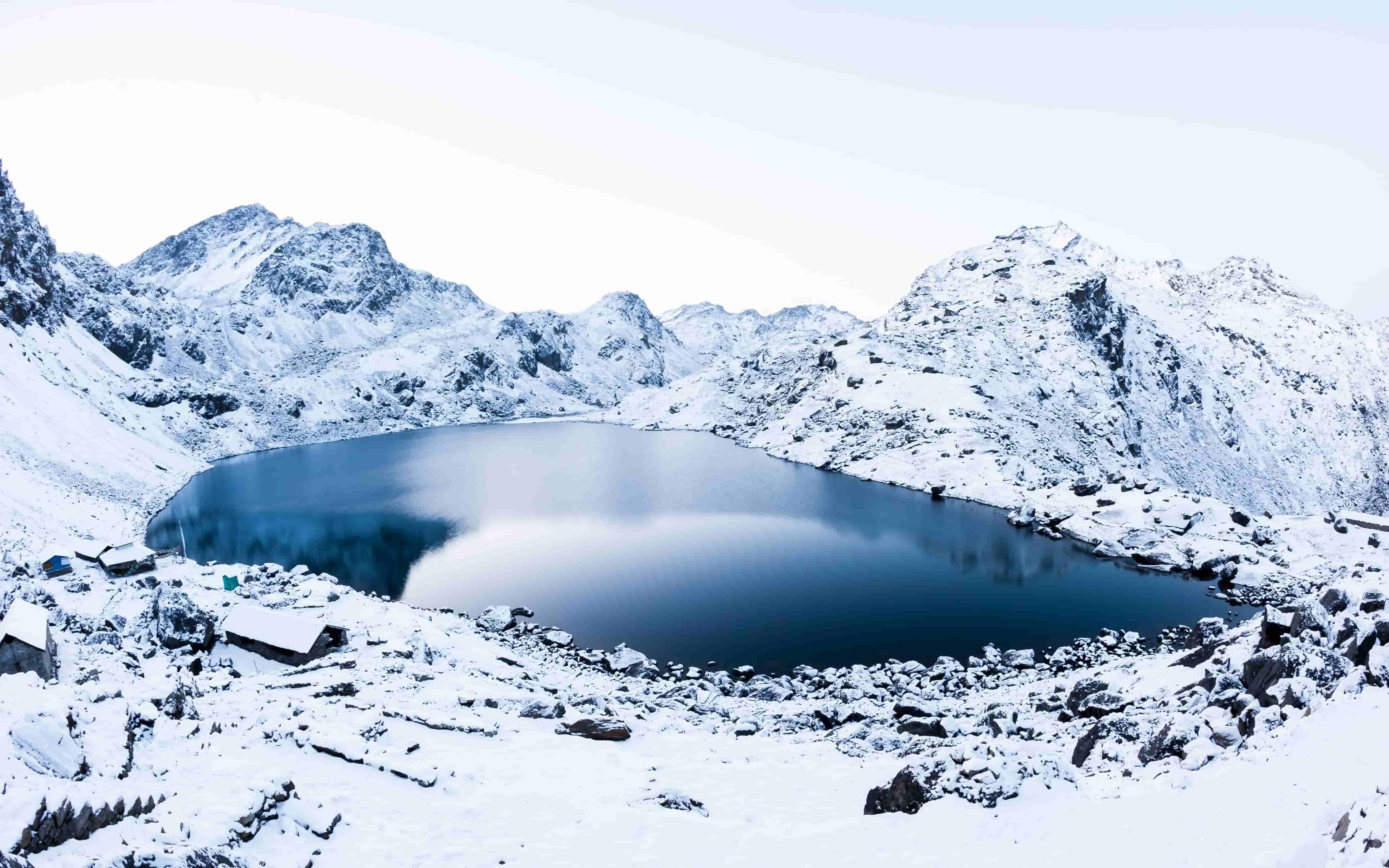
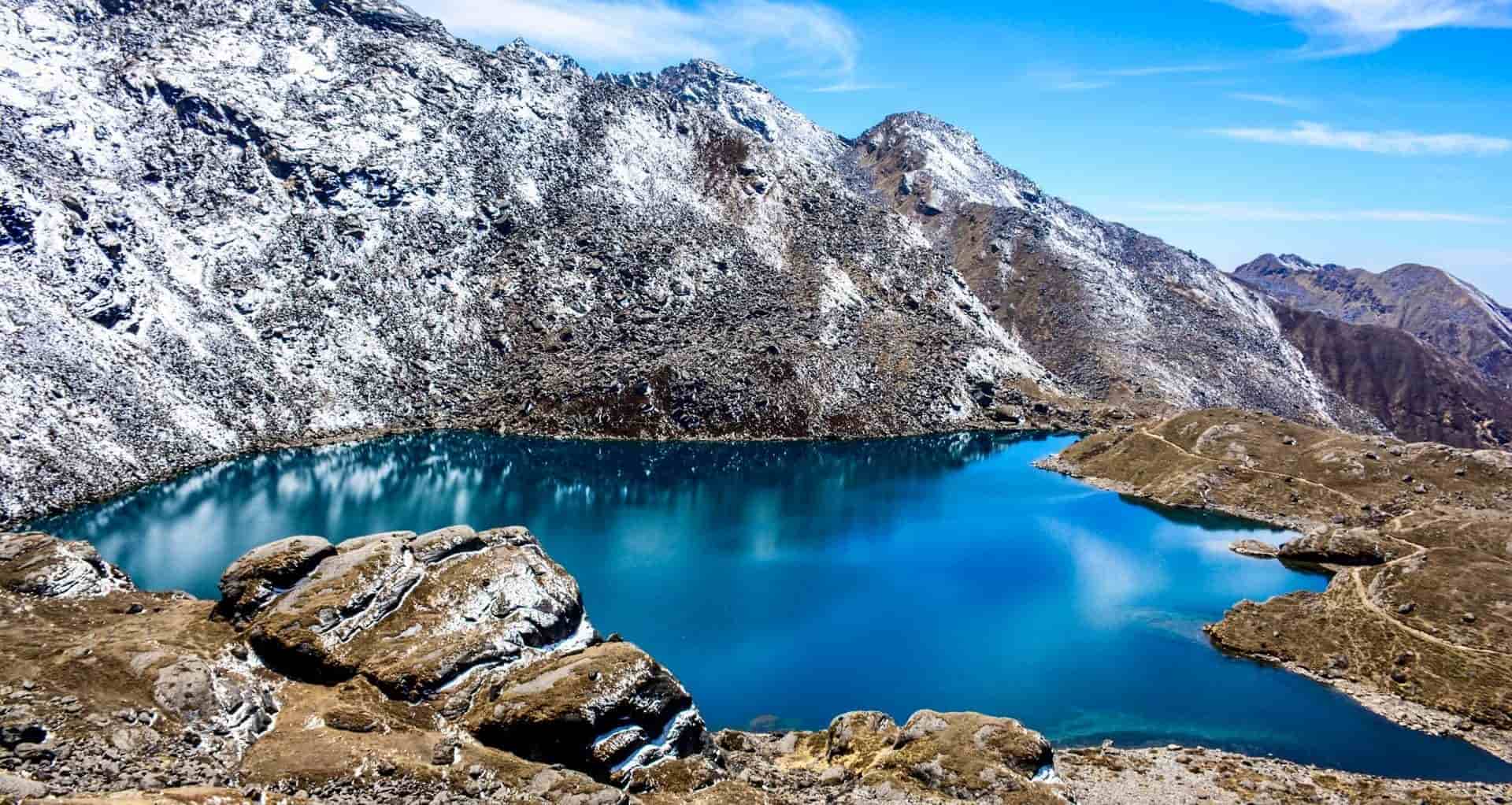
Gosainkunda Lake (4,380 m) is one of the most sacred sites in Nepal’s Himalayas. Hindu tradition says Lord Shiva created it, and the lake is also revered by Buddhists. Every year around the Janai Purnima full moon, pilgrims climb to its shores for a holy bath and prayers, so the lake is a place of devotion as well as a trekking highlight.
Spiritual Meaning
- Shiva’s lake: According to legend, Shiva struck the mountain with his trident to release water and cool his throat after swallowing poison, which is how Gosainkunda is said to have formed.
- Purification: Pilgrims believe that bathing in or sprinkling the water cleanses the spirit and brings blessings.
- Shared faith: Hindus, Buddhists and local shamans all honor the lake, and each tradition has its own rituals there.
- A living landscape: Small shrines, prayer flags and quiet offerings along the shore make the setting feel sacred even outside festival days.
About Janai Purnima
Janai Purnima falls on the full moon of the Nepali month of Shrawan, in late July or August, so the date changes each year. High-caste Hindu men change their sacred thread (janai) on this day as an act of spiritual renewal. It also coincides with Raksha Bandhan, when sisters tie rakhi threads on their brothers’ wrists. In earlier years, thousands of devotees have gathered at Gosainkunda Lake to bathe on the festival day.
An Important Safety Note
The festival falls in the middle of the monsoon, when trails are wet and slippery and weather changes fast. In 2026 this risk became tragically real. A violent flash flood swept through the Bhote Koshi and Trishuli river system in Rasuwa on 26 August 2026. Langtang, Kyanjin and Gosaikunda have since reopened for trekking, after a Bailey bridge was installed at Betrawati. Because of this, we recommend extra care with any trip planned around the festival, and we would not suggest it as a casual add-on.
Best Time to Visit Gosainkunda
| Goal |
Best Time |
Notes |
| Clear views and stable weather |
October to November |
The most reliable season for the full trek |
| Flowers and warm days |
April to May |
Snow may linger near the lakes in March |
| Festival atmosphere |
Janai Purnima (July or August) |
Wet, crowded and higher risk, so only with expert planning |
| Quiet and peaceful |
Early December |
Very cold, with a chance of snow at the lakes |
If You Plan to Join the Pilgrimage
- Choose an experienced local operator, and follow official advisories on weather and route conditions.
- Keep a flexible schedule with spare days, because delays are common in monsoon.
- Do not camp or rest close to rivers, gullies or steep slopes.
- Book accommodation in advance, since lodges near the lake are crowded and basic.
- Carry rain gear, warm layers, a headlamp and insurance that covers high-altitude trekking and helicopter evacuation.
- Respect the rituals, dress modestly, and never litter or wash in the lake.
Wildlife and Nature in Langtang National Park
Langtang National Park was established in 1976 and is Nepal’s first Himalayan national park. It covers about 1,710 square kilometers between the subtropical foothills and the Tibetan border. On the Langtang Gosainkunda Lake Trek, you climb through several climate zones in just a few days. Warm oak forest gives way to rhododendron and bamboo, then to juniper and birch, and finally to bare alpine meadows and glacial lakes. Wildlife sightings can never be promised, but the trail is full of nature, and the forests are a real treat even without an animal in view.
Nature Zones Along the Trek
| Zone |
Approximate Altitude |
What You Will See |
| Subtropical and lower forest |
1,400 to 2,300 m |
Oak, maple, bamboo and ferns around Syabrubesi and Lama Hotel |
| Rhododendron and mixed forest |
2,300 to 3,300 m |
Rhododendron, hemlock, birch and moss-covered trees |
| Subalpine zone |
3,300 to 4,000 m |
Juniper, shrubs, yak pastures and open valley views |
| Alpine zone |
Above 4,000 m |
Rocky slopes, glacial lakes, snow peaks and little vegetation |
Red Panda
The red panda is the most famous resident of Langtang’s forests, and one of the rarest and shyest. It lives in bamboo-rich forests, usually between roughly 2,200 and 3,600 m, spends much of its time in trees and is mostly active at dawn and dusk. The forests around Ghoda Tabela and the lower Gosainkunda area are known habitat. Sightings are rare, so treat one as a bonus, not a promise.
Other Mammals
- Himalayan black bear: Lives in the forests but avoids people.
- Himalayan tahr and ghoral: Mountain goat-like animals that you may spot on steep slopes.
- Grey langur monkeys: Often seen in the lower forests, especially in the early morning.
- Musk deer, yellow-throated marten and wild boar: Present in the park but rarely seen.
- Snow leopard: Found in the high country, but sightings by trekkers are extremely rare.
Himalayan Birds
Langtang is a good destination for birdwatchers, especially in spring and autumn.
- Himalayan monal (danphe): Nepal’s national bird, with shimmering, multicolored feathers.
- Pheasants and snowcocks: Blood pheasants and snowcocks live in the higher forests and meadows.
- Raptors: Eagles, lammergeiers and Himalayan griffons soar above the valley.
- Choughs and finches: Common around high villages, teahouses and yak pastures.
- Forest songbirds: Warblers, tits, laughingthrushes and others fill the lower forest with song.
Rhododendron Forests
Rhododendron is Nepal’s national flower, known locally as lali gurans. Trees of different heights and shades grow along the trail. Blooms usually appear between March and May and peak in April, painting the hillsides red, pink and white. In autumn, the same forests are rich in green, moss and morning mist, and the views are often clearer.
Rivers, Lakes and Glaciers
- Langtang River: Follows the trail for the first days, with waterfalls, rapids and forest views.
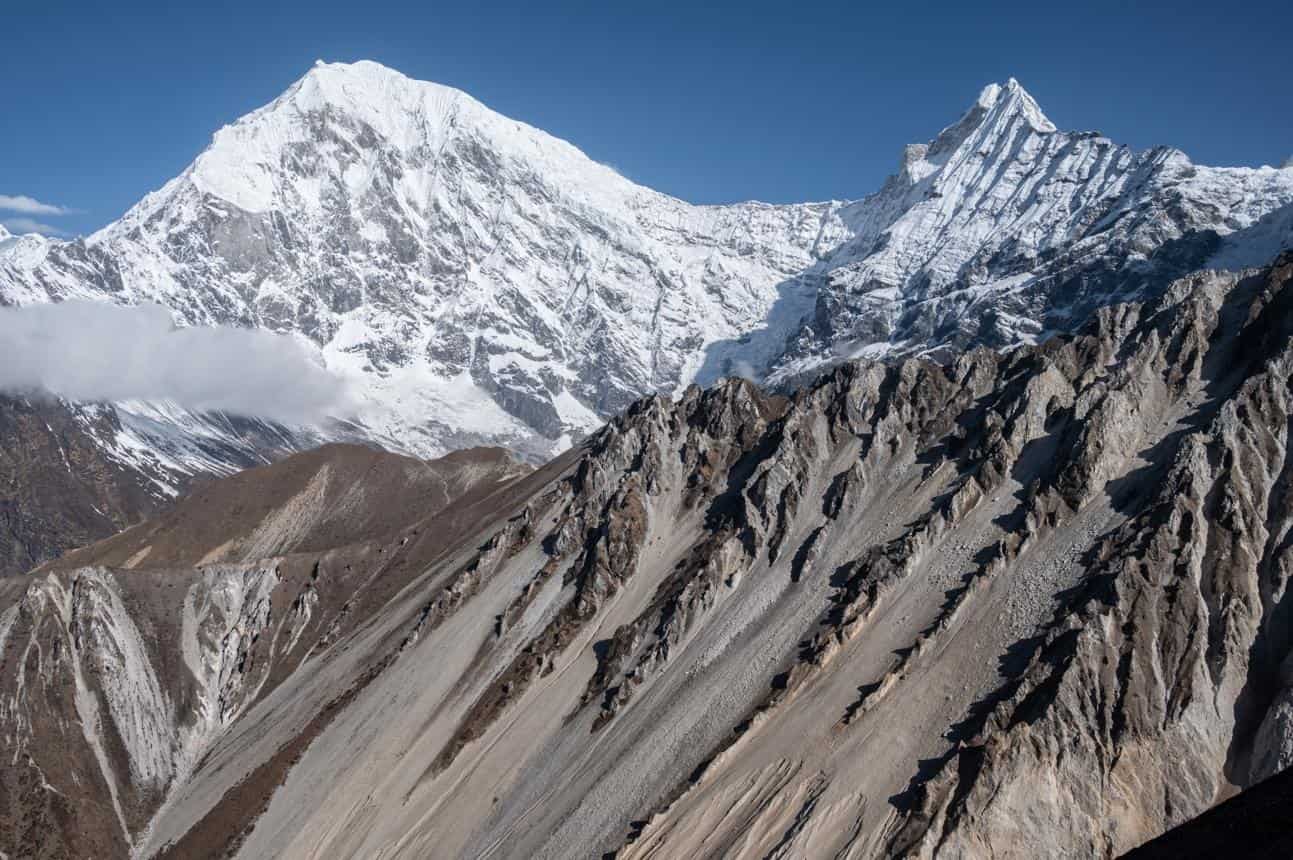
- Glaciers and snow peaks: Langtang Lirung and the peaks around Kyanjin Gompa tower above the valley.
- Gosainkunda lakes: A chain of cold alpine lakes with clear blue-green water, important for both nature and spirituality.
Best Time for Wildlife and Nature
- April and early May: Best for flowers, birds and active wildlife.
- October and November: Clear skies, crisp air and excellent mountain views.
- Winter: Fewer people and sharp light, but some animals move to lower altitude and trails can be icy.
- Monsoon: Lush and green, but leeches, rain and low cloud make wildlife viewing hard.
Responsible Wildlife Viewing Tips
- Walk quietly, and keep a safe distance from animals.
- Never feed or chase wildlife, and stay on marked trails.
- Use binoculars or a zoom lens instead of getting closer.
- Go early in the morning or around dusk for the best chance of sightings.
- Take all rubbish with you and avoid loud noise in forests.
- Follow your guide’s advice, because they know where animals are most active.
- Respect park rules, since Langtang is a protected area.
Why It Matters
Your park entry fee supports conservation, trail upkeep and local communities, and choosing local guides and teahouses helps protect this fragile mountain environment for the future.
Electricity, Wi-Fi and Mobile Network on the Langtang Gosainkunda Trek
Connectivity on the Langtang Gosainkunda Lake Trek is good in the lower villages and gets patchier as you climb. Most teahouses have electricity, often from solar panels or small hydropower, and many sell Wi-Fi or charging by the hour or the device. Signal depends on weather and terrain, and the region is still recovering from the August 2026 floods, so treat every figure below as a guide and confirm current conditions with your guide.
Connectivity at a Glance
| Stop |
Altitude |
Electricity and Charging |
Wi-Fi and Mobile Signal |
| Syabrubesi and Dhunche |
1,470 m / 1,950 m |
Reliable |
Best coverage on the route |
| Lama Hotel |
2,324 m |
Available, usually for a fee |
Weak or patchy |
| Mundu |
3,330 m |
Solar charging, limited |
Very limited |
| Kyanjin Gompa |
3,870 m |
Solar charging for a fee |
Paid Wi-Fi is often available, speeds vary |
| Thulo Syabru |
2,260 m |
Available |
Usually workable mobile signal |
| Sing Gompa |
3,330 m |
Limited solar |
Weak |
| Gosainkunda |
4,380 m |
Very limited, often cut when cloudy |
Little to no signal |
Electricity and Charging
- Paid charging: Most teahouses charge for each device, with prices rising at higher altitude, because power is scarce.
- Solar limits: On cloudy days, there may be little power, and charging can be restricted to certain hours.
- Power banks: Bring a power bank of 10,000 mAh or more, ideally two for longer trips, and charge it whenever you can.
- Sockets: Nepal uses mostly Type C, D and M sockets at 230 V. Bring a universal adapter and a multi-port charger.
- Cold drains batteries: Keep your phone and power bank inside your jacket or sleeping bag at night to protect their charge.
- Solar chargers: A small foldable panel can help, but it will not replace a power bank in poor weather.
Wi-Fi in Teahouses
- Wi-Fi is usually sold by the hour or by data pack, and costs more as you go higher.
- Speeds are slow and unreliable, especially in the evening when many trekkers connect at once.
- Do not count on Wi-Fi for urgent work, video calls or large uploads.
- Download offline maps, music, books and important documents before leaving Kathmandu.
Mobile Network and SIM Cards
- Local SIM or eSIM: The two main operators are Ncell and Nepal Telecom (NTC). You can buy a tourist SIM or eSIM in Kathmandu with your passport and a photo, or at the airport.
- Coverage differs: Coverage varies by operator and village, so ask your guide which network works best on your dates. Many trekkers carry one SIM from each operator.
- Data packs: Buy a data pack before you start, because top-ups on the trail can be difficult.
- Roaming: International roaming is expensive and unreliable in the mountains, so a local SIM is usually the better choice.
- No signal zones: Expect gaps between villages, in deep valleys and near Gosainkunda, so plan not to be reachable all day.
Safety and Emergency Contact
- Share your itinerary and daily check-in plan with family before you leave.
- Keep your phone charged for emergencies, and carry a power bank in your daypack.
- Your guide has a local phone and stays in contact with Nepal Trip Services, so emergency help does not rely on your own signal.
- Save your insurance number, emergency contacts and offline map on your phone.
Helpful Tips
- Switch your phone to airplane or battery-saver mode and turn off background apps.
- Take photos instead of streaming or video calls, to save power and data.
- Bring a small cable organizer and a short, sturdy charging cable.
- Enjoy the break. Many trekkers find that being offline is part of the experience.
Responsible Trekking and Local Etiquette on the Langtang Gosainkunda Trek
The Langtang Gosainkunda Lake Trek passes through a national park, sacred lakes and communities that have worked hard to rebuild after past disasters, including the 2015 earthquake and the August 2026 flood. Responsible trekking protects this fragile mountain environment and supports the local people who live in it. Small daily habits make a big difference, and your guide can help you put them into practice.
Leave No Trace Principles
| Principle |
What It Means on the Trail |
| Plan ahead |
Pack light, bring reusable items and know the rules of Langtang National Park |
| Stay on the trail |
Follow marked paths, and do not cut switchbacks, which causes erosion |
| Dispose of waste properly |
Carry out all non-biodegradable rubbish, including wrappers, batteries and tissues |
| Leave what you find |
Do not pick flowers, move stones or take souvenirs from shrines and nature |
| Minimize fire impact |
Use lodge stoves and avoid open fires, because forests grow slowly at altitude |
| Respect wildlife |
Observe from a distance, and never feed or chase animals |
| Be considerate of others |
Keep noise low, share the trail and give way to yaks, mules and porters |
Reduce Plastic and Waste
- Bring a reusable bottle and use boiled or filtered water or purification tablets instead of buying bottled water.
- Carry your own snacks in reusable bags, and avoid single-use packaging where you can.
- Take used batteries, sanitary items and wet wipes back to Kathmandu, because remote villages have limited disposal.
- Use biodegradable soap and toiletries, and never wash directly in streams or lakes.
- Choose quick-dry clothing and pack only what you need, to reduce the load for porters.
Respect Sacred Places
- Walk clockwise: Pass mani walls, chortens and prayer wheels on the left side, moving clockwise.
- Gosainkunda and the lakes: These are holy sites, so keep voices low, avoid washing, swimming or littering in them, and join rituals only if invited.
- Monasteries: Dress modestly, remove shoes and hats where asked, and ask before photographing inside.
- Sacred objects: Do not touch prayer flags, statues or offerings, or step over them.
Local Etiquette
- Greetings: Say “Namaste” with palms pressed together, or “Tashi Delek” in Tamang and Tibetan communities.
- Dress modestly: Cover shoulders and knees in villages, and avoid revealing clothing.
- Use your right hand: Offer and receive items, including food, with the right hand or both hands.
- Ask before photos: Always ask permission before photographing people, homes or rituals, and respect a “no.”
- Public affection: Keep it low-key, since it is not common in rural communities.
- Feet and heads: Do not point your feet at people or shrines, and avoid touching anyone’s head.
- Teahouse manners: Be patient and polite, and avoid bargaining hard over food or rooms.
Support the Local Community
- Stay and eat in family-run teahouses, and order your meals where you sleep, which is the usual courtesy.
- Buy local products such as yak cheese, handicrafts and woolen goods to put money directly into villages.
- Hire local guides and porters, and treat them as valued members of the team.
- Keep porter loads fair, within the 25 kg shared limit, and make sure they have warm clothing and proper shelter.
- Tip fairly if you are happy with the service. It is appreciated but not mandatory.
- After the 2026 floods, the Tamang communities of Rasuwa depend on returning trekkers, so your visit helps their recovery.
Do Not Give Sweets or Money to Children
Handing out candy, pens or money encourages begging and can harm children’s health and school attendance. If you want to help, donate to a local school, health post or community project through your guide or Nepal Trip Services.
Helpful Tips
- Ask your guide about local customs before you reach a new village.
- Learn a few Nepali words, such as “dhanyabad” (thank you).
- Do not drink alcohol around sacred sites, and avoid it at altitude.
- Report problems or concerns to your guide, rather than criticizing hosts in front of others.
- Leave every campsite, teahouse room and viewpoint cleaner than you found it.
Langtang Gosainkunda Trek Customization Options
No two trekkers are the same, so the Langtang Gosainkunda Lake Trek can be shaped around your time, fitness and interests. The standard itinerary is 12 days from Kathmandu to Kathmandu, but Nepal Trip Services can add rest days, extend the route toward Helambu or arrange a fully private departure. Tell us your dates, group size and goals, and we will build a plan that fits.
Customization at a Glance
| Option |
Best For |
What Changes |
| Extra acclimatization day |
First-time high-altitude trekkers, slower walkers |
Adds a rest or short hike day at Kyanjin Gompa or Sing Gompa |
| Helambu extension |
Trekkers with more time who want a longer loop |
Adds days through Helambu, with a different exit point |
| Private departure |
Couples, families, friends and small groups |
Your own dates, pace and guide |
| Shorter version |
Travelers with limited time |
Focuses on the Langtang Valley or the lower lakes |
| Comfort upgrades |
Trekkers who want extra ease |
Better Kathmandu hotels, extra porters or a private vehicle |
Extra Days
- Kyanjin Gompa rest day: A second day around Kyanjin Gompa lets you explore the monastery, visit the cheese factory or climb Kyanjin Ri or Tserko Ri at an easy pace.
- Extra stop before Gosainkunda: The climb from Sing Gompa to Gosainkunda is the steepest gain on the trek, so an additional night on the way gives your body more time to adjust.
- Buffer day: One spare day at the end of your trip protects you against weather or road delays.
- Kathmandu extras: Add a sightseeing day or an extra night before and after the trek to rest and explore the city.
Helambu Extension
The Helambu region lies south of Gosainkunda and is home to Sherpa and Tamang villages, gentle forest trails and rhododendron slopes. After crossing the Laurebina area, you can continue toward Tharepati and finish at Sundarijal near Kathmandu, instead of descending to Dhunche. This creates a longer, more varied loop with fewer repeated sections and a new final view of the valley. Recent route updates also describe Helambu as open for trekkers. This option needs a few extra days, and your guide will confirm trail conditions before you set out.
Private Departures
A private departure gives you:
- Your own dates: Start any day that suits you, not only on fixed group dates.
- Your own pace: Walk slowly, add rest days or take longer photo stops.
- Personal attention: Your guide’s focus stays on your group, which is ideal for families, couples and friends.
- Flexible planning: Adjust meals, rooms, side hikes and Kathmandu stays to your tastes.
- More privacy: Enjoy quieter mornings and dedicated support.
Private trips are priced by group size, with lower per-person rates for larger groups, and a custom quote is available on request.
Other Ways to Customize
- Seasonal timing: Choose spring for flowers and autumn for the clearest views, with our advice on the best dates.
- Fitness level: Pick a gentler route with shorter days, or a more challenging plan with added hikes such as Surya Peak.
- Interests: Focus on culture, photography, birdwatching or spiritual sites, and we will adapt stops and timing.
- Accommodation: Request upgraded hotels in Kathmandu or a quieter teahouse choice where available.
- Combine with other trips: Add the Langtang Valley, a Kathmandu Valley tour, Pokhara or Chitwan before or after the trek.
- Route changes: The route can also be adjusted to current road and trail conditions, which have changed after the August 2026 floods.
How to Customize Your Trek
- Send us your preferred dates, group size, fitness level and any special requests.
- Our team suggests a draft itinerary and a clear price.
- We fine-tune details together until you are happy.
- Confirm your booking and start preparing, with our help on permits, gear and insurance.
Helpful Tips
- Share your budget and expectations early, so we can propose the best plan.
- Book early for October, November and April, the busiest months.
- Add buffer days if your flights are tight.
- Ask us about cost differences, because extra days, private services and upgrades affect the final price.
How to Book the Langtang Gosainkunda Lake Trek
Booking with Nepal Trip Services is quick and personal. You can reserve online in a few minutes, or talk to a trek expert first to shape the itinerary around your dates and fitness. Our team replies fast, and you will get a clear confirmation, a trip checklist and help with permits, gear and insurance.
Simple Booking Steps
- Choose your dates and group size. The price depends on the number of trekkers, from US$999 for one person to US$800 per person for groups of 7 to 10. October, November and April are the busiest months, so book early for these.
- Send an enquiry or book online. Use the “Book This Trip” button on the trek page, or the “Make an Enquiry” form to ask questions first. You can also reach us on WhatsApp or Viber at +977-9828696557, or by email at info@nepaltripservices.com.
- Get your personal itinerary. Our expert confirms the route, start point, trail conditions and any customization, such as extra days or a Helambu extension.
- Pay your deposit. A deposit secures your spot and your guide for your dates.
- Send your details. We need your passport copy, arrival and departure flights, a passport-size photo, emergency contact and your travel insurance details.
- Prepare for the trek. We share a packing list, fitness advice and Kathmandu hotel suggestions, and arrange your permits.
- Meet us in Kathmandu. Your team picks you up at the airport, runs a pre-trek briefing and checks your gear before you set off.
Payment Guidance
- Deposit: [add your deposit percentage here] confirms your booking.
- Balance: [add when the balance is due, for example before departure or on arrival in Kathmandu].
- Payment methods: The site shows Visa, American Express, MasterCard and UnionPay. Please also add bank transfer or cash options if you accept them.
- Card fees: [add any card processing fee, if applicable].
- Currency: Prices are quoted in US dollars.
- Receipt: You will receive a written confirmation and payment receipt.
Cancellation and Changes
-
Cancellation by You: If you cancel your trip, the following cancellation charges will apply:
-
60 days or more before departure: 20% of the total trip cost (non-refundable booking deposit).
-
30–59 days before departure: 50% of the total trip cost.
-
15–29 days before departure: 75% of the total trip cost.
-
Less than 15 days before departure or no-show: 100% of the total trip cost.
-
Any non-refundable permit, flight, hotel or other advance booking charges will also be deducted where applicable.
-
Postponement: You may request to postpone your trip at least 30 days before departure, subject to availability. One date change may be permitted without a postponement fee, although additional costs arising from new bookings, permits or seasonal price differences must be paid by you. Requests made less than 30 days before departure may incur additional charges.
-
Cancellation by Us: If we cancel your trip due to unforeseen circumstances, unsafe weather conditions, natural disasters, road closures or other unavoidable safety concerns, we will offer an alternative departure date or a refund for the services not provided. Any non-recoverable expenses already paid to third-party providers may be deducted where applicable. If a trip is interrupted after it has started, additional accommodation, transportation or evacuation costs may be the responsibility of the traveller.
-
Notice: All cancellation, postponement and change requests must be submitted in writing by email. The date we receive your written request will be considered the official cancellation or change date.
-
Insurance: We strongly recommend purchasing comprehensive travel insurance at the time of booking. Your policy should cover trip cancellation and interruption, medical expenses, emergency helicopter evacuation and high-altitude trekking up to at least 5,000 metres. Please check the policy exclusions and coverage limits before travelling.
What We Need Before You Travel
- A passport valid for at least six months
- Nepal visa (available on arrival or online)
- Travel insurance with high-altitude and helicopter evacuation cover
- Details about allergies, food needs and medical conditions
- Your preferred Kathmandu hotel level, if you want us to arrange it
Helpful Tips
- Book your international flights only after your trek dates are confirmed with us.
- Keep two spare days in Kathmandu for weather or flight delays.
- Ask about the latest trail and road conditions, because routes in Rasuwa have changed since the August 2026 floods.
- Read the trip details and terms before paying, and ask us anything that is unclear.
Frequently Asked Questions (FAQs)
1. What is the Langtang Gosainkunda Lake Trek?
It is a 12-day trek in the Himalayas north of Kathmandu that combines two famous areas: the Langtang Valley and the sacred Gosainkunda lakes. You walk through forests and Tamang villages to Kyanjin Gompa, climb a viewpoint for mountain panoramas, then cross to the holy alpine lakes before descending to Dhunche.
2. How many days does the trek take?
The standard itinerary is 12 days from Kathmandu to Kathmandu, including two driving days and about nine days of walking. It can be shortened or extended, for example by adding a rest day at Kyanjin Gompa for extra acclimatization.
3. Where does the trek start and end?
It starts with a drive from Kathmandu to Syabrubesi and ends in Dhunche, from where you drive back to Kathmandu.
4. What is the highest point on the trek?
The highest point on the standard route is Tserko Ri at 4,985 m, reached on a day hike from Kyanjin Gompa. Gosainkunda Lake sits at 4,380 m, and the optional Surya Peak hike goes up to about 5,145 m.
5. Is this a good trek for first-time trekkers?
Yes, if you are reasonably fit and prepared for long walking days. The trek is rated moderate to challenging because of the altitude and steep sections, but it needs no technical skills or climbing experience.
6. How difficult is the trek?
The hardest parts are the climb to Gosainkunda, the high-altitude days above 4,000 m and the steady uphill sections toward Kyanjin Gompa. Most days involve 4 to 7 hours of walking, and the rest-and-acclimatization day helps a lot.
7. How long do we walk each day?
Most days are 3 to 7 hours, depending on the section. Short days such as Mundu to Kyanjin Gompa (3 to 4 hours) leave time to rest and adjust to the altitude.
8. How far is the total trekking distance?
The route covers roughly 80 to 100 km on foot, depending on side hikes and the exact trail taken. Your guide will confirm the daily distances on the trail.
9. What is the best time to do this trek?
Autumn (September to November) and spring (March to May) are the best seasons, with stable weather, clear mountain views and comfortable trails. Spring also brings rhododendron blooms, and autumn has the sharpest views.
10. Can I trek in winter?
Yes, but December to February is very cold at high altitude, and the Laurebina Pass and Gosainkunda area can be snowbound. Lower sections are fine, but the high route may need adjustments, so ask us before booking.
11. Can I trek during monsoon (June to August)?
It is possible, but we generally don’t recommend it. Rain, leeches, cloud-covered views and landslide risk make the trails harder. If you want to visit Gosainkunda for the Janai Purnima festival in August, tell us in advance so we can plan carefully.
12. How cold does it get?
In autumn and spring, daytime temperatures in the valley are mild, while nights at Kyanjin Gompa and Gosainkunda can drop below freezing. A warm down jacket and a good sleeping bag are essential.
13. What does the typical day-by-day route look like?
Kathmandu to Syabrubesi, then Lama Hotel, Mundu, Kyanjin Gompa, a day hike to Tserko Ri or Kyanjin Ri, back to Lama Hotel, Thulo Syabru, Sing Gompa, Gosainkunda, Surya Peak hike and descent toward Cholangpati, Dhunche and finally Kathmandu.
14. How long is the drive from Kathmandu to Syabrubesi?
Usually 7 to 9 hours, depending on road conditions and traffic. The road is scenic but winding, so it helps to start early and carry snacks and water.
15. Can the itinerary be customized?
Yes. We can add an extra acclimatization day, extend the trip to Helambu, or shorten it if your time is limited. Share your dates and fitness level and we will adjust the plan.
16. Is the Tserko Ri climb compulsory?
No. It is a day hike you can skip or replace with Kyanjin Ri (4,773 m), which is a little lower and easier. Both give excellent views of Langtang Lirung and the surrounding peaks.
17. Is the Surya Peak hike compulsory?
No, it is optional. It is a strenuous early morning hike at high altitude, so your guide will decide based on weather and how everyone is feeling.
18. What permits do I need?
You need a Langtang National Park entry permit, plus any local trekking fees or registrations required for the route. We arrange all permits, and you only need to bring your passport and passport-size photos. Permit prices change occasionally, so we confirm the current fees at booking.
19. Do I need a visa for Nepal?
Most nationalities can get a visa on arrival at Tribhuvan International Airport or apply online in advance. Check the latest rules and fees with the Nepal immigration website before you fly.
20. Do I need to hire a guide?
A guide is strongly recommended, and some trekking permits and regulations now expect trekkers to use a registered guide. A local guide also improves your safety, helps with acclimatization, shares cultural insight and handles teahouse bookings.
21. Is altitude sickness a risk on this trek?
Yes, it can be, because you spend nights above 3,800 m and Gosainkunda reaches 4,380 m. Walking slowly, drinking plenty of water, eating well and following your guide’s advice greatly reduce the risk.
22. What are the symptoms of altitude sickness?
Common signs are headache, nausea, dizziness, loss of appetite and trouble sleeping. If symptoms get worse, you should stop going up or descend, and your guide will make that call.
23. How do you manage acclimatization?
The itinerary includes gradual ascents and a rest day around Kyanjin Gompa with a “climb high, sleep low” day hike. We also monitor everyone’s health daily and adjust the pace when needed.
24. What happens in an emergency?
Your guide carries a first-aid kit and can arrange descent, local medical help or helicopter evacuation. This is why travel insurance with high-altitude evacuation cover is mandatory for our trekkers.
25. Do I need travel insurance?
Yes. Choose a policy that covers trekking up to at least 5,000 m, emergency helicopter evacuation, medical treatment and trip cancellation or delay.
26. How fit do I need to be?
You should be able to walk 5 to 6 hours a day on uneven terrain with a light daypack. Regular cardio, hiking, stair climbing or cycling for 6 to 8 weeks before the trek makes a big difference.
27. What should I pack?
Pack layers: a base layer, fleece, down jacket, waterproof shell, trekking pants, sturdy broken-in boots, warm hat, gloves, sunglasses, sunscreen, a headlamp, a water bottle and a sleeping bag. Trekking poles, a first-aid kit and personal medication are also useful.
28. Can I rent trekking gear in Kathmandu?
Yes. Sleeping bags, down jackets, poles and other equipment are available for rent or purchase in Kathmandu’s Thamel area at reasonable prices.
29. How much luggage can the porter carry?
Each porter carries up to 25 kg shared between two trekkers, so about 12 to 13 kg each. Keep a small daypack with your water, camera, snacks, rain jacket and valuables.
30. What is the accommodation like?
You stay in simple teahouses or lodges with twin-sharing rooms, blankets and shared bathrooms. Rooms get colder and more basic as you go higher, so a sleeping bag is recommended.
31. What food is available on the trek?
Menus include dal bhat (rice, lentils and vegetables), noodles, soups, pasta, eggs, Tibetan bread, momos and porridge. Dal bhat is the most reliable and gives long-lasting energy. Vegetarian options are widely available, and Langtang is known for local yak cheese.
32. Is drinking water safe?
Don’t drink untreated tap or stream water. Buy bottled water or, better, use boiled or filtered water or purification tablets to reduce plastic waste.
33. Are there hot showers, charging points and Wi-Fi?
Hot showers, device charging and Wi-Fi are available in many teahouses for an extra fee, but they get limited and slower at higher altitudes. A power bank and a local SIM or eSIM can help.
34. What is included in the trip cost, and how do I book?
The cost normally covers ground transport, guide and porter service, meals during the trek, teahouse accommodation, permits and taxes. It does not cover international flights, visa, Kathmandu hotels, insurance, personal gear, drinks and tips. To book, contact Nepal Trip Services with your preferred dates and group size, and we will confirm availability, price and the booking steps.
35. Why choose Nepal Trip Services for this trek?
You get experienced local guides, a carefully planned itinerary, flexible customization and attentive support from first inquiry to the end of the trek. Safety, authentic culture and a smooth trip come first.