Everest Base Camp Helicopter Tour: What To Expect, From Kala Patthar Landing To Breakfast Facing Everest
By Nepal Trip Services On 22 Oct 2026

By Nepal Trip Services On 22 Oct 2026
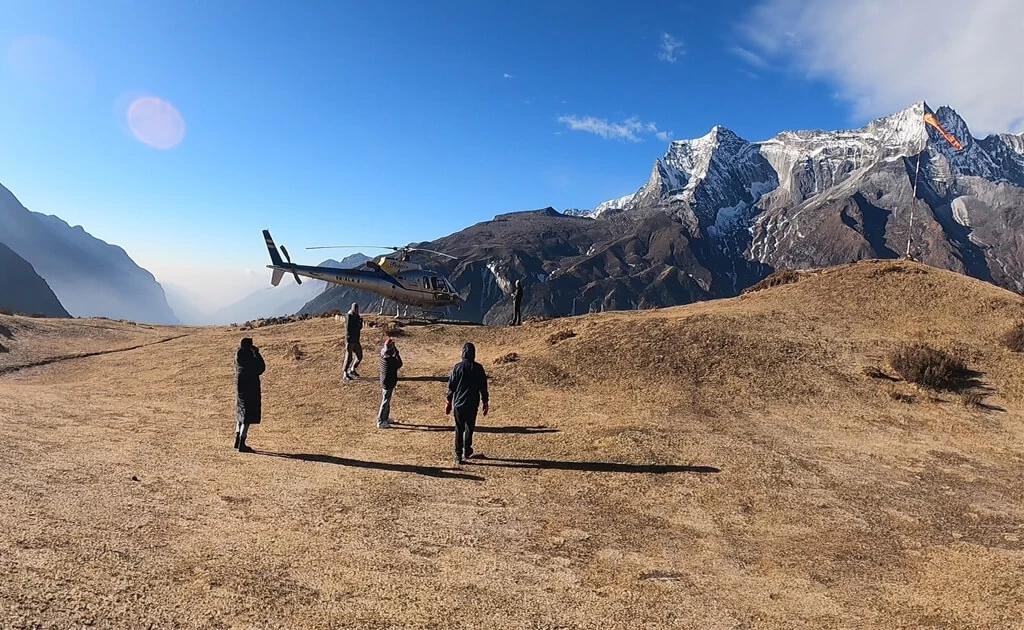
The Everest Base Camp Helicopter Tour takes you from your Kathmandu hotel to Kala Patthar (5,545m), facing the summit of Mount Everest, and back again by late morning. The whole trip takes about four to five hours. Walking to the same viewpoint on the classic trek takes 12 to 14 days.
This guide follows the day in the order you will live it. It covers the 5:30 AM pick-up, the Lukla refuelling stop, the flight over Everest Base Camp, the landing at Kala Patthar and breakfast at Hotel Everest View. It also answers the practical questions helicopter fans ask most: which aircraft flies, where to sit, how altitude affects the load and what happens when the weather turns.
If you already know you want to go, the full itinerary, inclusions and departure dates are on the Everest Base Camp Helicopter Tour with Kala Patthar Landing & Breakfast page.
Here are the key facts before we go through the day hour by hour.
|
Detail |
What to expect |
|---|---|
|
Total time |
About 4–5 hours, same-day return to Kathmandu |
|
Start and end |
Your hotel in Kathmandu (1,400m), with private pick-up and drop-off |
|
Flight route |
Kathmandu → Lukla → Everest Base Camp flyover → Kala Patthar → Syangboche (Hotel Everest View) → Lukla → Kathmandu |
|
Highest point |
Kala Patthar, 5,545m (18,192 ft) |
|
Time on Kala Patthar |
5–10 minutes |
|
Breakfast |
Hotel Everest View, Syangboche (3,880m), 45–60 minutes |
|
Aircraft |
Usually an Airbus H125 (AS350 B3e) |
|
Passengers |
Up to 5 per helicopter |
|
Difficulty |
Easy, with no trekking needed |
|
Best seasons |
October–November and March–May |
|
Price |
From US$1,500 per person (sharing) or from US$5,000 per helicopter (private) |
Your Everest day starts the night before. The Nepal Trip Services team calls or messages you to confirm the pick-up time, check the weather forecast and share final tips on clothing.
Use that evening to get ready:
At around 5:30 AM, a representative meets you in your hotel lobby. A private vehicle takes you through quiet streets to the domestic terminal at Tribhuvan International Airport. Pick-ups cover central areas such as Thamel, Durbar Marg, Boudha and Lazimpat.
At the airport, the team handles check-in and permits. Passengers and bags are weighed, and you meet your pilot for a safety briefing. It covers how to approach the helicopter, seatbelts and headsets, the Kala Patthar landing and the signs of altitude sickness.
The helicopter lifts off over Kathmandu Valley and turns east toward the Everest region. The first leg to Lukla takes about 45 to 50 minutes.
Below you, terraced hills and small villages give way to the Sunkoshi and Dudh Koshi river valleys. On a clear morning, the Langtang, Gaurishankar and Rolwaling ranges appear along the horizon. For the best mountain views on this outbound leg, the left side of the cabin is usually better.
Around 7:20 AM, you land at Tenzing-Hillary Airport in Lukla (2,860m), the gateway to Everest. Its short, steep runway is famous among pilots and aviation fans. The stop lasts 10 to 15 minutes while the pilot refuels and lightens the load for the thinner air ahead.
This 20 to 25 minute leg is the reason many people book a helicopter. In one short flight, you see the whole route that trekkers walk over almost two weeks.
In order, you pass:
The helicopter flies over Everest Base Camp rather than landing there. The landing comes next, at a better viewpoint about 180m higher.
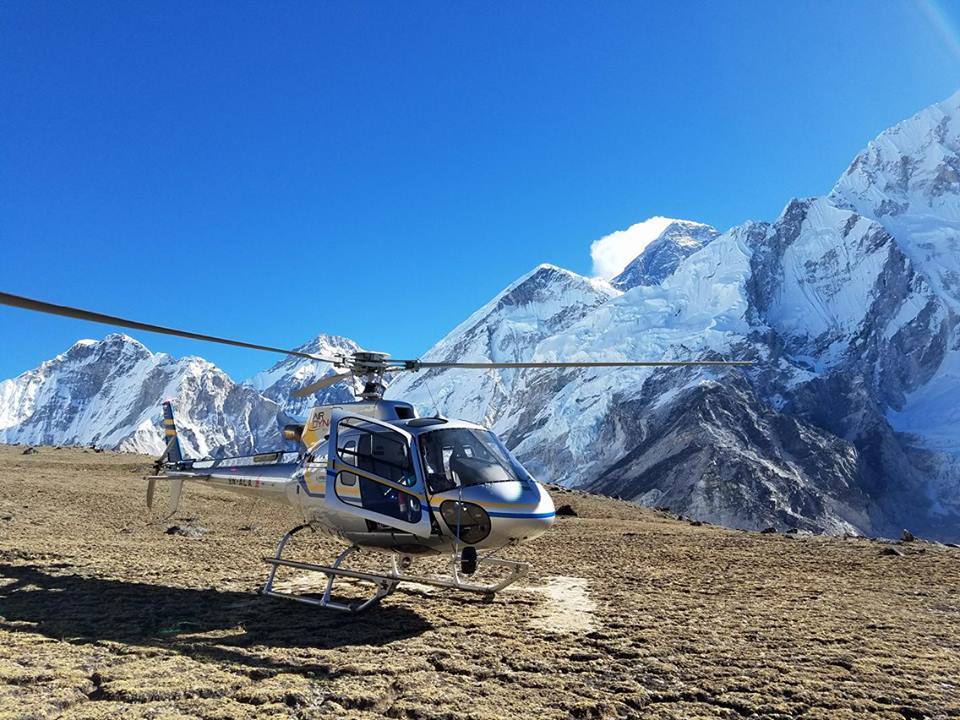
At about 8:00 AM, the helicopter touches down on Kala Patthar, the best-known Everest viewpoint in the Khumbu. You step out at 5,545m (18,192 ft), higher than Everest Base Camp, with the summit of Everest (8,848.86m) straight ahead.
The air at Kala Patthar holds about half the oxygen of sea level. You flew up from 1,400m in about an hour and a half, so your body has had no time to adjust. A short stop keeps the risk of altitude sickness low, and the cold and changing weather also call for a quick departure.
Morning temperatures here usually sit between -20°C and -5°C, and the wind makes it feel colder. Ten minutes is enough for photos and a quiet moment.
Thin air reduces how much weight a helicopter can lift. On a full or heavier flight, the pilot may fly passengers up to Kala Patthar in two short trips. The first group waits briefly at a lower point such as Pheriche or Lobuche. This is normal, safe practice in the Everest region, and everyone still gets the landing.
If clouds or wind make Kala Patthar unsafe, the pilot will choose another viewpoint instead.
From Kala Patthar, the helicopter drops down to Syangboche (3,880m), a short walk from Hotel Everest View. Japanese hotelier Takashi Miyahara built the hotel in 1971. It was once listed by Guinness World Records as the highest-placed hotel in the world.
You get 45 to 60 minutes here. Breakfast is served on the terrace or, on a cold or windy day, in the dining room. Everest, Lhotse, Ama Dablam and Thamserku fill the view.
A typical set breakfast includes:
The menu changes with the season, and vegetarian options are available on request. Breakfast is included in the tour price, while extra drinks, snacks and souvenirs are paid separately.
This stop is more than a meal. At 3,880m, your body recovers from the high landing while you warm up with a hot drink. If you booked a proposal or celebration add-on, this is when the cake and champagne appear.
If the weather closes in at Syangboche, breakfast may be served in Lukla or at another stop.
After breakfast, the helicopter flies back down the valley to Lukla for a final refuelling stop. This is your last look at the Khumbu peaks, so keep the camera ready.
You land in Kathmandu at around 10:30 AM, depending on the weather and air traffic. The team drives you back to your hotel, and the rest of the day is free to explore the city.
All times in this guide are approximate. The pilot may adjust the schedule for weather, air traffic or safety.
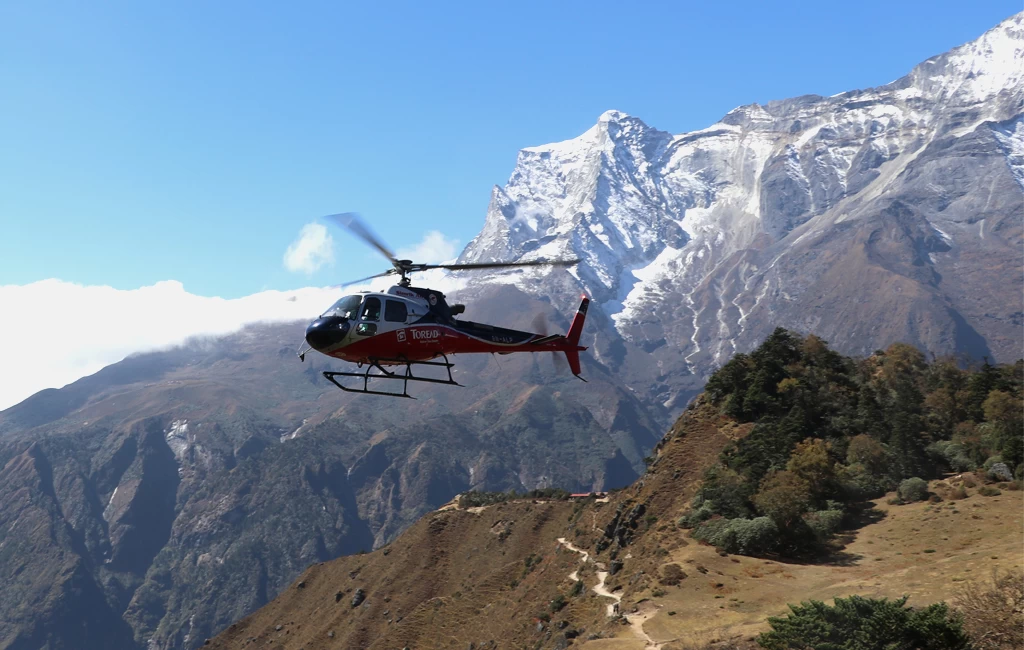
Most Everest helicopter tours from Kathmandu fly the Airbus H125 (AS350 B3e), the standard aircraft for high-altitude work in Nepal. It is used for sightseeing flights, mountain rescues and expedition support across the Himalayas.
The exact aircraft depends on the operator and availability, but every helicopter used is approved for high-altitude flying.
|
Seat |
What you get |
|---|---|
|
Front seat, beside the pilot |
The widest, clearest views |
|
Rear window seats |
Good side views for photos |
|
Rear middle seat |
Limited views, rotated between legs where possible |
On sharing flights, the pilot assigns seats by weight and balance, so the front seat is not guaranteed. A private charter gives you more say over who sits where.
The higher a helicopter climbs, the less weight it can safely carry. Up to five passengers can fly to Lukla and Syangboche, but Kala Patthar may need the shuttle approach described above.
That is why you are asked for each passenger's approximate weight when booking. It is a safety figure, not a judgement, and it may be checked at the airport.
The risk of altitude sickness on this tour is low, because you spend only minutes at 5,545m and then descend quickly. Some passengers still feel a light headache, dizziness or breathlessness during the climb. These symptoms usually ease once the helicopter heads down to Syangboche.
Mountain weather decides every Everest flight. Common causes of delay include morning fog in Kathmandu (especially December to February), low cloud around Lukla, strong winds up high, and rain or snow.
|
If this happens |
What the team does |
|---|---|
|
A short delay |
You wait at the airport or hotel until it clears |
|
The flight is cancelled on the day |
It is moved to the next available day |
|
The weather changes in the air |
The pilot picks another safe landing point |
|
Flights keep getting cancelled |
You can choose a full refund or switch to another tour |
The best protection is time. Book the tour early in your Nepal trip, not on your last day, and keep one or two spare days free.
For month-by-month weather, crowds and visibility, read the Best Time for an Everest Helicopter Tour: Month-by-Month Guide.
Kathmandu may feel mild at dawn, but Kala Patthar is often well below freezing. Wear your warm layers rather than packing them, since bag space on the helicopter is limited.
No warm gear? You can rent or buy down jackets, gloves and hats cheaply in Thamel.
Leave drones at your hotel. Flying one in Sagarmatha National Park needs several government permits, and drones are not allowed on this tour.
Above all, put the camera down for a minute at the top and simply look.
A sharing flight is the cheapest way to fly to Everest if you are travelling alone or as a couple. For a family or group of four to five, a private charter costs about the same per person or less.
|
|
Group sharing tour |
Private helicopter charter |
|---|---|---|
|
Price |
From US$1,500 per person |
From US$5,000 per helicopter (from about US$1,000 each for 5 people) |
|
Who flies |
You and other travellers |
Only your group, up to 5 people |
|
Departure |
Fixed early-morning schedule, once seats fill |
Your choice of date and time, weather permitting |
|
Seats |
Assigned by the pilot |
More flexibility |
|
Breakfast |
Shared table |
Private table |
|
Best for |
Solo travellers, couples, budget travellers |
Families, photographers, proposals and celebrations |
Prices change with the season, group size and fuel costs. The price includes hotel transfers, the round-trip flight, the Kala Patthar landing, breakfast at Hotel Everest View, Sagarmatha National Park and Khumbu municipality permits, landing and airport fees, and government taxes.
For a full breakdown, hidden costs to avoid and a comparison with trekking, read the Everest Base Camp Helicopter Tour Cost 2026/27 guide. You can check live dates and prices on the Everest Base Camp Helicopter Tour page.
It is worth it if you want to stand face to face with Everest but don't have two weeks, or the fitness, for the trek. You trade the slow journey and the trail life of the Khumbu for speed, comfort and a view from the air that trekkers never get.
The tour is not recommended for pregnant women, infants under two, or anyone with a recent cold or chest infection.
If you want the full mountain journey, compare this tour with the 14-day Everest Base Camp Trek or the shorter Everest View Trek. If you don't need the Kala Patthar landing, there is also the Everest Helicopter Tour with Hotel Everest View Breakfast.
No. The helicopter flies over Everest Base Camp (5,364m) and lands at Kala Patthar (5,545m) instead. Kala Patthar is higher and gives a clearer, more complete view of Everest.
The tour takes about four to five hours from hotel pick-up to drop-off. Most guests are back in Kathmandu by late morning.
You stay for 5 to 10 minutes. The short stop protects you from altitude sickness at 5,545m.
A sharing flight starts from US$1,500 per person. A private charter starts from US$5,000 per helicopter for up to five passengers.
Yes. Breakfast at Hotel Everest View (3,880m) is included in the tour price.
October to November and March to May give the clearest skies. Flights run all year, but the June to August monsoon brings more delays.
Yes. Children from age two can fly with a parent or guardian, and there is no strict upper age limit. A medical check is recommended for travellers over 65.
If the team cancels for weather or safety, you can reschedule free of charge, take a full refund (bank or card fees excluded) or switch to another tour of equal value.
No. Drones are not allowed on the tour and need several government permits in Sagarmatha National Park.
In one morning, the Everest Base Camp Helicopter Tour gives you the Khumbu Valley from the air, ten minutes on Kala Patthar facing Everest, and a hot breakfast at Hotel Everest View. You are back in Kathmandu before lunch.
To book, choose a sharing seat or a private charter, then send your travel date, passenger names and approximate weights. The team confirms availability and the final price. In peak season, book one to two weeks ahead.
See dates, prices and the full itinerary for the Everest Base Camp Helicopter Tour
Discover more articles that match your interests! Explore these similar blogs packed with insights, tips, and stories to keep you inspired.
Everest Base Camp helicopter tour cost 2026/27: from US$1,500 shared or US$5,000 private, with Kala Patthar landing and ...
Find the best month for an Everest Base Camp helicopter tour, with weather, visibility, temperatures and crowds for each...
Fly from Kathmandu to Everest in one morning. Land at Kala Patthar (5,545 m), fly over Base Camp, and have breakfast at ...